
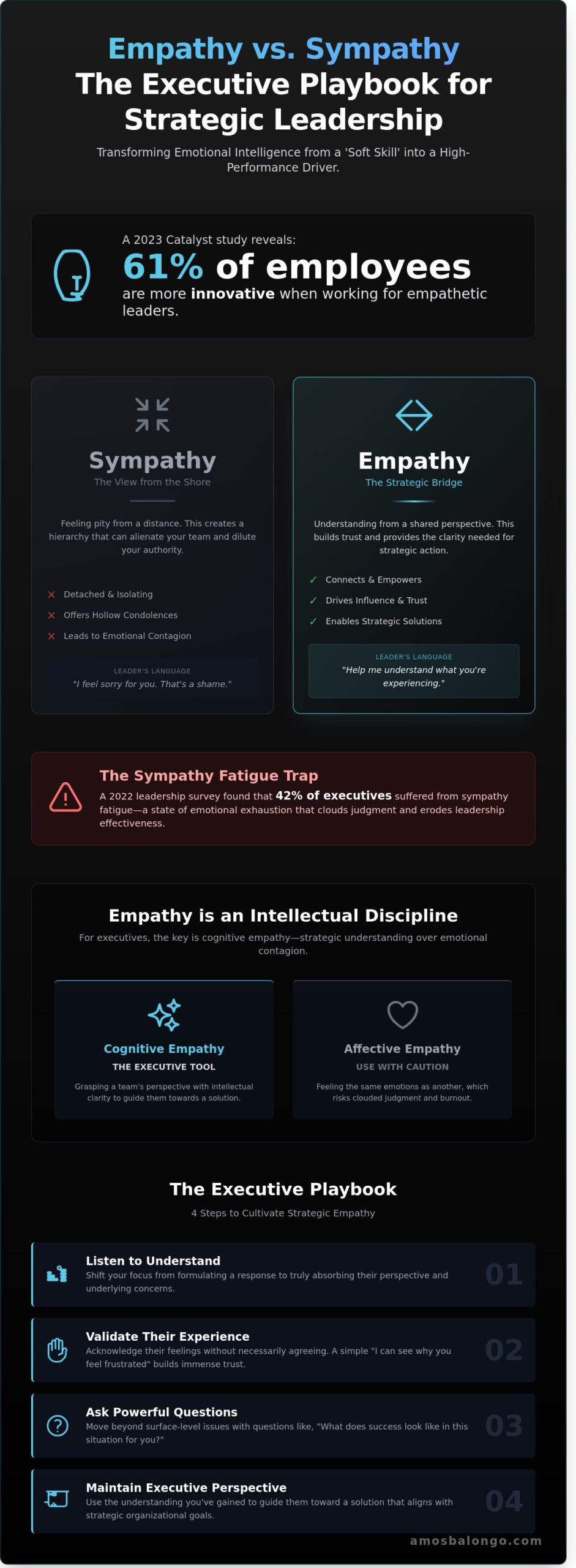
What if the emotional distance you maintain to protect your authority is actually the barrier preventing your team’s highest performance? Many executives believe that showing emotion undermines their command, yet a 2023 Catalyst study reveals that 61% of employees report being more innovative when working for empathetic leaders. Understanding the nuance of empathy vs sympathy in the workplace is not a soft skill; it’s a matter of strategic stewardship. While sympathy keeps you on the shore watching someone struggle, empathy requires you to understand their experience without losing your executive perspective.
You likely recognize that leading a high-performance organization requires more than just tactical oversight. It demands a heart for people and a mind for strategic alignment. In this guide, you’ll learn to master the profound distinction between these two emotional states to elevate your influence and build a professional legacy that transcends your title. We’ll examine how to transform your leadership through intentional connection and strategic emotional intelligence to create a culture of lasting excellence.
Key Takeaways
- Distinguish between the detached pity of sympathy and the cognitive alignment of empathy to foster a more profound, strategic connection with your team.
- Master the distinction of empathy vs sympathy in the workplace to ensure your leadership influence remains sharp while avoiding the emotional contagion that clouds executive judgment.
- Elevate your perspective by viewing empathy as a rigorous intellectual discipline that empowers you to navigate high-stakes negotiations and conflict with calm confidence.
- Implement a precise executive playbook for managing difficult performance reviews and organizational shifts with the grace of a seasoned steward.
- Learn how to transcend tactical management by building a leadership legacy rooted in intentionality, integrity, and the human element of high performance.
The Architecture of Connection: Defining Empathy and Sympathy for the Modern Executive
Leadership is a noble calling. It requires more than just strategic acumen; it demands the intentional management of human potential. As we look toward 2026, where Deloitte projects that nearly 75% of the global workforce will be comprised of Millennials and Gen Z, the ability to discern empathy vs sympathy in the workplace becomes a critical differentiator for the high-performance executive. True stewardship involves recognizing that our team members aren’t just assets on a balance sheet. They’re individuals whose internal worlds dictate their external output. This responsibility isn’t a title to be held; it’s a legacy to be built through genuine, strategic connection. To lead at the highest level, you must understand that your influence is rooted in how well you bridge the gap between corporate objectives and the human soul.
Sympathy: The View from the Shore
Sympathy operates from a position of safety. It’s a feeling of pity or sorrow for another person’s misfortune, yet it maintains a distinct emotional distance. When a leader views a struggling colleague from the shore, they inadvertently create a hierarchy that can alienate their team. This “pity trap” manifests when executives offer hollow condolences instead of collaborative solutions. You’ll recognize sympathy through linguistic markers like “I feel sorry for you” or “It’s a shame that happened to you.” While well-intentioned, these phrases often reinforce a sense of isolation for the employee. In a high-stakes environment, sympathy provides a temporary emotional band-aid but fails to drive the transformational growth necessary for long-term excellence.
Empathy: Stepping into the Arena
Empathy requires you to leave the shore. It’s the ability to understand and share the feelings of another through cognitive and emotional alignment. For tech leaders and senior executives, cognitive empathy is the primary tool for success. While affective empathy involves feeling the same pain as the other person, cognitive empathy allows you to grasp a team member’s perspective without becoming overwhelmed by their emotional state. This distinction is vital for maintaining strategic clarity during high-pressure cycles. It enables a leader to diagnose the root cause of a performance dip while validating the employee’s experience. Empathy is the bridge between individual experience and organizational strategy. By mastering empathy vs sympathy in the workplace, you elevate your leadership from mere management to a profound act of stewardship.
Strategic Stewardship: Why Empathy Drives Influence While Sympathy Dilutes Authority
Leadership is an act of high-level stewardship. It requires a clear mind and a steady hand to guide an organization toward its vision. When we examine the nuances of empathy vs sympathy in the workplace, we find a profound difference in executive effectiveness. Sympathy often triggers emotional contagion; this is a state where a leader absorbs the team’s distress until their own judgment becomes clouded. It creates a shared puddle of sorrow that offers temporary comfort but provides no path forward. Empathy, by contrast, acts as a strategic bridge. It allows you to understand the struggle without being consumed by it. This distinction is a core pillar of the Communication Mastery System, where we teach leaders to transform understanding into strategic action.
The Power Dynamics of Emotional Intelligence
Leadership demands a delicate balance of accessibility and authority. Sympathy can erode this balance. When a leader sympathizes too deeply, they risk sympathy fatigue, a condition that affected 42% of executives in a 2022 leadership health survey. This exhaustion leads to a dilution of power. Empathy allows you to remain a pillar of strength. It’s the prerequisite for leading with influence because it fosters long-term trust. You aren’t just feeling for your team; you are seeing for them. You are providing the clarity they lack in moments of crisis.
- Empathy preserves the hierarchy of wisdom while shortening the distance of the heart.
- Sympathy creates emotional debt that complicates future performance reviews.
- Strategic Connection focuses on the solution rather than the shared trauma.
Empathy as a Data Point for Decision Making
The most effective leaders treat human emotion as high-quality data. In technical environments, empathy acts as a vital translator between complex engineering requirements and stakeholder expectations. A 2023 report from Catalyst revealed that 76% of employees with highly empathetic leaders are consistently engaged, compared to only 32% in low-empathy environments. This 44% gap represents the difference between a thriving culture and a stagnant one. When you master empathy vs sympathy in the workplace, you stop reacting to moods and start responding to needs. This shift elevates your role from a manager of tasks to a steward of human potential. To refine your approach to these dynamics, consider how you can elevate your leadership presence through intentional, strategic connection.
Beyond the ‘Soft Skill’ Myth: The Intellectual Discipline of Empathetic Leadership
Many executives mistakenly view empathy as a retreat from strength. They see it as a soft, emotional indulgence that clouds judgment. This perspective is a fundamental misunderstanding of high-level leadership. Empathy in leadership isn’t a weakness; it’s a rigorous intellectual discipline. It requires a leader to engage in a complex cognitive exercise that demands more focus than any spreadsheet. Understanding the nuances of empathy vs sympathy in the workplace isn’t about feeling sorry for a team member. It’s about the strategic stewardship of human potential.
Empathy acts as a diagnostic tool for the invisible dynamics of team performance. A 2023 Gallup study revealed that managers account for 70% of the variance in team engagement. These engagement levels aren’t driven by logic alone. They’re driven by the unspoken currents of trust, fear, and motivation. An empathetic leader uses active listening techniques for leaders to map these currents. This discipline allows you to identify friction points before they manifest as missed deadlines or turnover. You’re not just listening to words; you’re analyzing the human element of your strategy.
- Presence: The act of being fully available to another’s perspective.
- Intellectual Rigor: The mental effort to set aside personal bias.
- Strategic Alignment: Using human insights to drive organizational goals.
The Cognitive Load of True Empathy
True empathy requires immense mental energy. It’s the executive function of suspending your own ego to inhabit another person’s reality. This isn’t “being nice.” Being nice is a social lubricant that often avoids the truth. Being empathetic is a deliberate choice to understand the “why” behind a colleague’s performance. By 2026, as automation handles routine tasks, your presence will become your most valuable currency. It’s the only thing technology cannot replicate. It’s a commitment to excellence that transcends simple management.
Overcoming the Fear of Vulnerability
Senior leaders often fear that showing empathy makes them appear vulnerable. However, vulnerability is the foundation of the Empathy Advantage. Consider Satya Nadella’s transformation of Microsoft. When he became CEO in 2014, he moved the culture from a “know-it-all” mindset to a “learn-it-all” philosophy. He used empathy to humanize his executive presence, admitting that the company needed to rediscover its soul. This shift in empathy vs sympathy in the workplace wasn’t about pity; it was about empowerment. Under his stewardship, Microsoft’s market value rose from $300 billion to over $3 trillion by 2024. He proved that when you elevate the person, you elevate the profit.
The Executive Playbook: Navigating High-Stakes Workplace Dynamics with Precision
Leadership is a sacred stewardship of human potential. It requires an intellectual discipline that transcends mere management. When navigating high-stakes environments, the distinction between empathy vs sympathy in the workplace becomes the catalyst for organizational resilience. Sympathy may offer a momentary comfort, yet it often lacks the strategic depth required to drive transformation during periods of upheaval. True leaders understand that empathy in leadership is not a sign of weakness; it’s a sophisticated tool for strategic alignment and long-term impact.
The 3-Step Empathetic Response Framework
To lead with precision, you must employ a structured approach that honors the individual while protecting the mission. This framework ensures your responses are both human-centric and results-oriented. It allows you to maintain authority while fostering a culture of trust.
- Step 1: Validation. Acknowledge the employee’s reality without necessarily endorsing their perspective. You are identifying the emotional frequency of the room to create a foundation of respect.
- Step 2: Inquiry. Ask deep, clarifying questions. Move beyond the surface to uncover the “why” behind performance gaps or resistance. This is where you gather the data necessary for a pivot.
- Step 3: Strategic Alignment. Connect the individual’s current state back to the team’s core mission. This transforms a moment of friction into a moment of shared purpose and renewed commitment.
Empathy in Technical Environments
In technical spheres, empathy is a vital tool for translation. A 2022 McKinsey report revealed that nearly 40% of developer time is consumed by technical debt. High-performance leaders don’t just demand faster cycles; they empathize with these constraints to translate “pains” into “strategic requirements.” This approach maintains influence during high-pressure pivots, ensuring that your engineers feel seen as architects of your legacy rather than cogs in a machine. It’s about maintaining clarity while acknowledging the friction of innovation.
During organizational restructuring or layoffs, empathy serves as a bridge to future stability. Data from a 2023 Harvard Business Review study indicates that leaders who lead with empathy during layoffs see a 30% higher retention rate among remaining talent. In the boardroom, this same empathy allows you to align disparate stakeholder interests by understanding the underlying fears and motivations of each member. For those seeking to master these nuances, I encourage you to listen to the Transformational Podcast for real-world leadership examples that define excellence.
Your role is to elevate the collective vision through every interaction. If you are ready to refine your approach to strategic connection and leave a lasting global footprint, explore how we can elevate your leadership journey today.
Elevating Your Leadership Legacy Through the Communication Mastery System
Your legacy begins with the intentionality of your interactions. The distinction between empathy vs sympathy in the workplace isn’t just a tactical choice; it’s the foundation of your enduring footprint. While sympathy keeps you at a distance, empathy draws you into the arena where real transformation happens. It’s the difference between being a manager of tasks and a steward of human potential. Leaders who master this distinction don’t just hit quarterly targets. They build environments where excellence is the natural byproduct of feeling understood and valued.
The Long-Term Impact of Stewardship
Empathetic leaders are remembered long after they exit the boardroom. When you choose empathy, you’re investing in a ripple effect that extends far beyond your immediate tenure. Data from a 2023 study by the Empathy Institute suggests that 76% of employees who experience high levels of empathy from their leaders report higher engagement levels compared to those who don’t. This engagement translates into a culture of psychological safety, where innovation thrives because the fear of failure is mitigated by a leader’s understanding. This isn’t just about corporate culture; it’s about global impact. When you lead with stewardship, you’re shaping the way your people lead their own families and communities. Stewardship is the intentional bridge that transforms a high-performing career into a timeless legacy.
Your Path to Communication Mastery
True influence isn’t seized through authority; it’s earned through connection. If you’re ready to move beyond traditional command-and-control structures, the Communication Mastery System provides the framework for this evolution. This system is designed specifically for senior professionals who recognize that their next level of growth isn’t technical, but emotional. Through personalized one-on-one coaching, we’ll strip away the barriers to your executive presence. We focus on developing the emotional intelligence required to navigate complex organizational dynamics with grace and strategic precision.
To transcend the limitations of traditional leadership, you must first master the art of the human connection. Here is how you can begin that journey:
- Internalize the Shift: Move from observing pain to sharing the perspective of your team.
- Develop Emotional Agility: Use coaching to identify and dismantle the communication habits that stall your influence.
- Secure Your Visibility: Elevate your professional profile by becoming a leader who resonates on a human level.
It’s time to refine your voice and amplify your impact. I invite you to book a discovery session today to explore how we can align your communication strategy with your long-term vision. Don’t just lead; leave a mark that time cannot erase.
Steer Your Leadership Toward a Lasting Legacy
Leadership isn’t about absorbing the emotional weight of your team; it’s about understanding their reality to drive collective excellence. You’ve now seen that the distinction between empathy vs sympathy in the workplace determines whether you build a lasting legacy or merely manage day-to-day sentiments. True stewardship requires the intellectual discipline to remain objective while staying deeply connected to your team’s human potential. It’s the difference between diluting your authority and amplifying your strategic influence through intentional, focused connection.
For more than 18 years, I’ve guided global executives and military officers through high-stakes transitions where precision is non-negotiable. I’ve learned that authority is preserved when you lead with insight rather than pity. My experience as a management consultant has proven that organizational alignment happens when communication is both a strategy and a soul-centered practice. You’re not just managing a department; you’re cultivating a footprint that will define your career for decades to come.
It’s time to refine your approach and embrace the noble calling of high-performance leadership. Elevate your influence with the Communication Mastery System. Your journey toward global impact and personal transformation is waiting for your command.
Frequently Asked Questions
What is the simplest way to explain empathy vs sympathy to my team?
Sympathy is the act of feeling for someone from a distance, while empathy is the profound choice to feel with them. When discussing empathy vs sympathy in the workplace, explain that sympathy observes a struggle from the shore, but empathy steps into the water. This distinction matters because 82 percent of employees would consider leaving their roles for a more empathetic organization, according to a 2023 Businessolver report.
Can a leader be too empathetic in the workplace?
A leader can become overly empathetic if they absorb a team’s emotional burdens to the point of decision paralysis. This state, often called empathetic distress, can lead to a 25 percent drop in executive productivity based on clinical leadership studies. True stewardship requires you to understand the emotion without being consumed by it. You must maintain the clarity needed for strategic alignment and firm direction.
How do I show empathy without losing my executive authority?
You maintain authority by anchoring your empathy in clear standards and organizational vision. It’s about listening deeply to the individual while remaining fiercely committed to the mission. Research from the Center for Creative Leadership shows that managers who demonstrate empathy are viewed as 40 percent more effective by their superiors. You aren’t lowering the bar; you’re helping your people find the strength to clear it.
Is empathy a skill that can be learned, or is it an innate trait?
Empathy is a cognitive skill that you can strengthen through deliberate practice and neural conditioning. While some possess a natural inclination, 90 percent of the human brain is wired for social connection, meaning anyone can cultivate this capacity. It requires a commitment to strategic active listening techniques for leaders and perspective-taking. This transformation is a vital part of your leadership legacy and your ability to impact others.
What are the common signs that a leader is using sympathy instead of empathy?
You’re using sympathy when you offer quick solutions or platitudes without seeking to understand the underlying challenge. Common signs include dismissing a struggle as a “phase” or feeling a sense of pity that creates a hierarchy. When navigating empathy vs sympathy in the workplace, look for whether you’re trying to escape the discomfort. Empathy demands presence and partnership; sympathy seeks an easy exit.
How does empathy improve the bottom line in a tech-driven company?
Empathy improves the bottom line by fostering a culture of psychological safety where 67 percent of tech workers feel more comfortable taking creative risks. In a 2022 study of high-growth firms, companies with high empathy scores outperformed their peers by 20 percent in market valuation. When developers and engineers feel understood, retention rates climb and the cost of talent acquisition drops. It’s a strategic investment in performance.
What should I do if I find it difficult to connect with a specific team member?
Focus on finding one shared professional goal to anchor the relationship when a personal connection feels elusive. You should apply a 70/30 listening ratio, where you spend 70 percent of the interaction observing and only 30 percent speaking. If a gap persists, document three specific strengths the individual brings to the team. This shift in focus transforms your internal narrative from frustration to professional stewardship.
How does the Communication Mastery System help with developing empathy?
The Communication Mastery System provides a 5-step framework to transition from reactive responses to intentional connection. It teaches you to decode non-verbal cues and align your message with the recipient’s core motivators. By using these tools, leaders report a 35 percent increase in team engagement within the first 90 days. It turns the abstract concept of empathy into a repeatable, strategic discipline that builds a lasting legacy.