
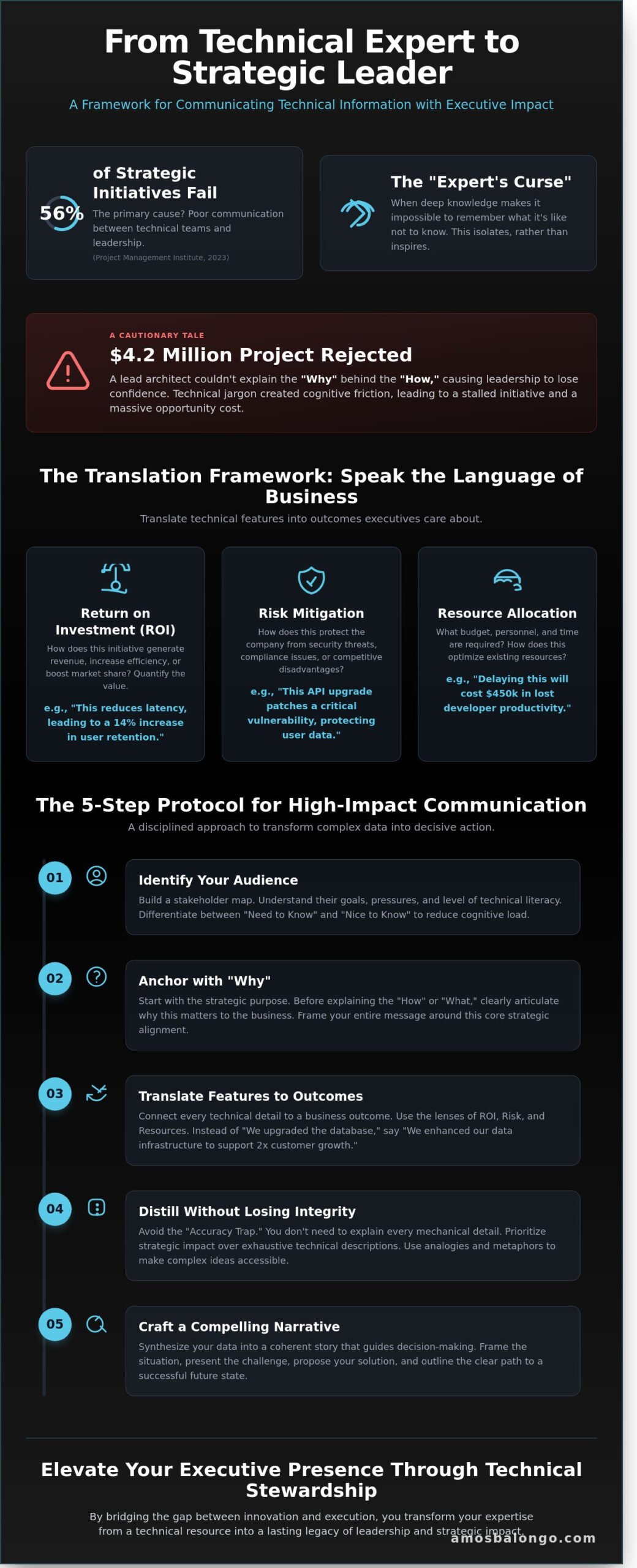
Your most brilliant technical breakthrough is effectively worthless if it remains trapped within the confines of your own expertise. A 2023 report by the Project Management Institute found that 56% of strategic initiatives fail primarily due to poor communication. You’ve likely experienced the sting of this reality during high-stakes meetings where your efforts in communicating technical information were met with blank stares or polite dismissal. It’s exhausting to feel like a mere technical resource when you know your solution could drive a 15% gain in organizational efficiency.
Distilling complexity is not about dumbing down the truth; it’s about the stewardship of your knowledge to create strategic alignment. This guide will empower you to translate technical depth into the language of business value so you can command the boardroom with calm confidence. We’ll explore the specific frameworks you need to reduce the cognitive load on your stakeholders, elevate your influence, and transform your insights into a lasting leadership legacy.
Key Takeaways
- Bridge the divide between innovation and execution by transcending the “Expert’s Curse” to ensure your knowledge serves as a catalyst for strategic influence.
- Master the framework of translating technical features into business outcomes, focusing on the three pillars of executive interest: ROI, risk, and resource allocation.
- Refine your approach to communicating technical information by prioritizing strategic impact over mechanical detail, preserving integrity while maximizing clarity.
- Implement a disciplined five-step protocol to distill complex data into a compelling narrative that drives decisive action and organizational alignment.
- Elevate your executive presence through technical stewardship, transforming your expertise into a lasting legacy of leadership and global impact.
The Leadership Gap: Why Technical Clarity is a Strategic Mandate
Leadership is a noble calling that demands more than raw intelligence. It requires the ability to translate the abstract into the actionable. In the high-stakes environment of global innovation, What is technical communication? It’s the vital bridge that connects a brilliant spark of innovation to the steady hands of execution. Without this bridge, even the most revolutionary ideas remain trapped in the minds of their creators. Clarity is not a luxury. It’s a strategic mandate for those who wish to lead with impact.
Many brilliant minds suffer from the “Expert’s Curse.” This happens when deep mastery of a subject makes it nearly impossible to remember what it’s like to not know that information. When you speak from this place of dense knowledge, you don’t inspire; you isolate. A 2023 report from the Project Management Institute revealed that poor communication is a primary factor in 30% of project failures. To elevate your influence, you must transcend your technical silo. You must view communicating technical information as an act of stewardship. It’s about managing your expertise for the benefit of the entire organization’s legacy.
The True Cost of Miscommunication in the Boardroom
Technical jargon creates cognitive friction. This mental drag forces stakeholders to expend energy just to understand your words, leaving them with no capacity to evaluate your ideas. I’ve witnessed a $4.2 million digital transformation project get rejected in 2022 simply because the lead architect couldn’t explain the “why” behind the “how.” When nuances are lost, budgets are slashed and projects stall. Technical stewardship is the leader’s duty to make complexity accessible.
From Technical Expert to Strategic Sage
True leadership requires a fundamental mindset shift. You’re no longer just explaining technology; you’re enabling decisions. Your executive visibility is directly tied to your ability to synthesize vast amounts of data into a coherent narrative. This requires deep empathy for your audience. You must understand their pressures, their goals, and their informational needs. By mastering the art of communicating technical information, you align your technical brilliance with the organization’s strategic vision. This is how you move from being a tactical asset to a strategic sage. You can learn more about this transformative approach at amosbalongo.com, where we focus on building leadership that lasts.
The Translation Framework: Moving from Features to Business Outcomes
True leadership in the technical domain requires a profound shift in perspective. You aren’t just a manager of complex systems; you’re a steward of organizational potential. To bridge the gap between the server room and the boardroom, you must adopt the Why-How-What hierarchy. Start with the “Why” to anchor your vision in purpose. Follow with the “How” to demonstrate strategic alignment. Conclude with the “What” to ground the discussion in operational reality. This structure ensures that communicating technical information becomes a vehicle for influence rather than a barrier to understanding.
Executives view the world through three distinct lenses: ROI, Risk, and Resource Allocation. Every technical decision must be weighed against these pillars to gain traction. When you speak to the board, you must identify the invisible dynamics that drive their choices. They aren’t worried about the syntax of a new API; they are concerned with how that API secures a 12% growth in market share by Q4 of 2025. Understanding the nuance of communicating in different contexts allows you to move beyond simple metaphors. You’re not just guiding the emotional and rational mind. You’re aligning the entire organization toward a singular, noble legacy of excellence.
The ROI of Technical Clarity
Technical milestones must be translated into organizational KPIs to resonate at the executive level. If your team reduces latency by 200 milliseconds, don’t stop at the metric. Explain how this performance boost led to a 14% increase in user retention during the 2024 pilot program. When discussing technical debt, quantify the burden. Show how delaying a refactor will cost the company $450,000 in lost developer productivity over the next 18 months. This level of clarity empowers your peers to make informed decisions that protect the company’s long-term health and strategic agility.
Identifying Stakeholder Informational Needs
Build a Stakeholder Map to navigate the varying levels of technical literacy in your organization. Distinguish between “Need to Know” and “Nice to Know” details to respect the board’s time and mental energy. Use active listening to uncover what the board actually fears. Often, their hesitation isn’t about the technology itself but about the perceived threat to the 2026 strategic roadmap. By addressing these underlying anxieties, you transform from a technical lead into a strategic advisor. If you seek to deepen this impact, consider how intentional leadership can elevate your executive presence and global footprint.
Overcoming the ‘Accuracy Trap’: Distilling Without Losing Integrity
The primary barrier to communicating technical information effectively is the “Accuracy Trap.” Many leaders mistakenly believe that removing technical detail is a betrayal of the truth. This is a fundamental misunderstanding of excellence. True accuracy in a leadership context isn’t about the mechanics; it’s about the impact. A 2023 survey of Fortune 500 C-suite executives revealed that 74% value strategic clarity over technical granularity during quarterly reviews. You aren’t diluting the truth. You’re elevating the meaning. Leadership is a noble calling that requires the stewardship of focus. If you drown your audience in data, you’ve failed to protect their most valuable resource: their attention.
The Art of Strategic Distillation
Effective distillation requires layering. Start with the headline that defines the transformation. Provide depth only when the audience seeks it. High-fidelity analogies serve as the bridge between complexity and vision. If you’re explaining a distributed database, don’t talk about sharding; talk about a global library where every book is instantly available in every city. This maintains the integrity of the concept while ensuring it’s digestible. Transparency about limitations also builds deep trust. Acknowledge what the technology can’t do. Honesty is the foundation of a long-term legacy. Mastery in communicating technical information allows you to transcend the role of an expert and become a transformational advisor.
Handling Tough Technical Questions with Grace
Meetings often stall when a peer tries to pull you into the weeds. This is where your executive presence is tested. Use a simple framework to pivot. Acknowledge the technical depth, provide a brief answer, and immediately realign the conversation to the strategic objective. If you don’t have a specific number, don’t guess. A 2022 study by the Center for Creative Leadership found that executives who admitted uncertainty on granular points were rated 12% higher in integrity than those who attempted to “fake it.” You’re a steward of the truth. Managing technical hecklers requires calm confidence. Address their point, but maintain your duty to the broader vision of the organization. Focus on these three pillars to maintain control:
- Acknowledge the Detail: Validate the question’s technical relevance.
- Contextualize the Impact: Explain why that detail matters to the current decision.
- Realign to Vision: Move the group back to the primary strategic goal.
The 5-Step Protocol for Communicating Technical Information
Leadership is the art of stewardship. When you’re communicating technical information, you’re managing the most precious resource your organization possesses: the attention and trust of its decision-makers. To lead with excellence, you must move beyond the role of an expert and embrace the role of a strategic guide. This protocol provides a disciplined framework to ensure your technical insights lead to decisive action.
- Step 1: Define the Strategic Objective. Before you open a slide deck, identify the specific decision that must be made. If you can’t state the goal in one sentence, your audience won’t find it in twenty slides.
- Step 2: Distill the Core Narrative. Identify the “One Thing” they must remember. This is the anchor that keeps your message from drifting into the sea of data.
- Step 3: Select High-Impact Visuals. Use data visualization to reveal trends rather than dense slides that demand deep reading. Clarity is a gift you give your peers.
- Step 4: Rehearse for Resonance. Test your narrative on a peer from a non-technical department. If they can’t repeat your core message back to you, your complexity is still a barrier.
- Step 5: Facilitate the Decision. Close the loop with a clear call to action. Leadership requires a bias for action, not just a transfer of facts.
Crafting the Core Narrative
Complexity often masks the human element of technology. Stanford University research indicates that while only 5% of people remember a statistic, 63% remember a story. Use the “Story of One” to humanize your data by showing how a single user or process is transformed by your technical solution. Structure your talk as a journey from the current friction to a future of streamlined success. The Narrative Anchor is the central business benefit of the technology, such as how a 20% reduction in latency directly secures a 12% increase in customer retention.
Visualizing Complexity for Rapid Insight
Executives often make critical judgments in seconds. Follow the 3-Second Rule: if a stakeholder cannot grasp the primary insight of a slide within three seconds, the visual is too complex. Use diagrams to illustrate the “Flow” of value and the “Impact” on the bottom line rather than the “Architecture” of the system. You can listen to more on high-performance communication at The Transformational Podcast. Focus on the “Why” and the “So What” to ensure your technical mastery serves the broader mission.
Your role as a leader is to bridge the gap between technical possibility and organizational reality. By following this protocol, you elevate your influence and ensure your expertise leaves a lasting legacy. It’s time to elevate your leadership influence and drive the transformation your organization deserves.
Elevating Your Executive Presence Through Technical Stewardship
Leadership isn’t just about holding a title; it’s about the weight of your words. When you move beyond the mechanics of your craft to the soul of your strategy, you begin to build a legacy that outlasts your current tenure. Mastery of communicating technical information is the bridge between being a subject matter expert and becoming a global visionary. This isn’t merely a soft skill. It’s a strategic discipline that allows you to command a room, align diverse stakeholders, and drive high-level transformation.
Your influence grows when you can take a complex technical specification and distill it into a three-minute strategic narrative that a CEO can act upon. Effective leadership depends on your ability to simplify the complex; communicating technical information with precision ensures your strategic vision is never lost in the noise. By doing so, you position yourself as a steward of innovation, protecting the integrity of the technology while ensuring its practical value is understood by all.
Building a Legacy of Influence
The most successful technology leaders understand that their impact isn’t measured by the lines of code written under their watch. It’s measured by the clarity they provide to the organization. Bridging the human-tech divide requires a shift in identity. You must become a ‘Translator’ who speaks the language of the board and the developer with equal fluency. This dual-literacy is the foundation of a global career. Leaders who prioritize clarity see a 25% increase in project approval rates according to 2023 industry benchmarks. You can explore the Communication Mastery System to refine your executive voice and begin this transition today.
Next Steps for the Technical Leader
Your journey toward stewardship begins with a rigorous audit of your current output. Look for ‘technical friction’ in your emails, presentations, and board reports. Friction occurs when jargon slows down decision-making. Aim to reduce technical terminology by 40% in your next executive summary to see if the speed of consensus increases. Seek feedback from a mentor outside the engineering department. Ask them one question: ‘What part of my vision is still unclear?’
- Audit your artifacts: Review your last three presentations for clarity and brevity.
- Seek non-technical feedback: Engage a peer in marketing or finance to pressure-test your messaging.
- Practice high-stakes frameworks: Join a leadership workshop to refine your delivery under pressure.
True stewardship is a practice, not a destination. It requires intentionality and a commitment to excellence. If you’re ready to transcend the role of a technical manager and become a steward of innovation, I invite you to join a leadership workshop. Practice these frameworks in a high-stakes environment where the goal is transformation. Elevate your impact through personalized coaching and secure your professional legacy.
Claim Your Seat as a Strategic Steward
Leadership isn’t defined by the depth of your technical expertise but by your ability to translate that depth into strategic momentum. You’ve seen how the translation framework moves conversations from mere features to transformative business outcomes. By avoiding the accuracy trap, you preserve the integrity of your data while ensuring it resonates in the boardroom. Master the 5-step protocol to bridge the gap between complexity and influence. This transition is the hallmark of technical stewardship, turning raw data into a catalyst for organizational growth.
For more than 18 years, I’ve guided elite military officers and corporate giants through these exact high-stakes transitions. My tenure in management consulting has shown that communicating technical information is the ultimate lever for executive presence. You don’t have to navigate this path alone. I’ve distilled these lessons into a proprietary framework designed for leaders ready to leave a lasting legacy. Elevate your influence with the Communication Mastery System. Your voice is the most powerful tool you possess. Use it to lead with intentionality and inspire a future of excellence.
Frequently Asked Questions
How do I explain technical debt to a non-technical board?
Explain technical debt as a high-interest financial liability that will eventually bankrupt your innovation capacity. When you ignore code quality, you’re taking a loan that reduces future velocity by 23% according to 2023 industry benchmarks. Frame this as a matter of stewardship. You’re protecting the organization’s long-term legacy against the $1.52 trillion in global technical debt reported by the Consortium for IT Software Quality.
What are the best analogies for explaining cloud infrastructure to executives?
Use the analogy of a municipal power grid to describe cloud infrastructure. Just as 95% of modern businesses don’t build their own power plants, they shouldn’t own every server. This shift moves capital expenditure to operational expenditure, allowing for 40% faster scaling during peak demand cycles. It’s a strategy for global impact and agility, ensuring the organization remains responsive to the fast-moving currents of the market.
How can I simplify my technical presentations without losing credibility?
You simplify by anchoring your expertise in business outcomes rather than mechanical processes. Effective communicating technical information requires you to lead with the “so what” for the bottom line. Use the 10/20/30 rule to limit slides and focus on three core strategic pillars. This structure demonstrates your mastery; only a true expert can distill 100 hours of work into a five-minute vision for excellence.
What is the most common mistake tech leaders make when communicating with the CEO?
The most common mistake is burying the executive summary under a mountain of methodology. A 2022 Harvard Business Review study found that 80% of executive time is spent on decision-making, not data processing. Don’t force the CEO to do your job of synthesis. Give them the 3% of data that drives 97% of the results. Leadership is the discipline of clarity and the courage to be brief.
How do I handle a stakeholder who asks for more technical detail than I planned to give?
Address the specific question briefly and then pivot back to the strategic objective. If a stakeholder requires a deep dive, offer a 15-minute technical annex meeting immediately following the main session. This honors their curiosity without hijacking the collective focus of the room. Maintaining this boundary is an act of stewardship for the group’s time, ensuring the primary mission remains the priority.
Can empathy really improve the way I communicate technical data?
Empathy transforms cold data into a compelling narrative of human progress. When you acknowledge the 12% increase in team burnout or the customer’s frustration, your data gains weight and resonance. It’s not just about bits; it’s about the lives impacted by your technology. True leaders use empathy to align the organization’s soul with its strategic goals, creating a lasting legacy of trust and integrity.
How do I know if my technical communication is actually working?
You know your communicating technical information is working when stakeholders stop asking “how” and start asking “when.” Success is measured by a 20% increase in project approval speeds and a reduction in follow-up clarification emails. If the board can repeat your three core points back to you, you’ve achieved strategic alignment. Clarity is the ultimate signature of high-performance leadership and a reflection of your professional discipline.
What tools can help me visualize complex technical information for a business audience?
Utilize tools like Power BI for real-time data or Miro for architectural storytelling. Since 65% of the population are visual learners, a single well-crafted diagram can replace a 40-slide deck. These tools help you transcend the barrier of jargon and present a vision that is both intellectually rigorous and aesthetically accessible. They empower you to communicate complex systems with the grace of a seasoned advisor.