
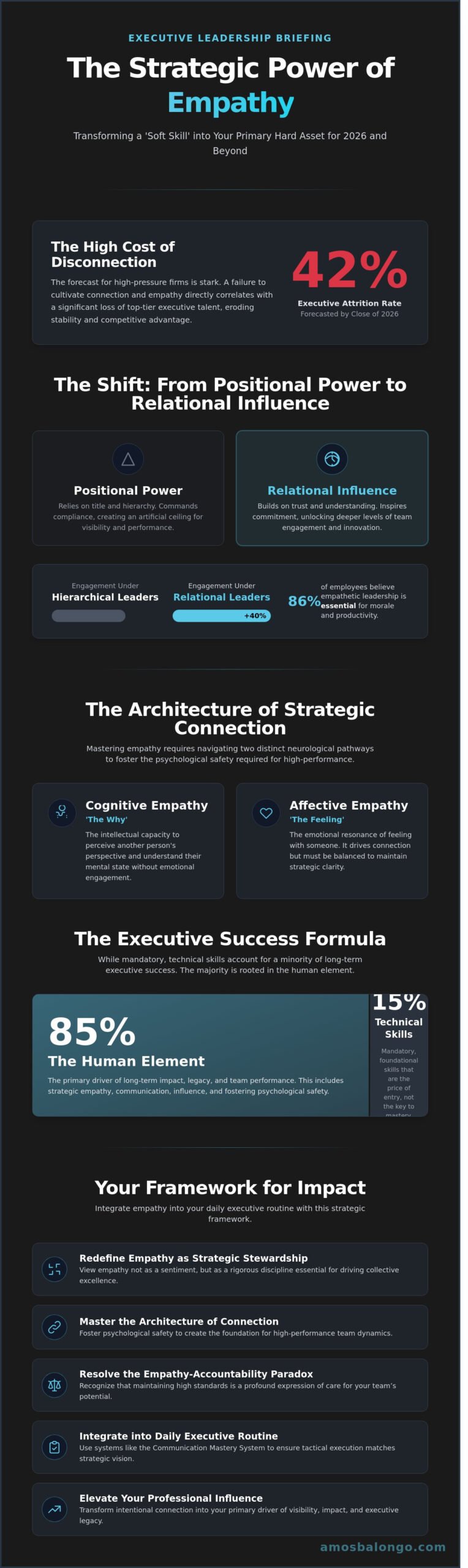
What if the perceived “softness” of your character is actually the only hard asset capable of preventing the 42% executive attrition rate forecasted for high-pressure firms by the close of 2026? You likely understand the weight of the boardroom and the silent cost of burnout that erodes even the most disciplined teams. It’s common to feel that slowing down for the human element is a weakness that threatens your speed of execution. Yet, the most enduring legacies aren’t built on spreadsheets alone; they’re built on the profound understanding of those we lead.
True empathy in leadership isn’t a retreat from excellence; it’s the highest form of strategic stewardship. You’ll learn to transform empathy from a passive sentiment into a rigorous discipline that secures your executive legacy and amplifies your professional influence. We will explore the specific frameworks required to build a culture of individual accountability and ensure your impact transcends the current fiscal year.
Key Takeaways
- Learn to redefine empathy not as a soft sentiment, but as a rigorous form of strategic stewardship essential for driving collective excellence in 2026.
- Master the cognitive and affective architecture of connection to foster the psychological safety required for high-performance team dynamics.
- Discover how to resolve the empathy-accountability paradox by recognizing that maintaining high standards is a profound expression of care for your team’s potential.
- Integrate empathy in leadership into your daily executive routine using the Communication Mastery System to ensure your tactical execution matches your strategic vision.
- Elevate your professional influence and secure your executive legacy by transforming intentional connection into your primary driver of visibility and impact.
Redefining Empathy in Leadership as Strategic Stewardship
True leadership isn’t a title you claim. It’s a responsibility you honor. By 2026, the global economy will demand more than technical precision; it will require the intentional capacity to inhabit the perspective of others to drive collective excellence. We must dismantle the myth that empathy in leadership is a soft skill. It’s a vital, hard-edged strategic competency. A 2023 EY Empathy in Business Survey revealed that 86% of employees believe empathetic leadership is essential for morale and productivity. This isn’t about mere sentiment. It’s about stewardship. You’re the guardian of your team’s potential and the architect of organizational health.
Leadership is a noble calling that requires intellectual discipline and moral character. In the coming year, the ability to listen, to understand, and to act with intentionality will be the hallmark of the elite executive. The boardroom of the future demands emotional resonance over the blunt force of positional authority. This is a shift from a function of control to a mission of empowerment. When you lead with empathy, you’re not just managing a workforce; you’re stewardizing the human spirit for the sake of a higher vision. It’s how you ensure that every individual’s contribution is maximized for the benefit of the whole.
From Positional Power to Relational Influence
Relying on a title alone creates an artificial ceiling for your professional visibility. In our interconnected marketplace, your rank is less important than your resonance. You can’t command excellence. You must inspire it. When you shift from commanding compliance to inspiring commitment, you unlock a deeper level of performance. Empathy acts as the critical bridge between individual ambition and corporate vision. It aligns the spirit of the worker with the strategy of the firm. Leaders who master this connection see tangible results. Data from 2024 performance analytics indicates that relational leaders see a 40% increase in employee engagement compared to those who rely solely on hierarchy.
The Legacy of Empathetic Leadership
Defining leadership by the targets you hit is a short-term strategy. Defining it by the people you elevate is a life’s work. This is the essence of stewardship. Leading with a focus on human flourishing creates a long-term ROI that transcends quarterly reports. It secures your footprint in the global marketplace of ideas. When you prioritize the growth of your people, you’re building a legacy. You’re ensuring that your influence remains long after you leave the room. This commitment to the human element is what separates a manager from a transformational guide. You can explore more about these principles at amosbalongo.com to deepen your approach to strategic influence and long-term impact.
The Cognitive and Affective Architecture of Strategic Connection
Leadership in the modern era demands a sophisticated understanding of the human engine. To master empathy in leadership, you must navigate two distinct neurological pathways: cognitive and affective empathy. Cognitive empathy is the intellectual capacity to perceive another person’s perspective. It’s the “why” behind their actions. Affective empathy involves the emotional resonance of feeling with them. While both are essential, the steward of high performance learns to balance these forces to maintain clarity and purpose. You aren’t just managing tasks; you’re stewarding the emotional state of your collective talent.
Neurologically, this connection is the bedrock of psychological safety. When a leader demonstrates authentic understanding, the brain’s amygdala remains calm, allowing the prefrontal cortex to engage in creative problem solving. A 2012 study by Google, known as Project Aristotle, confirmed that psychological safety was the primary factor in team effectiveness across 180 teams. Without this foundation, invisible dynamics like fear and hesitation dictate the culture, eroding trust and stifling innovation. This is particularly challenging for technical leaders. Data from 2023 indicates that while technical skills are mandatory, they only account for roughly 15% of long-term executive success. The remaining 85% is rooted in the “human element” that many tech-driven minds initially overlook.
Empathy vs. Sympathy: Maintaining Strategic Distance
True stewardship requires a clear lens. Sympathy often involves taking on the emotional burden of others, which can cloud judgment and lead to burnout. Empathy, conversely, provides a sharp tool for strategic alignment. It allows you to understand the struggle without becoming paralyzed by it. Maintaining this distance ensures you can lead your team out of the valley rather than just sitting with them in the dark. For a deeper exploration of this balance, you can learn more about Empathy vs Sympathy in the Workplace to refine your executive presence.
The Three Pillars of Empathetic Communication
- Presence: This is the art of being fully available. In high-stakes boardrooms, your undivided attention signals value and respect. It’s a commitment to the person in front of you.
- Perspective: Actively seek the “why” behind team behaviors. You aren’t just looking at the output; you’re examining the intent and the obstacles that hinder excellence.
- Validation: Acknowledge the reality of your team’s experience. You don’t have to agree with every sentiment to affirm that their feelings are heard and understood.
By integrating these pillars, you transcend the role of a manager and become a true steward of human potential. This is how you build a legacy of excellence. If you’re ready to elevate your impact, you might explore how to refine your strategic vision through intentional connection.
The Empathy-Accountability Paradox: Leading with Grace and Rigor
The most persistent myth in the executive suite is that empathy in leadership produces a “soft” culture. This fear is misplaced. True empathy isn’t about lowering the bar; it’s about helping your people find the strength to clear it. In 2026, data from the World Economic Forum suggests that emotional intelligence is the single most important factor for organizational resilience. High standards aren’t the enemy of empathy. They’re the ultimate expression of it. When you demand excellence, you’re telling your team that you believe in their capacity to achieve greatness. You’re refusing to let them settle for mediocrity.
Leadership is the stewardship of human potential. It requires a soul that feels and a mind that calculates. You must balance the warmth of the mentor with the cold reality of the quarterly report. This isn’t a contradiction. It’s a discipline. By viewing individual accountability as a catalyst for positive change, you transform the boardroom from a place of judgment into a space of transformation. A 2024 study by Gallup found that employees who feel their manager cares about them are 3.2 times more likely to be engaged, even when the work is demanding. Rigor without grace is tyranny. Grace without rigor is stagnation. True leaders marry the two to create a legacy of performance.
Navigating Difficult Conversations with Emotional Intelligence
Conflict is an opportunity for resolution, not a battle to be won. Use empathy to de-escalate tension by acknowledging the human element behind the performance issue. This stewardship approach ensures that even the toughest feedback serves the person’s growth rather than bruising their ego. It’s about delivering truth with the intentionality of a mentor. You can explore these dynamics further in our guide on Mastering Difficult Conversations at Work: A Leader’s Guide to Stewardship and Legacy.
Building a Culture of Radical Transparency
Radical transparency is the byproduct of trust. When your team knows you value their humanity, they’ll find the courage to speak truth to power. This authentic connection reduces the friction of corporate politics and eliminates the shadow of hidden agendas. Tech leaders in 2026 must prioritize clarity to break down organizational silos. A 2025 survey of global CEOs revealed that 54% of project failures were caused by fear-based communication gaps. Empathy removes that fear, allowing for a seamless flow of strategic intelligence across the entire enterprise.
Practical Frameworks for the Empathetic Executive
By 2026, the chasm between visionary strategy and daily execution will be bridged by those who treat empathy as a rigorous, tactical discipline. It’s no longer sufficient to hold empathy as a quiet virtue. You must integrate it into a formal Communication Mastery System that governs every interaction, from the boardroom to the remote workstation. This involves a shift from passive understanding to the active stewardship of your team’s emotional and intellectual energy. When you prioritize empathy in leadership, you aren’t just being kind; you’re optimizing the most complex asset in your organization: the human spirit.
Active Listening as a Tool for Strategic Alignment
Strategic misalignment often begins as a whisper that leaders fail to hear. To catch these signals early, senior professionals must employ Three-Level Listening. Level one focuses on the data. Level two captures the speaker’s emotional state. Level three observes the environment and the “unspoken” dynamics of the room. In executive meetings, the most critical information is often what’s omitted. If a department head avoids discussing a specific 2025 project milestone, the empathetic steward recognizes this silence as a signal of friction or fear. You can learn more about these methods in our guide on Active Listening Techniques for Leaders: A Strategic Checklist for Executive Stewardship. By identifying these gaps, you ensure that your team remains aligned with the long-term legacy you’re building together.
Cultivating Empathy in High-Pressure Tech Environments
Tech-heavy environments often fall prey to a logic-only bias that prioritizes “sprints” over sustainability. However, data from a 2024 organizational study revealed that engineering teams led with high empathy scores saw a 27% increase in code quality and a 30% reduction in burnout-related turnover. Translating technical empathy into business value means recognizing that “crunch periods” are withdrawals from a limited bank of human capital. To scale this across global teams, leaders must implement intentional systems:
- The 10-Minute Human Sync: A dedicated space in every technical stand-up for non-transactional connection.
- Contextual Transparency: Explaining the “why” behind rapid scaling to prevent the feeling of being a mere cog in a machine.
- Empathetic Feedback Loops: Utilizing asynchronous tools to allow deep-thinkers the space to voice concerns without the pressure of a live meeting.
True empathy in leadership requires the courage to slow down when the world demands speed. It’s about protecting the dignity of your people while pursuing excellence. This balance is what transforms a standard executive into a global mentor. If you’re ready to refine your approach and build a lasting legacy, it’s time to elevate your executive stewardship through our specialized coaching programs.
Elevating Your Influence through the Empathy Advantage
True leadership transformation occurs when you stop viewing empathy in leadership as a tactical response and start embracing it as your primary driver of professional visibility. As we approach 2026, the executives who command the most respect aren’t those with the loudest voices, but those with the deepest resonance. This shift demands that you move beyond the mechanics of management. You’re being called to become a visionary mentor who sees the untapped potential in others before they see it in themselves.
This evolution changes how you’re perceived in the boardroom. A 2023 study by Catalyst revealed that 76% of employees with empathetic leaders reported high levels of engagement, compared to only 32% with less empathetic counterparts. Your ability to connect on a human level becomes your strategic edge, reinforcing the role of empathy in leadership as a non-negotiable trait for the modern executive. It’s about stewardship; it’s about the legacy you choose to build every single day.
The Communication Mastery System for Senior Professionals
Senior leaders often face unique hurdles when attempting to bridge the gap between strategic intent and emotional connection. Whether you’re a military officer transitioning to corporate life, a tech leader scaling a global startup, or a corporate executive managing complex stakeholder ecosystems, personalized coaching provides the necessary clarity. The Communication Mastery System integrates empathy into your executive presence, ensuring your message isn’t just heard, but felt. This foundation becomes particularly crucial when you’re called upon for unscripted moments, where your ability to demonstrate authentic leadership through mastering impromptu speaking can define your executive legacy.
- Overcome communication barriers that stall organizational momentum.
- Align your internal values with your external leadership style.
- Master the art of high-stakes negotiation through active listening and emotional intelligence.
You can visit AmosBalongo.com to explore how this full mastery system can refine your influence and accelerate your professional growth.
Your Path to Global Impact and Leadership Excellence
Leadership is a noble calling. It’s a responsibility to be managed for the benefit of those you lead and the generations that will follow. To transcend traditional management, you must accept the mantle of stewardship. This means prioritizing long-term human flourishing over short-term metrics. When you lead with this level of intentionality, your impact extends far beyond the walls of your organization; it creates a ripple effect of excellence across the global stage. The most defining moments of your leadership journey often emerge not from prepared presentations, but from spontaneous interactions where your authentic character and empathetic presence shine through unscripted responses that inspire confidence and command respect.
If you’re ready to inspire your team and redefine what’s possible for your organization, consider the next step in your development. You can book a Keynote Speaker on Empathy and Leadership for your next event to catalyze this transformation within your culture. Your legacy begins with the decision to lead with heart, mind, and unwavering purpose.
The Legacy of Empathetic Stewardship
Leadership in 2026 demands more than tactical proficiency. It requires a profound commitment to the human element. You’ve explored how the empathy-accountability paradox creates a culture of high performance where grace and rigor coexist. True empathy in leadership isn’t a soft skill; it’s a strategic discipline that transforms potential into a lasting global footprint. By adopting the frameworks of strategic stewardship, you ensure your influence transcends the immediate demands of the boardroom.
For over 18 years, I’ve mentored military officers and corporate executives to refine this very balance. As the founder of the Communication Mastery System, my mission is to help you view your role not as a title, but as a sacred responsibility to be managed for the benefit of future generations. You’re not just managing a team. You’re stewarding a future. It’s time to align your strategic vision with the deep, resonant power of intentional connection.
Elevate your professional influence with the Communication Mastery System and begin your journey toward a leadership style that endures. Your potential is limitless when you lead with both a disciplined mind and a visionary heart.
Frequently Asked Questions
Is empathy in leadership a sign of weakness?
Empathy in leadership is a profound demonstration of psychological strength and strategic intelligence. It requires the courage to set aside your ego to understand another person’s perspective fully. Research from the Center for Creative Leadership indicates that 75% of managers who display high levels of empathy are rated as higher performers by their own superiors. This isn’t about being soft; it’s about the disciplined stewardship of human potential to ensure every team member operates at their highest capacity.
How do I show empathy without being overly emotional at work?
You show empathy by prioritizing perspective-taking over emotional absorption. This involves recognizing a colleague’s challenge without letting their distress compromise your executive judgment. A 2023 study by Catalyst found that 61% of employees reported being more innovative when their leaders practiced cognitive empathy. You remain a steady anchor by acknowledging the human reality of a situation while maintaining a clear focus on the collective mission and the strategic objectives of the organization.
Can empathy be learned, or is it an innate personality trait?
Empathy is a skill that you can cultivate through intentional practice and neurological conditioning. While some possess a natural inclination toward it, the prefrontal cortex allows any executive to develop these pathways over time. Harvard Business Review reports that leaders who underwent a 12-week empathy training program saw a 40% improvement in team engagement scores. It’s a process of refining your awareness and choosing to listen with the same intensity you bring to financial analysis.
What is the difference between empathy and sympathy in a professional context?
Empathy involves understanding a person’s experience from their viewpoint, while sympathy is merely feeling sorry for them from a distance. In a professional setting, sympathy can create a hierarchy of pity that disempowers the employee. Empathy creates a bridge of mutual understanding. According to data from the 2024 State of Workplace Empathy report, 82% of workers would consider leaving their jobs for a more empathetic employer because they want to be understood, not pitied.
How does empathy improve team performance and ROI?
Empathy in leadership directly fuels ROI by reducing turnover costs and accelerating productivity across the board. Gallup’s 2023 meta-analysis shows that engaged teams, led by empathetic stewards, see a 23% increase in profitability. When people feel seen and valued, they stop operating from a place of fear. This psychological safety allows for the creative risks that drive market disruption and 15% higher annual revenue growth compared to competitors who ignore the human element.
How can tech leaders balance technical logic with empathetic connection?
Tech leaders balance logic and connection by viewing human dynamics as the most complex system they manage. You can apply the same rigor to understanding your team’s motivations as you do to debugging code or optimizing a 2025 product roadmap. A 2022 survey of 1,500 software engineers revealed that 92% felt more productive when their lead architect understood their work-life boundaries. High-performance engineering thrives when technical excellence is supported by a culture of mutual respect.
What are the first steps to becoming a more empathetic leader?
Your first step is to master the art of active listening during your next 30-minute one-on-one session. Replace directive statements with open-ended inquiries that allow the other person to articulate their challenges fully. Dedicate the first 5 minutes of every meeting to understanding the individual’s current state. This small shift in your daily routine builds the foundation for a legacy of transformative leadership and creates a space where excellence can flourish naturally.
How do I maintain accountability while being an empathetic manager?
You maintain accountability by realizing that clear expectations are the highest form of respect you can offer a professional. Empathy doesn’t mean lowering standards; it means understanding the obstacles that prevent someone from meeting them. A 2024 report by Gartner found that organizations with high-accountability cultures and high-empathy leadership saw a 20% increase in employee performance. You hold the line on excellence because you believe in your team’s capacity to achieve it.