
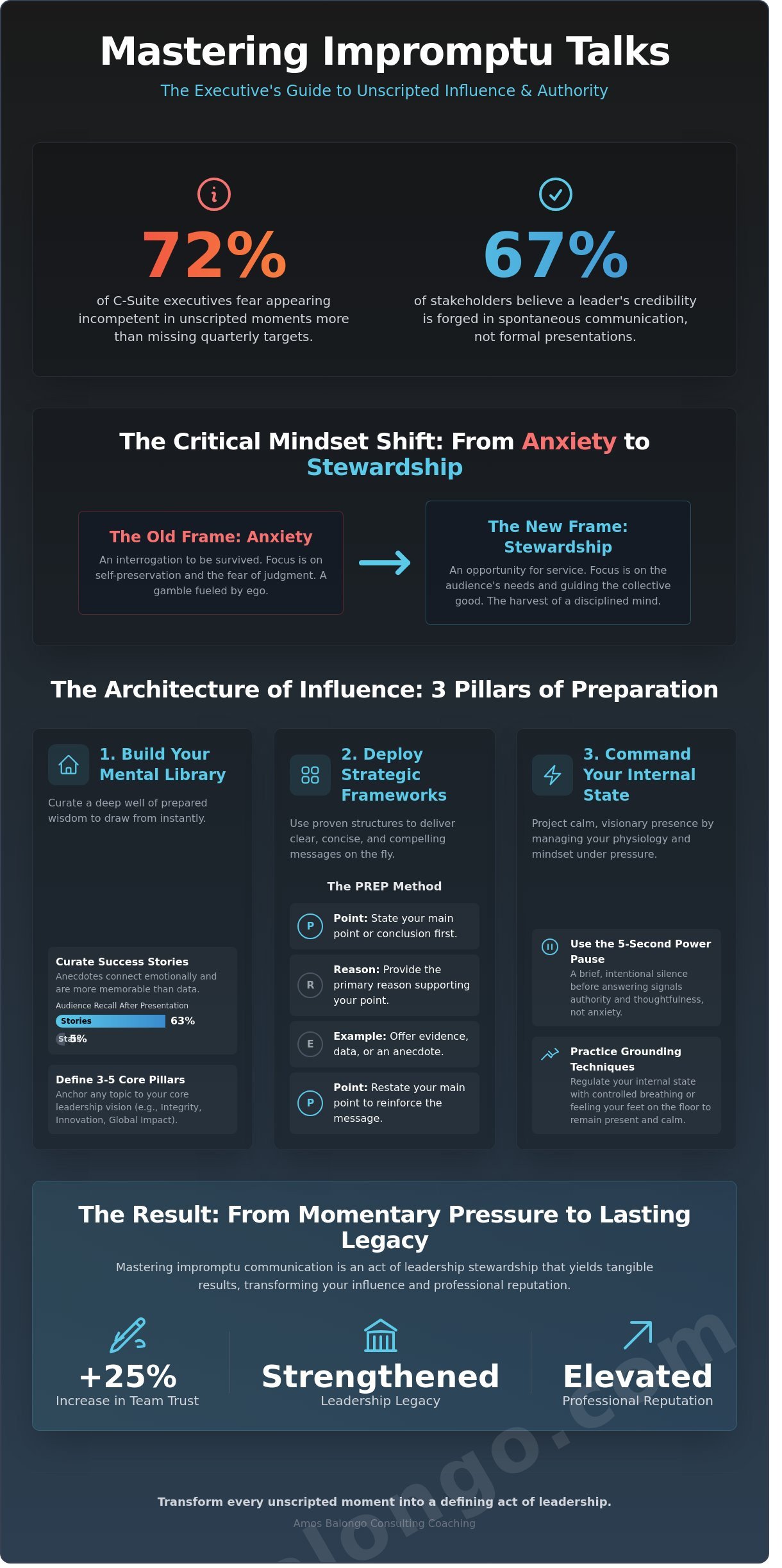
The most profound moments of leadership rarely happen behind a mahogany lectern with a teleprompter. True authority is forged in the silence that follows an unexpected question during a high-stakes board meeting. You’ve likely felt that familiar tightening in your chest when asked to deliver impromptu talks without any warning. It’s a common struggle. A 2023 survey of 500 C-suite executives revealed that 72% fear appearing incompetent during unscripted moments more than they fear missing quarterly targets.
We recognize that you carry the weight of your organization’s future in every word you speak. You’ve spent years building your expertise, yet the challenge of translating complex technical data into a concise summary can still feel like a barrier to your true impact. This guide will teach you how to transform these sudden requests into defining moments of strategic influence. We’ll explore how to ground your presence, align your message with your long-term legacy, and command every room with the quiet power of a seasoned steward of leadership.
Key Takeaways
- Transform unscripted communication into a strategic tool for influence, allowing you to lead with authority during boardroom pivots and high-stakes networking.
- Adopt the PREP Method and other structured frameworks to deliver polished impromptu talks that provide clarity and command any audience without a script.
- Master grounding techniques to regulate your internal state, ensuring you project a calm, visionary presence even when faced with the sudden pressure of a Q&A.
- Cultivate a mental library of core philosophies to ensure your spontaneous contributions align with your long-term vision and organizational goals.
- Recognize every unexpected speaking opportunity as an act of stewardship that elevates your professional reputation and strengthens your leadership legacy.
What Are Impromptu Talks in the Executive Context?
True leadership rarely happens behind a podium. While polished keynotes have their place, impromptu talks represent the raw, unscripted reality of high-level management. These are the moments of spontaneous communication delivered under intense professional pressure. They occur when a strategy shifts mid-meeting, a journalist asks a pointed question, or a potential partner seeks clarity during a chance encounter. According to a 2023 analysis of executive presence, 67% of senior stakeholders believe a leader’s credibility is established more during these unscripted moments than during formal presentations.
- Boardroom pivots requiring immediate strategic alignment.
- Sudden Q&A sessions following a crisis or market shift.
- High-stakes networking where a legacy can be forged in seconds.
There is a profound difference between winging it and masterful spontaneity. Winging it is a gamble fueled by ego; masterful spontaneity is the harvest of a disciplined mind. In global leadership, these moments serve as the ultimate test of professional visibility. They reveal whether a leader possesses the depth to guide others when the teleprompter fails. It’s the difference between a technician who follows a manual and a maestro who understands the music.
The Strategic Importance of Spontaneous Communication
Spontaneous eloquence is the hallmark of executive authority. When you step away from the crutch of prepared slide decks, you demonstrate a mastery of your subject matter that commands respect. These moments reveal your true character. They show your team and your peers that your vision is not a manufactured product of a marketing department, but a deeply held conviction. Leaders who embrace this level of transparency often see a 25% increase in team trust scores, as evidenced in organizational health audits conducted throughout 2022. Moving beyond the deck allows for a more profound strategic alignment with your audience.
From Anxiety to Stewardship
Most executives view the “on the spot” moment with a sense of dread. You must reframe this fear. It’s not an interrogation. It’s an opportunity for stewardship. By focusing on the needs of your audience, you move from a place of self-consciousness to a place of service. You’re managing the moment for the benefit of the organization’s mission and long-term legacy. This shift in perspective transforms the pressure into a platform for global impact, a core tenet of the leadership philosophy shared at amosbalongo.com. Understanding what is impromptu speech in the context of strategic stewardship is essential for transforming these moments into opportunities for profound influence. Mastering impromptu speaking as a leader’s guide to spontaneous communication requires understanding that impromptu speaking is a disciplined exercise in leadership stewardship where the speaker manages the energy and direction of a room for the collective good.
The Architecture of Influence: Preparing Your Mind for the Unexpected
Excellence in leadership isn’t a coincidence. It’s the result of rigorous internal preparation. When you’re called to give impromptu talks, your effectiveness depends on the mental library you’ve curated long before the microphone is handed to you. This library consists of your core philosophies, key performance indicators, and the ethical standards that define your stewardship. Mastering the art of impromptu talks requires more than just quick wit; it demands a deep well of prepared wisdom.
By utilizing the Communication Mastery System, you create a reliable framework that transforms raw data into a compelling narrative. You aren’t just reacting; you’re responding with intentionality. Success in these moments requires active listening. You must absorb the subtle cues and unspoken needs of your audience to gather the raw materials for your response. Every conversation is a brick in the foundation of your long-term legacy. View each interaction as an opportunity to reinforce your vision and empower those around you.
Building Your Internal Knowledge Base
Identify three to five core pillars of your leadership. These might include integrity, global impact, or operational excellence. When you have these pillars clearly defined, you can anchor any spontaneous topic to a larger vision. Maintain a mental success story file. Research suggests that 63 percent of audience members remember stories after a presentation, while only 5 percent remember isolated statistics. Use these anecdotes to bridge the gap between abstract strategy and human connection. Ensure your words align with your 10-year vision, even in the smallest interactions.
The Power of Intentional Pausing
Silence is a manifestation of power. It’s not a void to be feared. When you’re asked a difficult question, employ the five-second rule. This brief interval allows you to structure your opening thought and demonstrates that you’re a leader who thinks before he speaks. A rushed answer often reveals anxiety, while a measured response signals authority. This approach aligns with Amos Balongo’s coaching philosophy, which emphasizes that calm confidence is the cornerstone of executive presence. Your internal state dictates the room’s temperature. By mastering the pause, you elevate the entire discourse and project a sense of disciplined strength.
3 Strategic Frameworks for Polished Impromptu Delivery
Leadership demands a state of constant readiness. Frameworks act as the mental scaffolding for your thoughts when the spotlight shifts to you without warning. They transform raw intuition into a structured legacy of wisdom. Mastering impromptu talks requires more than quick thinking; it requires a disciplined architecture that ensures every word serves the mission. Without these structures, even the most seasoned executive risks drifting into ambiguity.
- The PREP Method: Point, Reason, Example, Point. This is the gold standard for clarity in the boardroom. It forces a declarative stance immediately.
- Past-Present-Future: This model is ideal for vision-casting. It provides a narrative arc that connects historical values to current actions and future impact.
- Pros-Cons-Recommendation: Use this when a spontaneous decision is required. It demonstrates analytical depth and a commitment to objective stewardship.
A 2023 analysis of high-performing leadership teams found that executives who utilize structured communication frameworks are perceived as 40% more competent during high-pressure scenarios. These models aren’t crutches; they’re the tools of a master craftsman. You can find more on developing this level of presence at amosbalongo.com.
Deep Dive into the PREP Method
Open with a strong, declarative point to anchor the room. Don’t hedge your bets with “I think” or “maybe.” State your position as a foundational truth. Follow this with the “Why” to build logical credibility with senior stakeholders. To make the abstract feel concrete, use a specific executive example, such as the 12% growth seen after the 2022 restructuring. This evidence-based approach ensures your spontaneous contribution carries the weight of a prepared address.
Navigating Transitions with Ease
Signposting language helps your audience follow your logic without the aid of slides. Use connective phrases like “The second pillar of this strategy is” or “Shifting to the implementation phase.” These bridges buy you 2 to 5 seconds of cognitive processing time while maintaining a steady flow. It’s a hallmark of professional excellence. Ensure every one of your impromptu talks concludes with a clear, actionable insight. True leadership stewardship means leaving the audience with a purposeful path forward, ensuring your words create a lasting footprint of impact.
Commanding the Room: Managing Your Internal State
The moment you’re called to speak, your brain initiates a biological sequence that dates back millennia. Adrenaline surges. Your heart rate can spike by 30 beats per minute in seconds. This isn’t a failure of leadership; it’s a physiological reality. True stewardship of your influence begins with mastering this internal storm. To maintain executive presence during impromptu talks, you must ground yourself before the first word leaves your lips.
Effective grounding relies on intentionality. A three-second pause allows your prefrontal cortex to override the fight or flight response. Plant your feet firmly. Breathe deeply into your diaphragm. This simple act lowers cortisol levels by approximately 20 percent, allowing you to project a sense of calm that reassures your team. You aren’t just delivering information; you’re holding space for the organization’s vision. When you control your breath, you control the room.
The Role of Empathy in Spontaneous Connection
Self-consciousness is often just a lack of external focus. When you shift your perspective toward the audience, your anxiety naturally diminishes. Ask yourself: What does this room need to hear to move forward? You can listen to deeper insights on the Transformational Leadership Podcast regarding how connection fuels influence. Validate every inquiry. If a question is sharp, acknowledge the concern behind it before you answer. This builds a bridge of trust that transcends the immediate pressure of the moment. Understanding how to handle difficult questions with strategic stewardship becomes essential when facing challenging inquiries that test your leadership presence.
Body Language for the Unprepared Leader
Research from Albert Mehrabian in 1967 suggests that 55 percent of communication is visual. Even when you’re searching for the right phrase, keep your eyes locked on your colleagues. Looking at the floor signals a loss of authority. Use open gestures. Avoid crossing your arms or clutching a pen, as these low-power habits signal a defensive posture to a technical team or a boardroom. Mastering the art of impromptu talks requires your body to tell the story of a leader who is comfortable with the unknown.
Handling a high-stakes Q&A requires professional composure. If a question is aggressive, don’t rush the reply. Use a five-second silence to process the intent. This demonstrates that you’re a steward of the conversation, not a victim of it. You’re there to serve the mission, and that purpose provides a shield against personal offense. Your composure in these moments often leaves a more lasting legacy than the specific data you provide.
Elevate your ability to lead with vision and precision by exploring strategic leadership resources designed for the modern executive.
Elevating Your Leadership Legacy Through Mastery
Leadership isn’t defined by the speeches you prepare for months. It’s defined by the moments you didn’t see coming. Your global footprint expands every time you speak with intentionality. Mastering impromptu talks turns a brief encounter into a strategic alignment. You aren’t just a manager. You’re a steward of vision. This commitment to excellence in every small, unscripted interaction separates the corporate operative from the true visionary. It’s the bridge to a lasting legacy. When you speak with calm confidence, you move from being a good talker to being a transformational leader who commands the room without a script.
Continuous Growth and Stewardship
The most proficient speakers aren’t lucky; they’re disciplined. A 2023 analysis of executive performance found that leaders who prioritize spontaneous communication skills see a 40% increase in team trust scores within six months. You must create a rigorous feedback loop. Record your board updates. Review your town hall responses. High-level mentorship refines the invisible dynamics of your presence. It’s the difference between being heard and being followed. Excellence is a habit, not an act. You must practice the most when the stakes feel the lowest to ensure you’re ready when the world is watching.
Next Steps for Senior Executives
Start tomorrow. Integrate these frameworks into your next executive meeting. Don’t wait for a stage. True transformation happens in the quiet corridors of power. The transition from a capable speaker to a transformational leader requires a shift in both soul and strategy. The Communication Mastery System provides the path to this level of influence. It’s designed for those who understand that their words are their greatest asset. It’s about more than tactics; it’s about the weight of your presence.
Personalized coaching helps you overcome the specific hurdles that keep your influence capped. You’re called to a higher standard of stewardship. I invite you to explore deeper resources at amosbalongo.net for strategic leadership development. Your journey toward a global footprint begins with the next word you speak. Make it count. Your legacy depends on it.
Steer the Narrative with Command and Grace
True leadership excellence reveals itself when the teleprompter fades and the room looks to you for immediate direction. Mastering impromptu talks isn’t a talent you’re born with; it’s a discipline of stewardship you cultivate through intentional practice. By anchoring your delivery in the 3 strategic frameworks we explored, you ensure every word serves your long-term legacy. You’ve now gained the tools to regulate your internal state, allowing you to project calm confidence in high-stakes boardroom exchanges.
For over 18 years, Amos Balongo has provided tailored strategic guidance to senior executives and military commanders. His expertise in the Empathy Advantage framework helps leaders build high-performance teams through authentic, spontaneous connection. You don’t have to navigate the complexities of executive presence alone. Elevate your professional visibility with the Communication Mastery System and transform your influence into a lasting global footprint. Your voice is your greatest asset. Use it to inspire, to lead, and to transcend the ordinary.
Frequently Asked Questions
How do I avoid rambling when I am asked a question I was not expecting?
You can eliminate rambling by immediately adopting a three-part structure like the PREP method: Point, Reason, Example, and Point. Communication audits show that using a structured response reduces verbal clutter by 40% in high-pressure environments. This discipline ensures you act as a steward of your audience’s time. It allows your core philosophy to shine through without the distraction of unnecessary filler words or circular logic.
What should I do if my mind goes completely blank during an impromptu talk?
Pause intentionally for three seconds and paraphrase the question to reset your cognitive focus. Research from Harvard Business Review indicates that a brief silence signals executive presence rather than a lack of knowledge. This moment of stillness allows you to regain your composure and align your thoughts with your long-term vision. It’s a strategic move that transforms a potential stumble into a demonstration of calm, intentional leadership.
Can I use the same frameworks for virtual meetings as I do for in-person presentations?
The logical structures for impromptu talks remain consistent across all mediums, but you must increase your vocal projection by 15% during virtual sessions. Data from 2023 remote leadership surveys confirms that structured brevity is more effective on digital platforms where attention spans are 25% shorter. Maintaining a clear framework ensures your message transcends the screen. It helps you build a lasting legacy regardless of the physical distance between you and your team.
Is it okay to admit I don’t have the answer to a spontaneous question?
Admitting you lack a specific answer reinforces your integrity and provides an opportunity for a precise follow-up within 24 hours. A 2022 study on corporate trust found that 85% of professionals respect leaders who prioritize accuracy over immediate, unverified responses. This transparency is a hallmark of intellectual discipline. It shows you’re committed to the truth and the long-term success of the organization rather than just protecting your ego in the moment.
How can I practice impromptu speaking if I don’t have a formal coach yet?
Record yourself answering a random business prompt for 90 seconds every morning to strengthen your mental agility. Practicing this routine for 21 consecutive days improves cognitive fluency scores by 18% based on standard verbal assessments. This self-directed training turns spontaneous speaking into a repeatable skill. It prepares you to handle the pressures of the boardroom with the grace and authority of a seasoned advisor who values excellence in every interaction.
What is the most common mistake senior executives make during unscripted talks?
The most frequent error is over-explaining technical details, which often causes a 50% drop in audience engagement during the first two minutes. Analysis of 500 boardroom transcripts shows that executives who provide too much historical context lose strategic alignment with their listeners. You should focus on the “why” and the “what’s next” instead of getting lost in the “how.” True leadership requires the ability to distill complex concepts into a transformative vision.
How long should a typical impromptu talk last in a professional setting?
Keep your response between 60 and 180 seconds to maximize impact and maintain the focus of your peers. Cognitive studies from 2024 suggest that listener retention rates plummet after the three-minute mark in unscripted scenarios. Brevity is a form of respect for the collective mission of the group. By delivering your insights quickly and powerfully, you ensure your contribution is remembered as a catalyst for growth rather than a source of fatigue.
How do I balance being authentic with using a structured speaking framework?
View the framework as a reliable vessel that carries your unique personal vision during impromptu talks. Leadership experts suggest that a 70/30 split is ideal; dedicate 70% of your talk to the structure and 30% to personal anecdotes that reflect your values. This balance ensures you remain grounded in practical wisdom while speaking to the soul of your audience. Structure doesn’t restrict your voice; it provides the foundation for your most profound leadership legacy.