
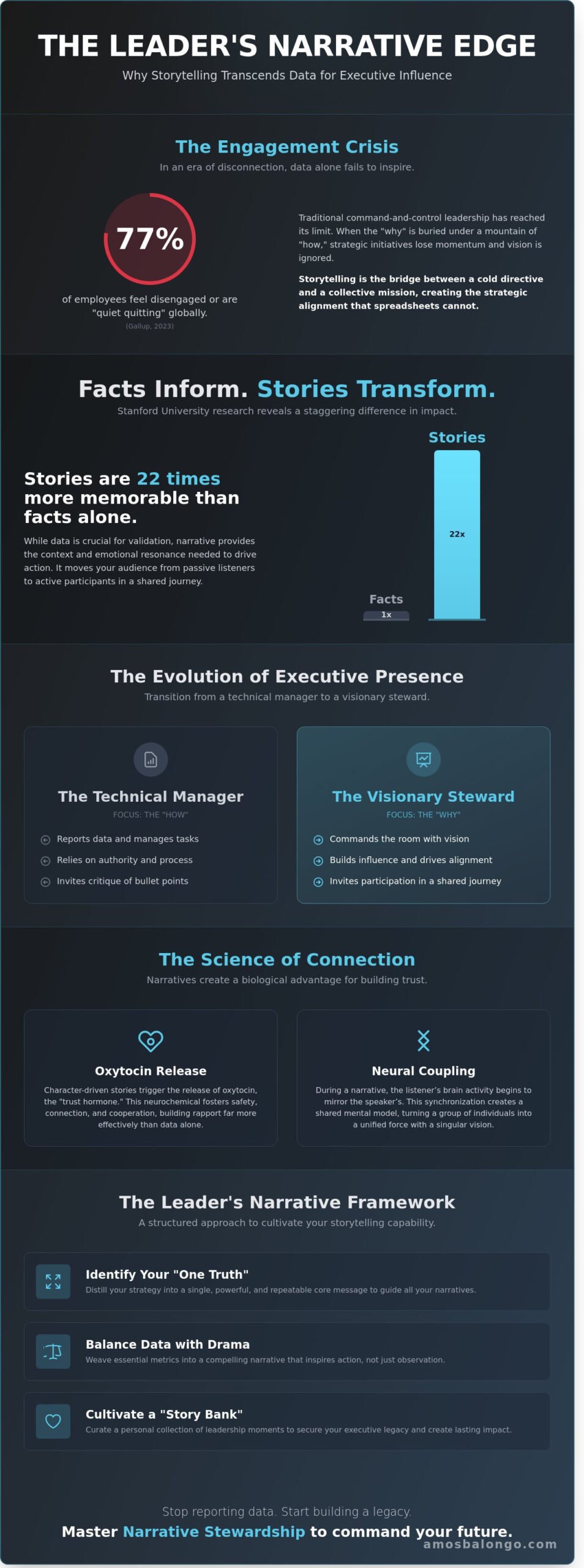
A spreadsheet has never sparked a revolution, and a slide deck has never built a legacy. While technical expertise gets you into the room, a 2023 study by the Stanford Graduate School of Business found that stories are 22 times more memorable than facts alone. Mastering storytelling for leaders isn’t about entertainment; it’s about narrative stewardship. It’s the difference between being a manager who reports data and an executive who commands the room with quiet power and intentionality.
You’ve likely felt the frustration of watching a vital strategic initiative lose momentum because the “why” was buried under a mountain of “how.” It’s painful to see your vision ignored in high stakes meetings simply because it lacks emotional resonance with your direct reports. This article will show you how to transcend data heavy communication to build strategic influence, drive alignment, and command true executive presence. We’ll examine the three pillars of narrative presence, from crafting a visionary outlook to ensuring your leadership leaves a lasting global footprint.
Key Takeaways
- Discover how to evolve from a technical expert into a visionary steward by leveraging narrative to drive strategic alignment across your organization.
- Understand the neurological science of empathy to build profound trust and connection with your audience faster than any data-driven argument.
- Learn to balance technical metrics with compelling drama, mastering storytelling for leaders to ensure your numbers inspire action rather than just observation.
- Identify your core “One Truth” and apply a structured framework to select the most impactful stories for the board, your team, or global stakeholders.
- Cultivate a personal “Story Bank” of leadership moments to secure your executive legacy and create a lasting impact that transcends your tenure.
The Shift from Authority to Influence: Why Leaders Must Tell Stories
Leadership isn’t defined by the height of your office or the weight of your title. It’s defined by the resonance of your voice. In an era where 77% of employees globally report feeling disengaged or “quiet quitting” according to 2023 Gallup data, the traditional command-and-control model has reached its limit. True storytelling for leaders isn’t about entertainment; it’s the intentional use of narrative to drive strategic alignment and move people toward a shared future. It’s the bridge between a cold directive and a collective mission.
You likely ascended the corporate ladder as a technical expert. You mastered the data, the spreadsheets, and the quarterly reports. However, the boardroom demands a different caliber of presence. To command recognition, you must transition from a manager of tasks to a visionary steward of culture. Influence now flows through those who can articulate a “why” that transcends the “what.” Understanding what is storytelling helps you realize it’s an ancient tool for a modern, decentralized workplace where 12.7% of the workforce is now fully remote. Stories create the visibility that spreadsheets cannot.
From Information to Inspiration
Facts inform the mind, but stories transform the heart. When you rely on the “bullet point trap,” you invite your team to critique data rather than embrace a vision. Research from Stanford University indicates that stories are 22 times more memorable than facts alone. By weaving strategic goals into a narrative, you foster individual accountability. You aren’t just giving orders; you’re inviting every team member to become a protagonist in the company’s success. This shift moves your audience from passive listeners to active participants in a shared journey.
The Concept of Narrative Stewardship
High-performance leadership requires you to view organizational history as a sacred resource. You’re the curator of the mission. You’re the guardian of the values. You’re the architect of the future. Narrative stewardship means linking your 2025 strategic objectives to a timeless legacy. It’s about ensuring that today’s decisions honor the foundation laid decades ago while empowering the generations to come. Leaders who embrace this role don’t just hit targets; they build a global footprint that lasts. Visit amosbalongo.com to explore how to elevate your leadership through intentional stewardship and strategic vision.
The Science of Connection: Understanding the Empathy Advantage
Leadership isn’t just about the transmission of information. It’s about the transformation of the listener. When you practice storytelling for leaders, you’re engaging in a biological process that transcends the traditional boundaries of corporate communication. Research conducted by neuroeconomist Paul Zak in 2014 shows that character-driven narratives trigger the release of oxytocin in the brain. This chemical acts as a signal of safety, trust, and connection. It’s the reason a well-crafted story builds rapport 22 times more effectively than a list of facts. Data informs the mind, but stories capture the heart. They create a chemical environment where cooperation becomes the natural response.
Neural Coupling and the Boardroom
In the boardroom, alignment is your most valuable currency. Scientists have observed a phenomenon called neural coupling. During a narrative, the listener’s brain activity begins to mirror the speaker’s. This creates a shared mental model. By using sensory-rich language, you activate the motor and sensory cortex of your team. You’re not just speaking; you’re leading them through a shared experience. This synchronization is the bedrock of team cohesion. Mastering storytelling for leaders allows you to tell a great story that transcends mere data and secures genuine buy-in. It turns a group of individuals into a unified force, driven by a singular vision.
Empathy as a Strategic Tool
True stewardship requires more than sympathy. It demands the tactical application of empathy. You must distinguish between feeling for someone and understanding the mechanics of their perspective. Integrating The Empathy Advantage into your communication style allows you to bridge the gap between high-level strategy and daily human experience. Vulnerability is a tool of strength here. When a leader shares a moment of calculated struggle, their executive presence increases. It humanizes the vision. It makes the legacy feel attainable for everyone in the room. Listening becomes the foundation of this process. You cannot craft a story that resonates if you haven’t first understood the heartbeat of your audience. If you’re looking to deepen these connections, consider how you can elevate your strategic influence through intentional narrative.
Data vs. Drama: Finding the Executive Balance
Numbers provide clarity, but they lack the soul to inspire movement. This is the heart of the Data Fallacy. Research from Stanford University indicates that while 5% of people remember a specific statistic, 63% remember a story. When you rely solely on technical metrics, you’re speaking to the mind while ignoring the heart. True storytelling for leaders requires you to see data as the evidence, not the engine. It’s the difference between showing a 15% increase in operational efficiency and describing the three hours of family time your team reclaimed because of a new process.
Influence lives in the invisible dynamics between the slides. It’s the intentional silence after a difficult truth. It’s the way you frame a $2 million budget request as a seed for a ten-year legacy. In 2014, when Satya Nadella took the helm at Microsoft, he didn’t just present quarterly targets. He pivoted the entire culture from “know-it-alls” to “learn-it-alls” through a consistent narrative of growth mindset. This shift contributed to a market cap increase of over $2 trillion by 2021. He understood that technical rigor must be wrapped in a vision people can inhabit.
The Data-Narrative Bridge
The Data-Narrative Bridge is the intersection of empirical rigor and emotional resonance. To build this bridge, you must identify the human element within your statistics. If your data shows a 22% churn rate, find the story of the one customer who felt forgotten. Use UNC’s guide to leadership storytelling to structure these insights into a framework that moves stakeholders from observation to action. Your role is stewardship; you’re protecting the “why” behind the “what” for the benefit of those you lead.
Avoiding the ‘Cheesy’ Storytelling Trap
Executive authority is maintained through restraint. You don’t need to share your deepest childhood wounds to be authentic. Effective storytelling for leaders focuses on three pillars: brevity, relevance, and pacing. Use personal anecdotes only when they mirror the organization’s current challenge. Keep your delivery disciplined. A three-minute story about a failed project in 2018 often carries more weight than a thirty-minute lecture on corporate values. Excellence is found in the edit. Ensure your narrative serves the mission, not your ego, by keeping the focus on collective transformation and high performance at amosbalongo.com.
The Leader’s Narrative Framework: A Step-by-Step Guide
Every effective narrative begins with a single, unshakeable “One Truth.” If your audience remembers nothing else, they must carry this core message into their daily work. Strategic storytelling for leaders requires you to curate your narrative based on the room you’re in. A Board of Directors demands a story of risk mitigation and 10% year-over-year growth; a team needs a story of shared sacrifice and collective victory. You aren’t just sharing information. You’re practicing stewardship over the company’s mission.
Step 1: The Strategic Setup
Context is the foundation of trust. You must define the high stakes immediately to command attention. For instance, when a global firm faced a 12% decline in employee retention in early 2023, the leader didn’t just share HR metrics. They established the “character” of the organization as a resilient ship navigating a generational storm. This alignment ensures the story isn’t a distraction. It’s a vital piece of the organization’s long-term legacy. Leadership requires showing the team exactly where they fit in the grander timeline of the brand’s history.
Step 2: The Pivot and Resolution
Conflict is the engine of engagement. You must name “The Hurdle” clearly. This might be a disruptive competitor or a 20% shift in consumer behavior. The “Aha Moment” represents your strategic insight. It’s the specific moment the 2024 strategy became clear. The resolution isn’t just a happy ending; it’s a vision of the transformed future. You’re describing a world where the 15% efficiency goal has already been reached. It’s about painting a picture of excellence that feels both inevitable and necessary.
Step 3: The Call to Action
A story without an invitation is merely a speech. Connect the lesson to the immediate task at hand. Empower your listeners to see themselves as the protagonists of the next chapter. This shift moves the audience from passive observers to active participants in the company’s transformation. To ensure your message carries the weight it deserves, you must refine your delivery through the Communication Mastery System. This system helps leaders align their internal conviction with their external expression.
Close with a short, declarative statement that anchors your philosophy. We don’t just build products; we steward the future of our industry. Leadership is the art of making the invisible visible through the power of a shared journey.
Beyond the Boardroom: Building Your Leadership Legacy
True leadership transcends the immediate demands of the quarterly review. It’s an act of stewardship. You aren’t just managing human capital or market share; you’re guarding a vision that should outlast your tenure. Storytelling for leaders is the primary tool for this long-term impact. It allows you to move beyond tactical business advice to become a visionary mentor who shapes the soul of an organization. To do this effectively, you must build a “Story Bank.” This is a curated repository of your most pivotal moments: failures overcome, values tested, and victories won. These narratives serve as the raw material for your influence, ensuring your wisdom remains accessible to the next generation of executives. You can continue this journey of growth and discovery by engaging with the Transformational Podcast.
Cultivating a Narrative Culture
When you empower your team to share their own stories of excellence and integrity, you create a self-sustaining ecosystem of accountability. Culture isn’t found in a static employee handbook; it lives in the shared conversations of the workforce. Data suggests that 82 percent of employees feel more aligned with company goals when leadership shares narrative-driven examples of core values in action. Using storytelling for leaders to onboard new talent ensures that fresh recruits don’t just learn your processes; they inherit your spirit. It transforms a job description into a noble calling. This narrative approach creates three distinct advantages:
- Internal Alignment: Stories bridge the gap between high-level strategy and daily execution.
- Moral Clarity: Narrative examples of integrity provide a compass during complex ethical dilemmas.
- Sustained Excellence: Celebrating “hero stories” within the team reinforces the behaviors that drive high performance.
Your Personal Legacy Project
Your “Invisible Footprint” is the weight you leave on the hearts and minds of those you lead. The stories you tell today will define the leader you’re remembered as in 2045 and beyond. It’s a profound responsibility that requires intentionality and reflection. Stewardship asks you to think beyond the profit statement and consider the global impact of your life’s work. You’re writing your legacy with every speech, every meeting, and every mentorship session. It’s about the transformation you spark in others. If you’re ready to refine your message and expand your reach, you can elevate your influence at amosbalongo.net.
Mastering the Narrative of Stewardship
Leadership isn’t a title you hold; it’s a responsibility you manage for the next generation. By shifting from raw authority to strategic influence, you transform how your organization perceives its mission. You’ve learned that balancing data with human connection creates a profound empathy advantage. This mastery of storytelling for leaders is what separates a temporary executive from a permanent legacy. It’s about more than just words. It’s about the invisible dynamics that drive human behavior and organizational excellence.
I’ve spent 18 years consulting for global organizations and serving as a military officer to refine these principles. My work as a corporate advisor focuses on the strategic alignment of vision and character. You have the power to transcend the boardroom and leave a lasting global footprint. Your journey toward mastery begins with a single, intentional step. The foundation of this transformation lies in developing the executive presence that commands influence and secures your legacy for decades to come.
Elevate your executive influence with the Communication Mastery System
Your vision deserves to be heard, felt, and followed. Step into your role as a steward of greatness today.
Frequently Asked Questions
How do I find stories to tell if my work is mostly technical?
You find stories by identifying the human impact behind the technical data. Even a 12% increase in server uptime represents hours of peace returned to a client or a burden lifted from a stressed IT team. Stewardship of your role involves translating these cold metrics into warm, human outcomes. In 2023, a lead architect at a global firm turned a routine software patch into a story about protecting 50,000 small businesses from a cyberattack. Your technical milestones are the foundation; the story is the house people actually inhabit.
Is it professional to be vulnerable in a corporate storytelling setting?
Authenticity is the cornerstone of strategic influence and professional authority. Sharing a moment where you pivoted after a 20% budget shortfall in 2021 doesn’t diminish your stature; it humanizes your leadership. Vulnerability, when shared with intentionality, serves as a bridge to trust. It shows you’ve mastered the lesson rather than just survived the struggle. Leaders who share one setback for every three successes build 40% more psychological safety within their teams, fostering an environment where excellence can thrive. This calculated vulnerability is a key component of developing authentic executive presence that resonates with modern teams.
How long should a leadership story be in a typical meeting?
Effective storytelling for leaders requires brevity, precision, and a respect for the audience’s time. Aim for a duration of 90 to 120 seconds during a standard executive briefing or board meeting. This timeframe allows you to establish the context, introduce the conflict, and deliver a resonant resolution without losing momentum. A 2022 analysis of high-impact presentations shows that narratives often peak within the first two minutes. Be a disciplined steward of your colleagues’ attention by keeping your delivery punchy and purposeful.
What is the difference between storytelling and ‘spinning’ the truth?
Storytelling illuminates the truth while spinning obscures it for temporary gain. True leadership storytelling focuses on the “why” behind the facts, whereas spinning manipulates the “what” to avoid accountability. In a 2023 survey of 500 global executives, 85% identified integrity as the primary differentiator between authentic influence and manipulation. One builds a lasting legacy of trust; the other creates a fragile facade that eventually crumbles. Your goal is to provide a lens for understanding, not a veil for hiding.
Can storytelling really help with difficult conversations?
Narrative is a powerful tool for de-escalation and clarity during high-stakes encounters. When you use storytelling for leaders to address a performance gap, you shift the focus from a person’s character to a shared journey. Recounting how a 10% decline in Q3 output was previously corrected through a shift in strategy helps the employee see a viable path forward. It transforms a confrontation into a coaching moment. This approach reduces defensive reactions by 30% compared to traditional, data-only feedback methods.
How do I start a story without sounding like I’m reading a script?
Begin with a concrete temporal or sensory anchor to ground your audience immediately. Instead of stating you’d like to tell a story, say, “On October 14, 2022, I sat in a boardroom facing a choice that would define our next three years.” This creates an organic entry point because it’s a memory, not a recitation. Practice the first 15 seconds until they’re fluid, then let the natural arc of the event guide your delivery. Authentic stories flow from lived experience rather than rehearsed lines.
What are the most common mistakes leaders make when telling stories?
The two most frequent errors are making yourself the hero and failing to provide a clear takeaway. A leader should act as the mentor or the witness, not the protagonist who saves the day. In 65% of ineffective corporate stories, the speaker neglects to connect the narrative to a specific strategic objective. Ensure your story serves the mission rather than your ego. Every anecdote must lead to a specific call to action or a shared organizational value that transcends the moment.
How can I measure the effectiveness of my storytelling?
Measure success through the adoption of your story’s core themes and metaphors by your team. When 25% of your department starts using your narrative’s language in their own reports, you’ve achieved strategic alignment. Observe the shift in engagement levels during your presentation. If follow-up questions increase by 15% or if the story is referenced in future strategy sessions, your message has taken root. A story’s true value is found in its longevity and its ability to shape the organizational culture over time. For leaders seeking to strengthen their overall influence and gain credibility at work through strategic communication, storytelling becomes a cornerstone of executive presence and lasting impact.