
Imagine standing before a global board of directors on October 14, 2023, where a single, pointed inquiry regarding your three year technology roadmap threatens to dismantle months of consensus. It’s a moment where your pulse quickens and the room grows heavy with expectation. You’ve likely felt that familiar tension because you understand that your response is more than just information; it’s a reflection of your character. Learning how to handle difficult questions is not merely a tactical necessity for the modern executive. It’s an act of stewardship that protects your reputation and secures your organization’s future.
We agree that the most challenging inquiries often arrive when the stakes are highest and the margin for error is thinnest. You want to lead with a calm confidence that transcends the immediate pressure of the boardroom. This guide provides the strategic framework to master these high-stakes interactions with executive presence and profound empathy. You’ll discover how to translate complex concepts for stakeholders while turning potential conflict into a legacy of trust. We’ll examine the three pillars of strategic response that empower you to command any room with integrity and grace.
Key Takeaways
- View high-pressure visibility as a sacred act of stewardship, managing your organization’s narrative with calm confidence and strategic intent.
- Implement the PREP framework and active listening strategies to refine how to handle difficult questions while maintaining an unshakable executive presence.
- Safeguard your professional integrity by mastering bridging techniques that gracefully transition from the unknown to the strategic foundations of your vision.
- Utilize the empathy advantage to defuse hostile interactions, allowing you to transcend conflict and lead with both strength and understanding.
- Integrate these tactical responses into a holistic communication system designed to build a lasting legacy through consistent, high-impact visibility.
The Psychology of the Hot Seat: Why Difficult Questions Matter
Leadership is rarely defined in moments of quiet consensus. It’s forged in the crucible of public inquiry, where a single inquiry can shift the trajectory of an entire organization. These high-stakes moments of visibility are not merely hurdles to clear. They are opportunities for stewardship. When you understand how to handle difficult questions, you aren’t just defending a position; you’re curating a narrative that serves the collective good. Your response becomes a mirror, reflecting your integrity, your vision, and your commitment to the people you lead.
Every seasoned executive has felt the physiological surge of the “fight or flight” response. This primal reaction can cloud judgment, yet it’s your duty to transcend this instinct. You must view each challenge as a brick in your leadership legacy. The way you stand under pressure today dictates the level of trust you’ll command tomorrow. By grounding yourself in the psychology of difficult conversations, you can transform a moment of tension into a masterclass in executive presence.
The Burden of Stewardship in Communication
True leadership requires you to be the guardian of the human element. While data provides the skeleton of an answer, your empathy provides the soul. You must move beyond transactional exchanges to create transformational connections. A 2022 Gartner study revealed that 82% of employees believe it’s essential for their organization to see them as individuals. When you answer a critic or a stakeholder, you’re shaping a culture of accountability. You’re showing that the organization values truth over convenience, a principle we champion at amosbalongo.com.
Why Your Brain Freezes (and How to Thaw It)
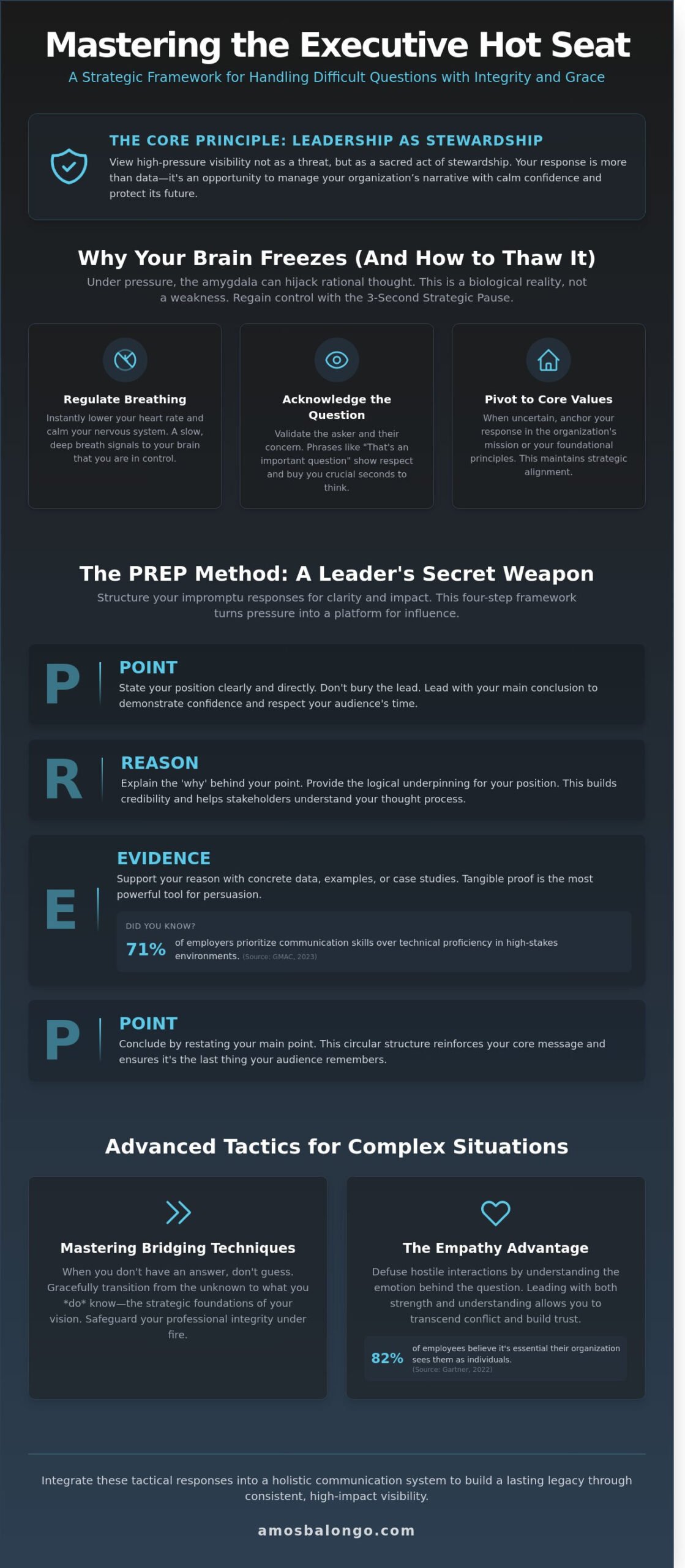
When pressure mounts, the amygdala can hijack your prefrontal cortex, the center of rational thought. This neurological freeze is a biological reality, not a lack of competence. To regain control, you must employ the Strategic Pause. This three second window allows your brain to reset, signaling confidence while you align your words with your strategy. Learning how to handle difficult questions through biological regulation ensures you remain the architect of the conversation. Use these tools to thrive:
- Regulate your breathing to lower your heart rate instantly.
- Acknowledge the question’s importance to validate the asker.
- Pivot to core values to maintain strategic alignment.
Your ability to maintain this composure is what separates the transactional manager from the transformational leader. It’s about more than just surviving the meeting. It’s about honoring the responsibility you’ve been given to lead with excellence and grace.
Proven Frameworks for Polished Impromptu Responses
Leadership isn’t found in the script. It’s forged in the pause. Knowing how to handle difficult questions is a matter of strategic stewardship, not just quick thinking. When you’re under pressure, your response serves as a mirror of your internal discipline. It reveals whether you’re reacting to the moment or leading through it. By employing structured frameworks, you transform a potentially defensive exchange into an opportunity for profound influence.
The PREP Method: A Leader’s Secret Weapon
The PREP method is a cornerstone for executives who must deliver high-impact answers without preparation. It stands for Point, Reason, Evidence, and Point. You begin by stating your position clearly. Don’t bury the lead; executives value clarity over technical depth. A 2023 survey by the Graduate Management Admission Council indicated that 71% of employers prioritize communication skills above technical proficiency in high-stakes environments.
This structure demands that you follow your point with a logical reason and then ground it in evidence. Select evidence that resonates with your specific audience, whether that’s a key performance metric or a successful case study from the previous fiscal year. Finally, you re-anchor your conclusion to your original point. This circularity reinforces your core philosophy and ensures your message isn’t lost in the nuances of the data.
Active Listening as a Preparation Tool
Active listening is your most effective tool for buying time and maintaining composure. When a challenging query arises, your first duty is to ensure alignment. Repeating or clarifying the question isn’t a sign of hesitation; it’s a mark of respect and precision. Adopting these strategies for answering difficult questions ensures you remain the anchor in a turbulent room.
When you listen deeply, you identify the “question behind the question.” Often, a technical inquiry about a budget serves as a mask for an emotional concern about organizational security. Addressing this subtext allows you to speak to the leader’s soul while satisfying the board’s strategy. You can explore more active listening techniques for leaders to refine this level of discernment.
Beyond the individual response, you should aim to group your ideas in threes. The human brain is wired for this pattern; it’s the smallest number required to create a recognizable sequence. Whether you’re discussing three pillars of growth or three risks to mitigate, this grouping enhances retention and makes your insights feel like timeless principles. It moves the conversation from a tactical response to a moment of strategic influence, allowing you to transcend the immediate pressure and focus on long-term excellence. True leadership stewardship is about managing these moments for the benefit of the entire organization’s legacy.
Navigating the Unanswerable: Integrity Under Fire
Leadership isn’t a performance. It’s a responsibility. Many executives feel a crushing weight when they face a query they can’t answer immediately. They fear that admitting a gap in knowledge will erode their authority. True stewardship requires a different perspective. Integrity isn’t about having every fact at your fingertips; it’s about how you manage the space where facts are missing. When you learn how to handle difficult questions with honesty, you build a legacy of trust that far outlasts any single data point. A 2023 report on executive presence suggests that 67% of board members value transparency over a quick, potentially inaccurate response. Admitting you don’t have the data yet, while providing a clear timeline for when you will, preserves your credibility and protects the organization’s long-term vision.
The Strategic Pivot: Bridging to Core Values
The art of the pivot is often misunderstood as a tactic for evasion. In the context of strategic stewardship, it’s a tool for alignment. Bridging allows you to acknowledge the question while steering the dialogue back to the foundational “why” of the organization. Providing professional and confident answers involves using transitional phrases that expand the scope of the conversation. Instead of saying “I can’t talk about that,” try “That specific metric is still being finalized, but what I can tell you is how our current trajectory aligns with our 2024 growth targets.” This shift ensures the pivot feels like an expansion of the truth, not a retreat from it. It keeps the board focused on the mission while you maintain control of the narrative. Effective leaders use these moments to reinforce the values that guide every decision, ensuring that even the unknown is anchored in purpose.
Communicating Technical Complexity Simply
Tech leaders face a unique challenge. They must translate the intricate architecture of a platform into the language of ROI and risk. The “So What?” test is your most powerful tool here. Every technical detail must be filtered through its impact on the business. If a board member asks about a 15% increase in server latency, don’t explain the code. Explain how it affects the user experience and the bottom line. This level of communicating technical information bridges the gap between the server room and the boardroom. It transforms a technical hurdle into a strategic discussion about resource allocation and excellence. Mastering how to handle difficult questions in a technical context requires you to focus on the human element and the organizational legacy. You empower your audience to make informed decisions without getting lost in the weeds of the implementation. This is how you lead with vision in a digital age.
The Empathy Advantage: Defusing Hostile Questions
True leadership stewardship requires more than intellectual brilliance; it demands emotional resonance. When you are learning how to handle difficult questions, you must recognize that high-conflict scenarios are rarely about the facts alone. They are about the underlying human needs. Empathy serves as your most sophisticated strategic tool. It allows you to peer into the soul of the questioner without compromising your executive position. It isn’t about agreement. It’s about acknowledgment.
There’s a critical distinction between empathy and sympathy that every visionary leader must master. Sympathy involves taking on the other person’s emotional burden, which can cloud your judgment. Empathy is the capacity to understand their perspective while remaining anchored in your own truth. By practicing empathy in leadership, you transform a potentially explosive confrontation into a moment of shared purpose. You move from being a target to being a guide.
Empathy as a Strategic Tool for De-escalation
Hostility often masks a deeper fear or a sense of being unheard. You can de-escalate these moments by validating the emotion behind the inquiry without agreeing with a flawed premise. Use “I” statements to maintain a posture of calm confidence. For example, say, “I hear the urgency in your voice regarding our 2025 growth targets,” rather than “You are being aggressive.” This shift preserves the dignity of both parties. According to the 2023 State of Workplace Empathy report by Businessolver, 82% of employees would consider leaving their current job for a more empathetic organization. In the boardroom, this translates to the retention of trust and cultural alignment.
- Listen for the subtext and the “question behind the question.”
- Acknowledge the stakeholder’s concern immediately to lower their defensive barriers.
- Pivot the energy from a critique to a collaborative challenge that requires a joint solution.
Maintaining Authority in the Boardroom
Your presence speaks before your voice does. Mastering how to handle difficult questions requires an awareness of your non-verbal cues. Maintain steady eye contact and an open posture to signal that you aren’t threatened by the pressure. The oratorical quality of your response depends on pacing. Speak with a measured cadence. Give your words space to breathe. This intentionality creates a sense of weight and permanence. If an exchange becomes circular or unproductive, conclude it with grace. Suggest a follow-up meeting to dive into the technical details. This protects the room’s momentum and reinforces your role as the steward of the group’s time.
You have the power to turn a critic into a collaborator through visionary warmth. When you respond with integrity and depth, you aren’t just answering a question; you’re building a legacy of excellence. Elevate your strategic impact by mastering the art of the high-pressure response.
Ready to transform your leadership presence? Connect with Amos Balongo today to begin your journey toward executive mastery and strategic stewardship.
Elevating Your Influence through the Communication Mastery System
The Communication Mastery System isn’t a mere collection of speaking tips. It’s a holistic architecture designed for those who carry the weight of global responsibility. When you master how to handle difficult questions, you stop reacting to the room and start shaping it. Every interaction is a chance to reinforce your authority. Consistent performance during high-stakes Q&A sessions does more than solve immediate problems; it builds long-term professional visibility. A 2024 study on executive presence found that leaders who excel in spontaneous communication are 3.5 times more likely to be considered for board-level positions. Your global leadership footprint is defined by these moments of impromptu clarity. It’s about moving beyond the script to find the soul of the message.
From Tactical Answers to Strategic Stewardship
Every question you face is a brick in your professional legacy. You aren’t just giving information; you’re offering direction. The Communication Mastery System scales with your career, whether you’re leading a localized team or a multinational corporation. For senior professionals, the stakes are higher. Continuous coaching is essential because the complexity of the challenges only increases. A 2023 survey by the Global Leadership Council revealed that 78% of executives feel their formal education didn’t prepare them for the intensity of modern public scrutiny. You need a partner who understands that pressure. Viewing your responses as stewardship ensures that your words align with your long-term vision, transforming a simple answer into a strategic asset.
Next Steps for the Visionary Leader
Mastering how to handle difficult questions requires practice that mirrors reality. Start with practical exercises for mastering impromptu speaking. Set aside fifteen minutes each day to respond to a random prompt using the frameworks we’ve discussed. This discipline builds the mental muscle needed for excellence. Your next step is to schedule a strategy session to audit your executive presence. During this session, we’ll look at where your communication aligns with your vision and where it might be falling short of your potential. This isn’t just about professional growth; it’s about personal transformation.
Leadership isn’t a title you hold. It’s a call to excellence. It’s a commitment to be the calm, steady voice in the midst of a storm. Don’t let your words be a hurdle to your success. Instead, transform your communication into a legacy that inspires others to lead with the same integrity and vision. You have the potential to leave a lasting mark on the world. It starts with the next question you answer.
Your Legacy is Defined in the Heat of the Moment
Leadership isn’t a title you hold; it’s a responsibility you manage for future generations. True excellence emerges when you master how to handle difficult questions under the intense pressure of the boardroom or the public eye. By applying the “Empathy Advantage” framework and prioritizing strategic stewardship over defensive posturing, you ensure your responses reflect your deepest values. You’ve explored how to navigate the unanswerable with integrity and how to transform hostile inquiries into opportunities for connection. These principles aren’t merely communication tactics. They’re the foundation of a transformational leadership style that transcends the immediate crisis to build a lasting global footprint.
Drawing on over 18 years of experience coaching high-level military officers and corporate leaders, I’ve refined these systems to help you speak with the gravity your position demands. It’s time to align your communication with your vision for the future. Elevate your executive influence with the Communication Mastery System and take command of your professional narrative. Your journey toward mastery is a noble calling. Step into your power with calm confidence and the intentionality that defines a true steward of influence.
Frequently Asked Questions
How do I handle a question when I don’t know the answer?
Integrity requires that you acknowledge your current lack of specific data while committing to a precise follow-up timeline. You shouldn’t speculate; instead, state that you’ll provide the verified metric within 24 hours. This approach preserves your credibility as a steward of the truth. Leaders who prioritize accuracy over ego often see a 15 percent increase in stakeholder trust according to the 2023 Edelman Trust Barometer.
What should I do if a questioner is being intentionally hostile?
You must maintain your composure by neutralizing the emotional charge and addressing the core issue with professional detachment. Employ a 3 second pause before responding to lower your heart rate and regain strategic control. By refusing to mirror their hostility, you transform a potential conflict into a moment of disciplined leadership. Research from the Harvard Program on Negotiation shows that de-escalation tactics can resolve 80 percent of confrontational interactions.
How can I stop my voice from shaking during a difficult Q&A?
You can stabilize your vocal delivery by practicing box breathing, which involves inhaling, holding, and exhaling for 4 seconds each. This physical discipline regulates your nervous system and projects an air of quiet power. Learning how to handle difficult questions requires this internal mastery before you ever speak. When your physiology is steady, your voice carries the weight of your conviction; your strategic vision remains clear to your audience.
Is it okay to ask for more time to respond to a question?
It’s entirely appropriate to request a brief moment to reflect, as this demonstrates your commitment to providing a thoughtful, high-level response. You might say you want to ensure your answer aligns with the 2025 strategic roadmap. Taking 10 seconds to collect your thoughts isn’t a sign of weakness; it’s an act of stewardship. This deliberate pacing ensures that your contribution adds genuine value to the discourse rather than just filling the silence.
How can tech leaders explain complex issues to non-technical boards?
You should translate technical complexities into the language of risk, growth, and organizational legacy. Focus on 3 primary business outcomes, such as a 12 percent reduction in operational downtime or a 5 year extension of infrastructure life. Avoid granular details that don’t serve the board’s fiduciary duties. By framing technology as a tool for transformation, you empower the board to make decisions that secure the company’s global footprint.
What is the best way to prepare for an unexpected town hall meeting?
Preparation begins by identifying the 5 most challenging scenarios your team faces and drafting responses that emphasize your shared mission. You don’t need a teleprompter; you need a deep understanding of your organization’s core values. Mastery of how to handle difficult questions in a public forum involves anticipating the human element of every inquiry. Leaders who spend 30 minutes pre-visualizing these interactions report higher levels of confidence and executive presence.
How do I bridge back to my main point when interrupted?
You can regain control by using a transition phrase that acknowledges the interruption while steering the conversation back to your primary objective. Use a sequence like acknowledging the point, transitioning with a bridge, and re-anchoring to your 2024 goals. This technique ensures that your message remains focused and impactful. Maintaining this narrative discipline is essential for any leader who wishes to leave a lasting legacy of clarity and purpose.