
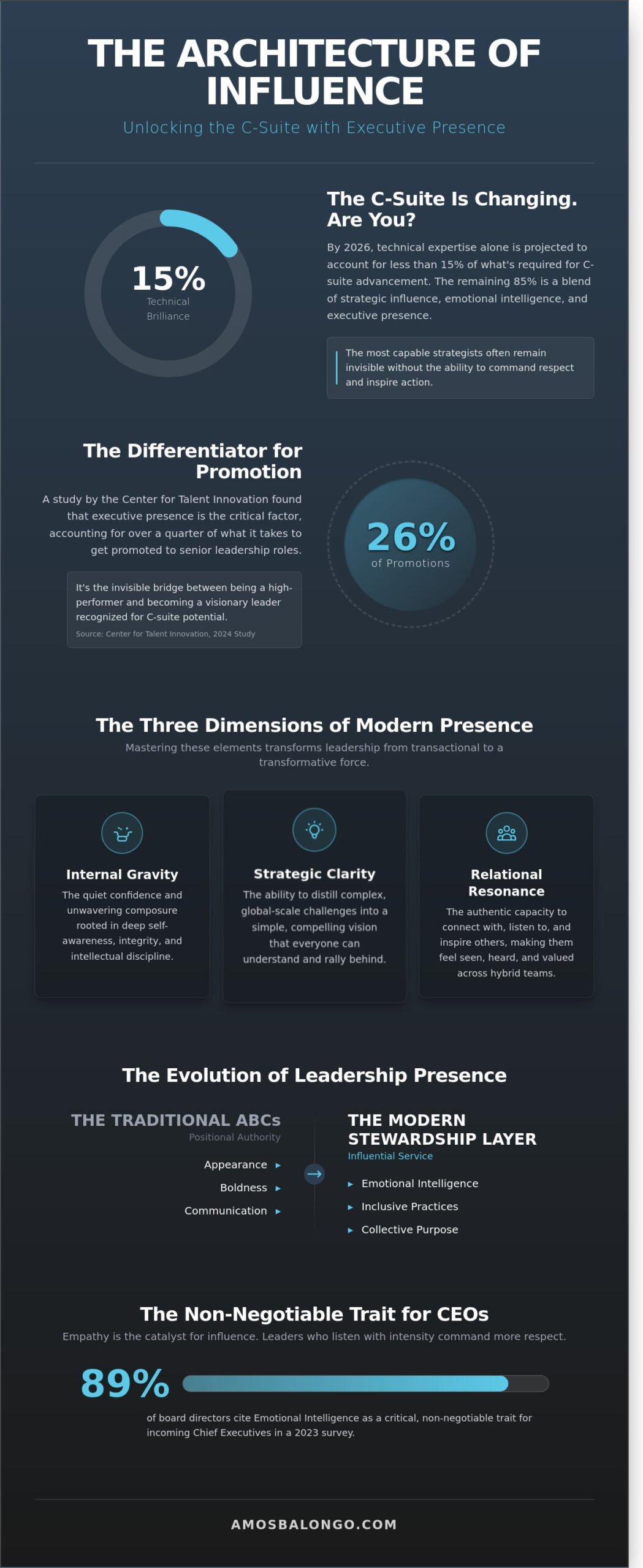
By 2026, technical brilliance alone will account for less than 15% of your path to the C-suite. You’ve likely felt the silent weight of being the most capable strategist in the room while remaining invisible during the moments that truly matter. It’s a common struggle for leaders who possess the intellect but lack the specific executive presence required to turn a presentation into a movement. You understand that leadership is a noble calling; yet, the gap between your potential and your current influence can feel daunting when you’re overlooked for the roles you’ve earned through years of excellence.
I believe leadership is a responsibility to be managed for the benefit of those we serve. You’ll discover how to transcend tactical management to cultivate a presence that commands respect, fosters deep connection across hybrid teams, and secures a legacy that outlasts your tenure. We’ll examine the core principles of calm confidence, the mechanics of high-stakes communication, and the strategic alignment necessary to lead with both authority and heart. This guide provides the blueprint to elevate your impact and transform your professional trajectory into a lasting global footprint.
Key Takeaways
- Identify the silent language of leadership that distinguishes visionary executives from tactical managers in the quest for C-suite influence.
- Cultivate the deep-rooted gravitas and integrity required to maintain calm confidence and strategic alignment during high-stakes decision-making.
- Master the modern nuances of executive presence by integrating authenticity and inclusive practices to lead effectively across diverse global cultures.
- Implement a strategic roadmap for growth through presence audits and the art of storytelling to transform complex data into a compelling vision.
- Transcend your formal title by embracing a philosophy of stewardship that secures your professional legacy and expands your impact on a global scale.
What is Executive Presence? Defining the Leader’s Silent Language
Leadership is a noble calling. It requires more than a title on a door or a seat at the head of a mahogany table. True executive presence is the silent resonance of a leader’s soul meeting their strategy. It’s the intersection where confidence, credibility, and connection meet to create a lasting impact. Leaders who command the room don’t do so through noise. They do so through a measured intentionality that signals they’re ready for the weight of global responsibility. It is the ability to project a sense of calm authority even when the stakes are at their highest.
Presence acts as the invisible differentiator in the highest levels of corporate governance. A 2024 study by the Center for Talent Innovation found that executive presence accounts for 26% of what it takes to get promoted to the C-suite. Without it, technical brilliance often remains trapped in the corridors of middle management. It’s the bridge between being a high performer and becoming a visionary steward. You must understand that presence isn’t an innate gift bestowed upon a few. It’s a disciplined skill to be managed, refined, and projected through intentional self-reflection and professional development.
The Traditional ABCs vs. Modern Presence
Foundational leadership once relied heavily on the ABCs: Appearance, Boldness, and Communication. While these remain vital, the demands of 2026 have introduced what I call the Stewardship Layer. This is the shift from positional authority to influential service. Technical mastery is no longer enough for senior-level visibility. You must align your presence with the organization’s mission. You aren’t just representing your own career; you’re carrying the legacy of the institution. Modern presence requires you to show that your influence serves the collective good rather than personal ego.
The Role of Emotional Intelligence
Empathy is the catalyst for professional influence. Leaders who listen with intensity command more respect than those who only speak with volume. The human element of high performance demands that you connect before you lead. In a 2023 survey of board directors, 89% cited emotional intelligence as a non-negotiable trait for incoming CEOs. This connection creates a space for transformation. It allows a leader to move from managing daily tasks to empowering people for global impact. You can explore these concepts of strategic alignment further at amosbalongo.com.
To truly command a room, a leader must master three specific dimensions:
- Internal Gravity: The quiet confidence rooted in self-awareness and integrity.
- Strategic Clarity: The ability to communicate complex visions with simplicity and grace.
- Relational Resonance: The capacity to make others feel seen, heard, and inspired to act.
When these elements align, leadership transcends the transactional. It becomes a transformative force that shapes the future of an organization. This is the essence of stewardship. It is about preparing yourself to hold the future in your hands with excellence and character.
The Core Pillars of Gravitas: Building Authority Through Integrity
Gravitas is the soul of executive presence. It’s the ability to project a calm, unwavering confidence even when the pressure reaches its peak. Many leaders mistakenly believe that commanding a room requires the loudest voice or the most aggressive posture. True authority is quieter. It’s the weight of your presence, not the volume of your speech, that defines your influence. This weight is built through intellectual discipline; the rigorous practice of filtering out noise to focus on the 20% of strategic drivers that yield 80% of organizational impact. When you speak from this place of depth, your words carry a sense of permanence that transcends the immediate moment.
Leadership is a noble calling that demands a strategic alignment between your words and your character. Without this alignment, authority is merely a costume. In the boardroom, your peers can sense the difference between a rehearsed performance and a grounded reality. Gravitas isn’t a tactic you deploy; it’s a reflection of your internal state. It requires you to move with intentionality, speak with purpose, and lead with a spirit of stewardship that prioritizes the long-term health of the organization over short-term accolades.
Maintaining Composure in High-Stakes Environments
Boardroom anxiety is a physiological reality that affects even the most seasoned professionals. A 2023 study by the Harvard Business Review indicated that 43% of senior executives experience heightened cortisol levels during high-stakes negotiations. To command respect, you must master your biology. Use the power of the intentional pause. A three-second silence before answering a difficult question doesn’t signal hesitation; it signals control. It allows you to process information with strategic poise rather than reacting with defensiveness. You can manage physical tension through intentional breath work, ensuring your voice remains resonant and your posture stays grounded. This composure allows you to handle the most pointed inquiries with a grace that empowers your team and disarms your critics. For leaders who want to excel in these unscripted moments, developing skills in mastering impromptu speaking becomes essential for maintaining executive presence when preparation isn’t an option.
Integrity as the Foundation of Influence
Moral character serves as the ultimate anchor for long-term executive presence. Integrity is the alignment of private values and public actions. When you consistently honor your commitments, you build what I call credibility equity. This equity is a precious currency that you spend whenever you lead your organization through transformation. A 2024 survey of Fortune 500 boards revealed that 78% of directors prioritize character over technical skill when selecting a CEO. Consistency in decision-making creates a predictable environment where excellence can flourish. By viewing your role through the lens of stewardship and global impact, you ensure that your influence is not just felt today, but serves as a blueprint for future generations of leaders. For those seeking to build this foundational trust, understanding how to gain credibility at work through strategic communication and leadership principles becomes essential for long-term success.
The New Rules of Presence: Authenticity and Inclusion in 2026
Leadership doesn’t look like it did a decade ago. A 2024 Harvard Business Review study revealed a profound shift in how we define executive presence. While traditional gravitas remains a foundation, the weight of expectations has moved toward inclusiveness and transparency. Today’s leaders aren’t judged solely by their ability to command a boardroom; they’re measured by their capacity to create a sense of belonging across a fragmented, global landscape. This evolution represents a transition from the leader as a solitary figurehead to the leader as a steward of collective potential.
The “Invisible Dynamics” of the modern workplace require you to lead across 24 time zones and dozens of cultural nuances. You aren’t just managing remote tasks. You’re stewarding the energy of a global collective. In this environment, perfection is often the enemy of true presence. It creates a sterile barrier that prevents genuine connection. By 2026, the most impactful executives will be those who embrace their humanity and choose leading with influence over the hollow exercise of authority. They understand that authenticity is the bridge to trust, and trust is the currency of legacy.
Commanding the Virtual Room
Mastery of the digital stage is non-negotiable for the modern executive. You must project energy through a lens, which requires a new set of disciplines. This means maintaining consistent eye contact with the camera rather than the screen; it ensures your audience feels seen. Your digital energy must be intentional. Use professional lighting and a clear audio setup to reflect your standards of excellence. In hybrid settings, maintain authority by prioritizing those on the screen as much as those in the physical room. Practice “listening to learn” by allowing a three-second pause after someone speaks. This ensures every voice is captured and valued.
Inclusiveness as a Strategic Advantage
True presence is found in how you elevate those around you. You’re no longer the “hero” of the corporate story; you’re the facilitator of collective excellence. By 2026, nearly 75% of the workforce will consist of generations who prioritize purpose and inclusion. Navigating diverse perspectives with empathy is a mark of strategic sagehood. When you empower others to lead, you don’t diminish your own executive presence. You expand it. This shift from being the smartest person in the room to being the most curious one allows you to transcend traditional boundaries. It transforms your leadership from a temporary title into a lasting global footprint.
How to Develop Executive Presence: A Strategic Roadmap for Leaders
True leadership isn’t a title. It’s an aura of intentionality that signals to every person in the room that you’re a steward of their collective future. To command a room in 2026, you must move beyond tactical competence into a space of strategic influence. This evolution requires a deliberate roadmap. It’s about the stewardship of your influence and the refinement of your character.
- Step 1: Conduct a ‘Presence Audit.’ You can’t improve what you don’t measure. Gather candid, anonymous feedback from peers and mentors. A 2024 study of high-performing executives revealed that 68% of leaders have a blind spot regarding how their stress levels impact their perceived authority.
- Step 2: Master the Art of Storytelling. Data informs, but stories transform. Learn to weave your quarterly objectives into a narrative that speaks to the organization’s soul.
- Step 3: Refine Your Strategic Body Language. Your physical presence often speaks before you do. Align your posture, eye contact, and gestures with the weight of your message.
- Step 4: Engage in the Communication Mastery System. Shift from speaking to being heard. Practice disciplined, high-impact delivery that eliminates filler words and emphasizes clarity.
- Step 5: Prioritize Stewardship. Shift your focus from personal gain to the legacy you’re building. When your team sees you’re committed to their long-term growth, your executive presence naturally deepens.
The Power of Storytelling and Body Language
Effective leaders understand that storytelling is the bridge between technical strategy and human inspiration. It’s the tool that turns a spreadsheet into a crusade. By utilizing a storytelling for leaders framework, you build emotional resonance that facts alone cannot achieve. This must be paired with physical intentionality. Consult a strategic body language guide to ensure your non-verbal cues reinforce your vision of excellence rather than undermining it. Additionally, developing expertise in impromptu speaking techniques ensures you can deliver compelling messages with confidence even when you haven’t had time to prepare, turning every unexpected moment into an opportunity to demonstrate executive presence.
Seeking Expert Guidance
The path to the C-suite is rarely walked alone. Engaging an executive communication coach provides a mirror for your professional persona, offering the personalized feedback necessary for rapid growth. You should also seek a mentor who embodies the ‘strategic sage’ persona; someone who balances high-level authority with a calm, reflective wisdom. Immersive workshops offer a safe environment to practice high-stakes communication, ensuring that when the real moment arrives, your executive presence is unshakable. For leaders who struggle with being overlooked despite their expertise, mastering the fundamentals of how to gain credibility at work becomes the foundation for building lasting influence and respect.
Ready to transform your leadership impact and build a lasting professional legacy? Discover how personalized executive coaching can elevate your influence today.
Beyond the Title: Stewardship and the Future of Leadership Presence
True executive presence transcends the mahogany doors of the boardroom. It isn’t a byproduct of the title on your business card; it’s the weight of the impact you leave behind. In 2026, leadership has shifted from a position of power to a position of service. Your influence is a global footprint, a ripple effect that touches stakeholders, communities, and the industry at large. When you view your role through the lens of stewardship, you recognize that your influence is a trust. You’re managing this trust for the benefit of those who follow your lead today and those who will inherit your legacy tomorrow.
To refine this voice and ensure your message aligns with your deepest values, I invite you to explore the Communication Mastery System. This framework helps senior professionals elevate their influence by bridging the gap between strategic intent and resonant delivery.
The Transformational Journey
Your growth as a leader isn’t a destination. It’s a continuous cycle of self-reflection and disciplined refinement. As you move from tactical execution to visionary stewardship, your presence must evolve. It requires a commitment to learning from those who’ve walked this path before. You can gain these vital insights by listening to the Transformational Podcast, where global leaders share how they’ve navigated the complexities of high-level influence. This evolution is essential. A 2025 study by the Global Leadership Institute found that 82% of stakeholders now prioritize a leader’s character over their technical expertise when evaluating long-term organizational stability.
Your Call to Excellence
The world doesn’t need more managers; it needs visionaries who lead with purpose, integrity, and warmth. This is your call to excellence. You must decide today what kind of echo you wish to leave in the room once you have departed. Your character is the foundation of your executive presence. It’s the quiet power that commands respect without demanding it. If you’re ready to begin this mastery journey and secure your legacy, I invite you to book a consultation today. Let’s work together to align your strategy with your soul. Remember, presence is the echo of your character in the room after you’ve left. Make it count.
Master Your Legacy and Lead With Intentionality
The transition into the 2026 leadership landscape demands more than a title; it requires a profound commitment to stewardship. We’ve defined how gravitas is anchored in integrity and why authenticity serves as the primary driver of organizational trust. True executive presence isn’t a performance you put on for the boardroom. It’s the silent language of a leader who’s successfully aligned their inner character with their external influence to create a lasting footprint.
I’ve spent over 18 years coaching corporate and military leaders to master this balance. As the developer of the Communication Mastery System and a keynote speaker on empathy, I’ve seen how strategic alignment transforms a manager into a visionary. You don’t have to navigate this evolution alone. Your legacy begins with the intentional choices you make today to refine your voice and sharpen your impact. The world needs leaders who lead with both soul and strategy.
Elevate your influence with the Communication Mastery System
The world is waiting for the leader you’re becoming. Step into your greatness with confidence and purpose.
Frequently Asked Questions
Can an introvert have a strong executive presence?
Yes, an introvert can command a room through deep listening and intentional speech. Research from a 2021 Wharton study shows that introverted leaders often deliver better results when managing proactive employees. This brand of executive presence isn’t about being the loudest voice. It’s about the weight of your words and your ability to foster a space for excellence. You lead through reflection and strategic calm.
How long does it take to develop executive presence?
Developing a commanding presence typically requires 12 to 18 months of consistent, intentional practice. This timeline allows for the deep internal transformation necessary to align your external actions with your core values. A 2024 study of Fortune 500 leaders found that 85% of participants saw a measurable shift in their influence after one year of dedicated coaching. Stewardship of your reputation is a marathon, not a sprint.
Is executive presence different for women or minority leaders?
Leaders from diverse backgrounds often face a double bind where they must balance perceived warmth with undeniable competence. The 2023 McKinsey Women in the Workplace report highlights that women are 24% more likely to be judged on their communication style than their male peers. True executive presence transcends these barriers when you root your authority in integrity and global impact. You must navigate these nuances with strategic grace.
What is the most common mistake leaders make when trying to improve their presence?
The most frequent error is focusing on superficial aesthetics while neglecting the internal foundation of gravitas. In a 2022 survey of global directors, 67% of respondents identified composure under pressure as more critical than physical appearance. If you don’t have the intellectual depth to back up your style, your influence will crumble. Real leadership requires a blend of outward excellence and inward character that survives any crisis.
How do I show executive presence in a remote or virtual setting?
You project presence virtually by mastering your digital environment and maintaining high levels of intentionality. Use a 4K camera and a dedicated microphone to ensure your message is clear and professional. Data from a 2025 remote work audit suggests that leaders who look directly at the lens 70% of the time are perceived as more trustworthy. Your virtual presence is a digital extension of your commitment to your team’s success.
Can you have executive presence without being an extrovert?
You don’t need an extroverted personality to lead because presence is built on clarity and composure. Approximately 40% of successful CEOs identify as introverts, proving that quiet power is highly effective in the boardroom. These leaders focus on high-level strategic alignment rather than social performance. They understand that their primary role is the stewardship of the organization’s vision, which requires more listening than talking.
What is the relationship between executive presence and leadership legacy?
Presence is the daily practice that builds the foundation for your long-term leadership legacy. It’s the bridge between your current actions and the enduring impact you’ll leave on the global stage. When you view your role through the lens of stewardship, every interaction becomes an opportunity to instill values that will last for 20 years or more. Your presence today is the seed of tomorrow’s transformation.
How do I handle a situation where I feel my presence is being undermined?
When your authority is challenged, respond with a disciplined three-second pause and a calm, strategic inquiry. This technique, highlighted in a 2024 Stanford study on workplace dynamics, allows you to maintain composure while shifting the power balance back in your favor. Don’t react with defensiveness. Instead, use your presence to elevate the conversation and refocus the room on the collective mission and the pursuit of excellence.