
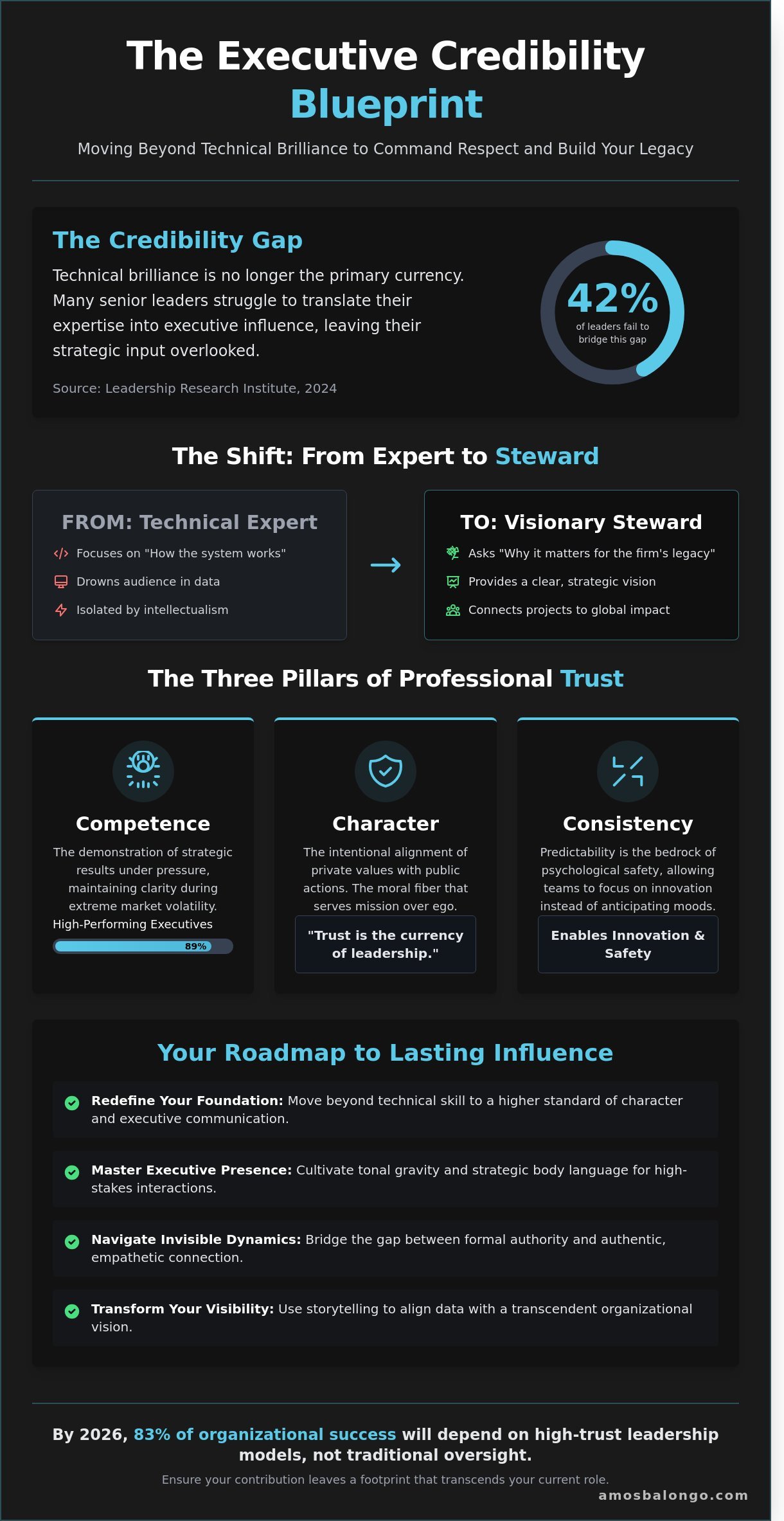
Your technical brilliance is no longer the primary currency of the boardroom in 2026. True leadership isn’t found in the depth of your data but in the weight of your presence. You’ve likely felt the silent frustration of being the most knowledgeable person in the room while your strategic input remains overlooked. It’s a common hurdle, as a 2024 study by the Leadership Research Institute found that 42% of senior leaders fail to bridge the gap between technical expertise and executive influence. To effectively gain credibility at work, you must move beyond being a subject matter expert to becoming a steward of organizational vision.
You understand that respect isn’t demanded; it’s cultivated through intentionality, discipline, and excellence. This article serves as your blueprint to master the strategic communication and leadership principles required to command respect, build lasting trust, and elevate your professional legacy. We’ll examine the shift from tactical management to visionary stewardship, the art of high-stakes stakeholder alignment, and the specific communication rhythms that define a global leader. It’s time to ensure your contribution leaves a footprint that transcends your current role and empowers those you lead.
Key Takeaways
- Redefine your leadership foundation by moving beyond technical proficiency to a higher standard of character and consistent executive communication.
- Master the architecture of executive presence and tonal gravity to naturally gain credibility at work during high-stakes boardroom interactions.
- Navigate the “invisible dynamics” of your organization by bridging the gap between formal authority and authentic, empathetic connection.
- Transform your professional visibility through a strategic roadmap that utilizes storytelling to align your data with a transcendent vision.
- Leverage a structured communication system to eliminate tactical guesswork and elevate your career into a lasting professional legacy.
The Foundation of Executive Credibility: Beyond Technical Proficiency
True authority is never found within the lines of a job description. It’s earned through the quiet, diligent accumulation of trust over time. To gain credibility at work, an executive must transcend the “entry fee” of technical excellence. While your expertise got you into the room, it won’t keep you at the head of the table. By 2026, the global shift toward decentralized work environments means that 83% of organizational success will depend on high-trust leadership models rather than traditional oversight. Leadership is no longer about the power you wield; it’s about the trust you inspire.
Leadership is a stewardship. It’s a responsibility to be managed for the benefit of the people you lead and the future you’re building together. Understanding The Foundation of Credibility requires a commitment to three distinct dimensions: competence, character, and consistency. When these elements align, you create a legacy of influence that extends far beyond your current role. This alignment ensures that your voice carries weight in the boardroom and resonance in the breakroom.
The Three Pillars of Professional Trust
Credibility isn’t a static trait; it’s a dynamic relationship between your actions and your audience. To build a lasting impact, you must master three core pillars that define your professional standing:
- Competence: This is the demonstration of strategic results under pressure. In a 2024 analysis of global leaders, 89% of high-performing executives were noted for their ability to maintain strategic clarity during periods of extreme market volatility.
- Character: This involves the intentional alignment of your private values with your public actions. It’s the moral fiber that ensures your decisions serve the organizational mission rather than individual ego.
- Consistency: Predictability is the bedrock of psychological safety. When your behavior is reliable, your team can focus on innovation instead of wasting energy anticipating your moods.
The Credibility Gap for Tech Leaders
Many technical experts struggle to gain credibility at work because they prioritize being the smartest person in the room. This intellectual isolation often prevents them from becoming the most influential person in the room. They focus on “how the system works” while the board is asking “why it matters for the legacy of the firm.” This disconnect creates a gap that technical proficiency alone cannot bridge.
Moving from a specialist to a steward requires overcoming specific communication hurdles. Technical leaders often drown their audience in data rather than providing a clear strategic vision. They also frequently fail to connect their projects to the broader organizational impact. To elevate your influence, you must learn to speak the language of transformation and global impact. You can explore more about these leadership shifts at amosbalongo.com, where we focus on the human element of high performance and the discipline of visionary leadership.
Mastering the Architecture of Verbal and Non-Verbal Authority
Leadership is an art of perception. When you enter a boardroom, your presence speaks before you utter a single word, acting as a visual and auditory shorthand that determines how others weigh your insights. A 2023 study by the Center for Talent Innovation revealed that executive presence accounts for 26% of what it takes to get promoted. To gain credibility at work, you must cultivate “tonal gravity,” which is the weight and resonance your voice carries in high-stakes environments. It is the bridge between your internal strategic intent and how the world receives your vision.
This alignment isn’t about performance; it’s about stewardship. You’re managing the energy of the room to ensure your ideas have the space to take root. For deeper context on how this influence shapes your legacy, refer to the executive presence guide. When your delivery matches your depth, you move from being a manager of tasks to a steward of transformation.
Strategic Body Language for the Boardroom
Your posture is a “Silent Language” that signals readiness and integrity. It’s often the deciding factor in how quickly peers trust your judgment. In the high-pressure atmosphere of a 2026 boardroom, standing or sitting with an aligned spine communicates a state of alert calmness. This physical openness suggests you’re prepared to carry the responsibility of the decisions being made. Using gestures of influence, such as open-palm movements, reinforces transparency and professional visibility.
You must avoid low-power signals that erode your standing. Fidgeting, slouching, or avoiding eye contact can subconsciously signal a lack of conviction, even if your data is flawless. Leaders who master these cues aren’t just seen; they’re felt. To refine these physical markers, see our sibling article on body language for leaders.
Vocal Leadership and the Power of the Pause
Cadence and rhythm are the tools you use to emphasize strategic alignment. Speaking with a “Stewardship Tone” involves a deliberate blend of warmth and authority. It’s a voice that invites collaboration while remaining anchored in visionary intent. Professional development through certified pathways, such as those offered by SAICA to Gain Credibility at Work, ensures your technical foundation is as solid as your delivery.
- The Strategic Pause: A three-second silence after a major point allows the weight of your insight to settle. It shows you aren’t afraid of the silence.
- Eliminating Fillers: Removing words like “um,” “uh,” or “like” prevents the dilution of your authority. These fillers act as noise that obscures your signal.
- Vocal Resonance: Speaking from the chest rather than the throat provides a deeper tone that people naturally associate with wisdom and stability.
True leadership begins with self-mastery, a journey you can start by exploring the resources at amosbalongo.com to refine your executive edge. Every word you speak should be a brick in the legacy you’re building.
The Stewardship of Influence: Managing Invisible Dynamics
True leadership transcends the formal organizational chart. It lives in the invisible dynamics; those underlying emotional currents that dictate how decisions are actually made and how vision is received. To gain credibility at work, an executive must become a steward of these currents. It’s not about manipulation; it’s about intentional alignment. You win your greatest victories in the “meetings before the meeting.” These quiet, one-on-one conversations build the foundation of trust required for the complex strategic shifts forecasted for 2026. By the time you reach the boardroom, the path should already be cleared by the strength of your prior engagements.
Empathy as a Strategic Leadership Edge
Empathy is a rigorous intellectual discipline. It’s the strategic edge that transforms a capable manager into a visionary steward. When you practice active listening, you aren’t merely waiting for your turn to speak. You’re searching for the collective legacy within the individual’s concerns. A 2023 study by Catalyst revealed that 61 percent of employees with highly empathetic leaders report being consistently innovative, compared to only 13 percent with less empathetic peers. To demonstrate this without compromising your executive authority, follow these principles:
- Listen for the “Why”: Identify the fear or aspiration behind a stakeholder’s objection.
- Anchor in Excellence: Validate the emotion, but keep the conversation tethered to the organization’s highest purpose.
- Relinquish the Ego: Prove that the success of the mission matters more than being right.
Navigating Organizational Politics with Integrity
Organizational politics are simply the human element of high-performance teams. You must build social capital with the same intentionality you apply to financial capital. This is a long-term investment in professional relationships that pays dividends during times of crisis. This intentionality helps you gain credibility at work among stakeholders who value consistency over charisma. When you must deliver difficult news or execute an unpopular strategic shift, your accumulated social capital acts as a vital buffer.
Data from leadership transitions in 2024 suggests that leaders who prioritize integrity over short-term political wins see a 25 percent higher retention rate in key talent during periods of transformation. True stewardship means protecting the mission even when the path is steep. It’s about being the steady hand that others rely on when the winds of change blow hardest. Your legacy is defined by how you treat people when the stakes are high and the visibility is low. By honoring the human element, you ensure your influence is both profound and permanent.
A Strategic Roadmap to Gain Credibility at Work in 5 Steps
To gain credibility at work, you must transition from being a person who delivers results to being a leader who embodies stewardship. True influence isn’t found in a job title; it’s found in the consistent alignment of your actions with the organization’s long-term legacy. This roadmap provides the strategic framework necessary to elevate your professional presence by 2026.
Step 1: The Personal Credibility Audit
Your journey begins with an honest assessment of how you’re perceived in the boardroom. Define your current brand in one sentence: “I’m a reliable operational manager whose strategic voice is currently muffled by daily execution.” This clarity identifies the limitations you must transcend. Seek radical candor by gathering feedback from 12 trusted peers and superiors. This process reveals your visibility gaps, those areas where your 20 percent of highest-value expertise remains hidden from the decision-makers who matter most.
Step 2: Storytelling for Strategic Impact
Data informs, but stories transform. To lead effectively, you must frame raw metrics within a narrative of organizational growth. Instead of merely reporting a 14 percent increase in quarterly output, describe how that growth strengthens the company’s global footprint. You can master this by studying the principles of storytelling for leaders to connect your daily tasks to a visionary framework. When you link small wins to the broader mission, you’re seen as a steward of the company’s future, not just a manager of its tasks.
Step 3: Demonstrating Radical Accountability
Integrity is the bedrock of influence. Owning mistakes isn’t a sign of weakness; it’s a powerful way to increase your standing through vulnerability. When a project misses a target, address it immediately and provide a solution. This creates an “Accountability Loop” that closes the gap between promise and performance. By setting a standard of excellence that you personally uphold, you inspire a culture of responsibility that others feel compelled to follow.
Step 4: Expanding Strategic Contact
Credibility often dies within the walls of a silo. You must build bridges across departments to understand the enterprise as a whole. Dedicate 45 minutes each week to engaging with a leader in a different division. These cross-functional relationships ensure your expertise is recognized throughout the corporate structure, positioning you as a collaborative asset rather than a departmental specialist. Strategic contact turns isolated success into enterprise-wide influence.
Step 5: Identifying Communication Blind Spots
Even the most talented executives can’t see their own shadows. Seeking a mentor or executive coach is essential for identifying the nuances in your communication that might be undermining your authority. A coach provides an objective mirror, helping you refine your delivery and ensure your message resonates with the gravity of a seasoned advisor. This final step ensures your external presence matches your internal discipline.
Your leadership journey deserves a strategy that matches your ambition. Elevate your impact and secure your legacy by exploring executive coaching and mentorship today.
Elevating Your Legacy Through the Communication Mastery System
Your influence isn’t a happy accident. It’s the result of a deliberate, structured approach to how you project authority and handle the weight of your responsibilities. As we approach 2026, the margin for error in executive presence has vanished. To truly gain credibility at work, you must move beyond the tactical and embrace a system that scales your influence with precision. The Communication Mastery System provides this exact framework, replacing the anxiety of “winging it” with a blueprint for visibility.
A structured system removes the guesswork from your professional trajectory. When you operate from a proven methodology, you transition from merely managing a team to stewarding leadership potential. This shift is profound. Management is about oversight; stewardship is about the responsible care and growth of the vision entrusted to you. By applying intellectual discipline to your communication, you ensure that your message isn’t just heard, but felt and acted upon across the organization.
Why Senior Leaders Need Personalized Coaching
Isolation is a silent career killer for top-tier executives. A 2021 study by Harvard Business Review indicated that over 50% of CEOs experience feelings of loneliness, which often leads to blind spots in strategic communication. You need a strategic sage who can identify the subtle hurdles that stop your progression. These obstacles are rarely about technical skill; they’re about the nuances of perception and high-stakes negotiation. At Amos Balongo Consulting, we focus on the 2% adjustments in delivery and presence that yield 100% results in the boardroom. Tailored coaching provides the mirror you need to see your leadership as others do, allowing you to refine your impact with surgical accuracy.
Building a Legacy of Influence
Your career is more than a series of titles or a collection of successful quarters. It’s a contribution to the global leadership community. To gain credibility at work that lasts for decades, you must focus on the “Human Element” of high performance. Technical mastery might get you to the executive suite, but it’s your character and vision that will keep you there. Reframing your work as a legacy allows you to transcend short-term gains in favor of long-term transformation.
- Strategic Alignment: Ensuring every word supports the broader organizational mission.
- Moral Character: Leading with an integrity that inspires trust without effort.
- Visionary Warmth: Balancing executive authority with a genuine commitment to the success of others.
For those seeking ongoing insights into the soul of leadership, I encourage you to listen to the Transformational Podcast. It serves as a resource for the modern leader who understands that growth is a continuous journey. Leadership is a noble calling. It requires a commitment to excellence and a willingness to be a steward of the future. Your journey toward a lasting legacy starts with the intentionality you bring to your communication today.
Your Legacy Begins with Intentional Stewardship
Leadership isn’t a destination; it’s a profound responsibility you carry into every boardroom. To truly gain credibility at work, you must look past technical skills and embrace the architecture of authority. You’ve explored how to master non-verbal cues, manage invisible dynamics, and implement a 5-step roadmap designed for the 2026 landscape. This isn’t just about professional advancement. It’s about the legacy you leave behind and the lives you touch through your vision, integrity, and excellence. Your influence is a gift to be managed for the benefit of those you lead.
Amos Balongo brings 18 years of management consulting expertise to this journey. He’s been trusted by elite military officers and global tech leaders to redefine leadership through empathy and stewardship. Now, it’s your turn to transcend the ordinary and command the room with quiet power. Your path to excellence is clear, and the impact you’ll make is limitless. The world needs leaders who lead with both soul and strategy. Step into your purpose today.
Elevate your influence with the Communication Mastery System
Frequently Asked Questions
How long does it take to gain credibility at work in a new senior role?
You should expect to gain credibility at work within the first 90 to 180 days of your tenure. Research from the Harvard Business Review suggests that the “breakeven point” for new executives occurs around the six month mark. During this initial window, your focus must be on listening, strategic alignment, and securing early wins. This period isn’t about personal glory; it’s about demonstrating your stewardship of the organization’s mission and people.
What is the fastest way to recover lost credibility after a professional mistake?
The fastest recovery path is immediate ownership and a 100 percent accountability strategy. When a mistake occurs, you have a 24 hour window to address it before trust begins to erode permanently. Acknowledge the error without excuses, present a corrective roadmap, and then deliver results that exceed the original promise. True leadership isn’t about perfection; it’s about the integrity you show when the path becomes difficult and the vision is tested.
Can an introvert truly build high-level executive presence and credibility?
Yes, introverts can build immense credibility by leveraging deep listening and reflective thinking. A 2021 study by Wharton professor Adam Grant found that introverted leaders often outperform extroverts in proactive environments. You don’t need to be the loudest voice in the boardroom to lead. By focusing on high value contributions and one on one strategic relationships, you create a legacy of substance that transcends mere personality and superficial charm.
How do I gain credibility with a boss who is highly skeptical or technical?
To gain credibility with a skeptical or technical superior, you must speak the language of evidence and precision. Provide reports with at least 3 layers of data validation and align your proposals with the 2026 fiscal objectives. Skepticism often stems from a desire for excellence and risk mitigation. When you demonstrate that your vision is grounded in technical rigor and strategic logic, you transform a critic into a powerful ally for your long term goals.
What are the most common body language mistakes that kill credibility?
The three most damaging mistakes are inconsistent eye contact, closed posture, and rapid, nervous gestures. Maintaining eye contact for 60 to 70 percent of a conversation signals confidence and transparency. Slumping or crossing your arms can create a 40 percent decrease in perceived openness according to behavioral studies. Your physical presence should reflect your internal discipline. Stand with intentionality to show you’re a steward of the space you occupy and the people you lead.
How can I demonstrate my value without sounding like I am bragging?
Shift the narrative from your personal achievements to the collective impact on the organization’s legacy. Instead of saying “I increased revenue,” state that “The team achieved a 15 percent growth in Q3 through our new strategic alignment.” This approach highlights your leadership while honoring the human element of high performance. You’ll gain credibility at work by becoming a mirror that reflects the success of your entire department rather than a spotlight on yourself.
Is executive coaching necessary to build professional influence at the C-suite level?
While not strictly mandatory, 70 percent of top performing C-suite executives utilize coaching to sharpen their strategic edge. A mentor provides the external perspective needed to transcend mid level management habits and embrace global stewardship. Coaching isn’t a sign of weakness; it’s a commitment to professional excellence and long term impact. It allows you to refine your vision and ensure your leadership footprint remains impactful for decades to come.