
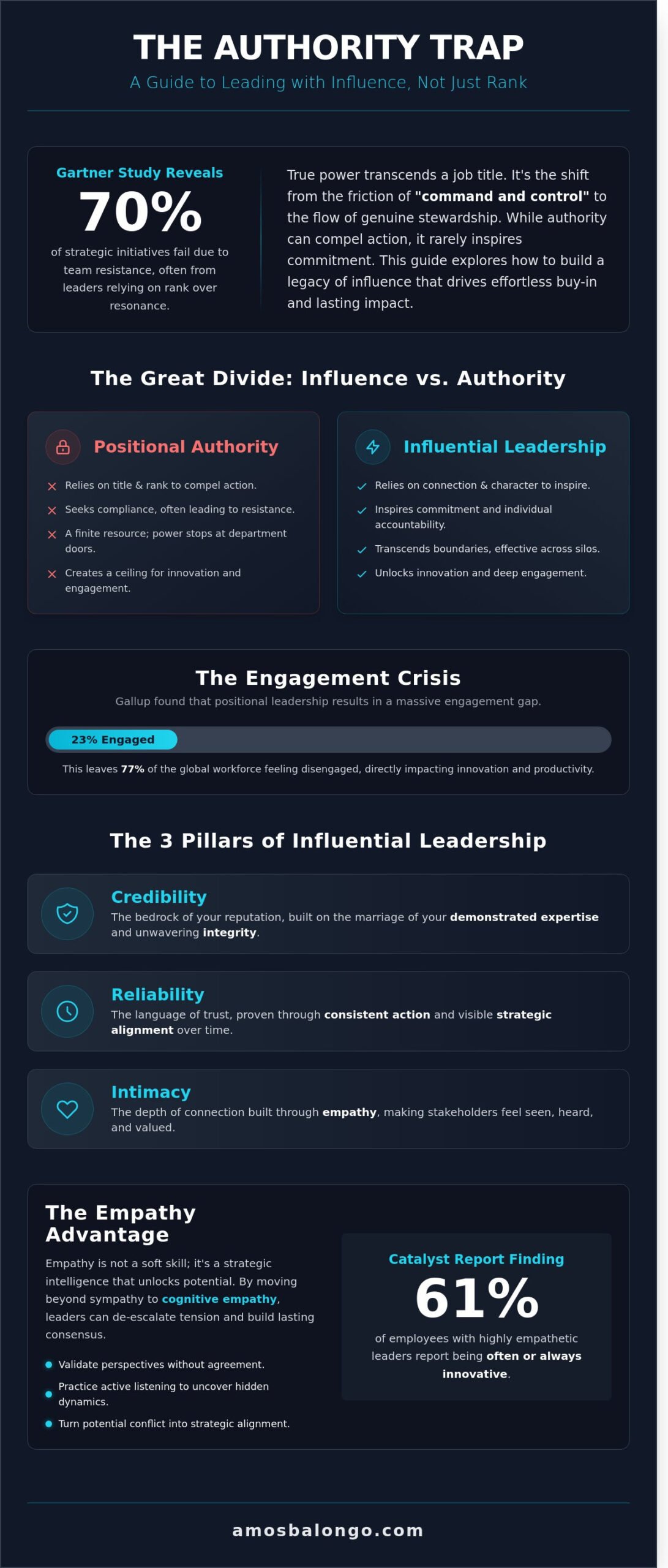
What if your executive title is the very thing holding your vision back? True power doesn’t reside in the gold nameplate on your desk or the rigid reporting lines on an organizational chart. It lives in the quiet, intentional space between authority and inspiration. When you focus on leading with influence, you move beyond the friction of “command and control” and enter a realm of genuine stewardship. A 2023 study by Gartner revealed that 70% of strategic initiatives fail due to team resistance; this usually happens when leaders rely on their rank rather than their resonance.
You’ve likely felt the exhaustion of trying to drive alignment while feeling invisible in critical boardroom discussions. It’s a heavy burden to carry when your expertise is met with silence or hesitation. Amos Balongo Consulting Coaching developed this guide to teach you how to master the art of influential leadership to secure effortless buy-in and build a culture of accountability. We’ll examine the three pillars of impactful presence, the mechanics of strategic alignment, and the path to creating a professional legacy that transcends your current role.
Key Takeaways
- Learn to transcend the limitations of positional authority by cultivating a leadership style that prioritizes genuine connection over mere compliance.
- Discover how to leverage the “Empathy Advantage” to strengthen your executive presence and foster strategic alignment across every level of your organization.
- Develop the specific frameworks required for leading with influence within technical environments and across silos where you lack direct command.
- Implement a sophisticated communication system that balances analytical logic with emotional resonance to move stakeholders toward a shared vision.
- Shift your perspective from short-term management to long-term stewardship, focusing on the intentional creation of a meaningful leadership legacy.
Beyond the Job Title: Understanding Influence vs. Authority
Influence isn’t a demand. It’s a resonance that echoes through the halls of an organization, turning a group of individuals into a unified force for excellence. While authority relies on the power of a title to compel action, Understanding Influence vs. Authority reveals that true impact stems from inspiration. Positional power is a finite resource. It buys you time, but it doesn’t buy you hearts. When a leader relies on their rank, they often settle for compliance. This is the shadow of the Commander. The Influencer, however, seeks commitment, a deep-seated drive that moves people to act because they believe in the vision, not because they fear the consequence.
The Commander operates through dictate and control. The Influencer operates through connection and character. In the modern boardroom, the old command-and-control models are crumbling. They’re being replaced by a more profound philosophy: leadership stewardship. This is the understanding that your role isn’t to own a team, but to manage the influence you’ve been given for the benefit of the collective. It’s about personal transformation that leads to organizational growth. When you prioritize leading with influence, you’re building a legacy that outlasts your tenure.
The Limitations of Positional Authority
Relying on “because I said so” is a losing strategy for any executive. A 2023 study by Gallup found that only 23% of global employees feel truly engaged at work. This engagement gap is the direct result of leaders leaning too heavily on their titles. Authority creates a ceiling for innovation. In a flat organization, where 70% of communication is cross-functional, your title carries little weight outside your direct reporting line. If your power stops at your department’s door, it isn’t power at all. It’s just a label. Understanding why your title is not your leadership is crucial for executives who want to create lasting transformation. True leading with influence transcends these boundaries, allowing you to drive results through trust rather than hierarchy.
The Three Pillars of Influential Leadership
To elevate your impact, you must cultivate three essential pillars that form the foundation of trust. These principles are central to the work we do at amosbalongo.com to develop visionary leaders:
- Credibility: This is the bedrock of your reputation. It’s the marriage of your demonstrated expertise and your unwavering integrity.
- Reliability: Consistency is the language of trust. Your strategic alignment must be visible in every action you take over time.
- Intimacy: This isn’t about oversharing; it’s about empathy. It’s the depth of connection you build with stakeholders that makes them feel seen and valued.
When these pillars are strong, your influence becomes an unstoppable force for good.
The Architecture of Influence: Empathy and Executive Presence
True leadership transcends the organizational chart. It lives in the quiet spaces between a directive and a result. When we speak about leading with influence as an essential leadership skill, we’re discussing the intentional stewardship of human capital. This architecture rests on two pillars: the depth of your empathy and the weight of your presence. It’s a discipline that demands you see the person behind the professional, ensuring your vision resonates at a soul level.
Mastering the Empathy Advantage
Empathy isn’t a soft skill; it’s a strategic intelligence. A 2023 report by Catalyst found that 61% of employees with highly empathetic leaders report being often or always innovative. You must move beyond sympathy into cognitive empathy. This involves validating a colleague’s perspective without necessarily agreeing with their conclusion. By practicing active listening, you identify the “invisible dynamics” that dictate boardroom behavior. This allows you to uncover the real objections hidden beneath surface-level concerns, turning potential conflict into a moment of strategic alignment. Emotional intelligence becomes the tool that de-escalates tension and builds a lasting consensus. Understanding empathy in leadership as strategic stewardship of human potential transforms this capacity from a passive sentiment into a rigorous discipline that secures your executive legacy.
Cultivating Command and Recognition
Executive presence is the intersection of poise and intentionality. It’s how you hold the space in a high-stakes environment. Research indicates that 55% of your message is conveyed through body language and vocal tonality. Your voice must project a calm confidence that invites trust rather than demanding compliance. High-influence leaders ensure their contributions are felt through strategic visibility, focusing on the human element of every decision. Mastering the art of leading with influence isn’t about being the loudest person in the room. It’s about being the most grounded. To refine these internal capacities, many executives seek to elevate their leadership legacy through dedicated mentorship. This intentionality ensures your impact transcends your tenure, creating a footprint of excellence that others feel compelled to follow.
Navigating Invisible Dynamics: Influencing Across Silos and Tech Teams
True leadership isn’t a title. It’s a commitment to the stewardship of collective potential. In high-performance environments, particularly those heavy with technical expertise, the traditional levers of power often fail. You cannot command innovation; you must invite it. Influential leadership requires you to transcend the boundaries of your own department to foster a culture of shared excellence. When we break down the “Silo Effect,” we’re not just moving data between teams. We’re aligning the soul of the organization toward a singular, global impact.
Influencing Without Direct Reports
Horizontal leadership is the hallmark of a sophisticated executive. In matrixed organizations, your ability to move projects forward depends on social capital you’ve cultivated long before a deadline looms. A 2023 study by the Project Management Institute revealed that 71% of high-impact projects succeed primarily due to strong stakeholder alignment rather than formal authority. You must treat every interaction as an opportunity to build trust.
- The Pre-Meeting Strategy: Never enter a boardroom expecting to win an argument. Instead, engage key stakeholders individually. This creates a space for honest dialogue and ensures your vision is a shared one.
- Value Exchange: Identify what your peers value most. If the marketing team needs data to prove ROI, provide it. Your influence grows when you become a catalyst for their success.
By focusing on these invisible dynamics, you transition from a manager of tasks to a curator of relationships. You can find more resources on developing this mindset at amosbalongo.com.
Leading Technical Minds with Influence
Technical experts and engineers often resist traditional authority because their loyalty lies with logic and craftsmanship. They don’t want a boss; they want a partner who respects the integrity of their work. Research from the Harvard Business Review indicates that 60% of technical professionals feel their strategic contributions are misunderstood by executive leadership. To bridge this gap, you must translate complex engineering requirements into long-term business value.
Leading with influence in this space means anchoring every request in the “why.” Don’t just ask for a faster system. Explain how that speed secures the company’s legacy by serving 1 million more users with excellence. When you frame technical challenges as a mission of stewardship, you empower individual accountability. It’s about moving from a culture of compliance to one of deep, intentional contribution. This approach doesn’t just deliver code; it builds a foundation for lasting transformation.
The Communication Mastery System: Frameworks for Persuasion
Leading with influence requires more than charisma; it demands a structured architecture for human connection. The Communication Mastery System serves as your strategic vehicle for this transformation. It moves beyond the simple exchange of information to the intentional cultivation of shared conviction. When you utilize this system, you aren’t just delivering a message; you’re acting as a steward of a larger vision that invites others into a legacy of excellence. Persuasion is not about manipulation. It’s about aligning the soul of the organization with the logic of the boardroom.
A 5-Step Framework for Influential Dialogue
- Step 1: Alignment. You must establish common ground immediately. A 2023 analysis of executive negotiations found that 82% of successful outcomes began with a clear statement of shared strategic goals.
- Step 2: Inquiry. Use probing questions to surface hidden concerns. You can’t lead where people feel unheard.
- Step 3: Reframing. Position your idea as the specific solution to their pain. Transform “my proposal” into “our solution.”
- Step 4: Evidence. Anchor your proposal in data. Citing a 15% increase in efficiency from previous quarters provides the intellectual rigor necessary for buy-in.
- Step 5: Commitment. Invite a clear, actionable next step. Ambiguity is the enemy of influential leadership.
The Art of Storytelling for Leaders
Many executives fall into the trap of “data dumping,” yet research shows that stories are 22 times more memorable than facts alone. Moving toward narrative-driven leadership allows you to simplify complex visions without losing their strategic depth. You must craft an “Origin Story” for every new initiative to build emotional buy-in. This narrative explains the “why” behind the “what,” connecting the project to the organization’s long-term global impact. A leader uses story to bridge the gap between complex technical requirements and the visceral human desire to contribute to something greater than themselves.
Handling pushback is where your calm confidence truly shines. Difficult questions aren’t obstacles; they’re opportunities for deeper strategic alignment. Data from the McKinsey Global Institute indicates that leaders who respond to dissent with curiosity rather than defensiveness see a 25% higher rate of team engagement. By maintaining your composure, you demonstrate that you’re a steward of the mission rather than a defender of your own ego. This approach allows you to lead with influence by turning skeptics into collaborators through the power of reasoned, visionary dialogue. When unexpected questions arise in high-stakes meetings, your ability to respond with clarity and conviction becomes even more critical—this is where mastering impromptu speaking as a leader transforms potential moments of vulnerability into demonstrations of executive presence.
To further refine your ability to inspire and guide your organization, you can master the art of strategic leadership through our executive resources.
From Management to Stewardship: Building a Legacy of Influence
True leadership transcends the immediate gratification of a successful quarter. It requires a fundamental shift in perspective. You must move from the mindset of a manager who controls resources to a steward who nurtures potential. When you’re leading with influence, your focus expands beyond the balance sheet to the human lives under your care. This isn’t a soft approach to business; it’s a rigorous commitment to excellence that ensures your impact outlives your tenure. Legacy isn’t something you leave behind at the end of a career. It’s something you build every single day through intentionality and vision.
The transition from being a star performer to a maker of stars is the ultimate test of an executive. It requires humility to step out of the spotlight and discipline to let others shine. This evolution creates a sustainable leadership culture. You aren’t just hitting targets; you’re building an ecosystem where high performance is the natural result of shared purpose. A 2024 analysis of executive performance suggests that leaders who prioritize talent development over personal accolades see a 40 percent higher rate of internal promotion within their teams.
Leadership as a Noble Calling
Leadership is a sacred trust. You’re the steward of organizational potential, responsible for aligning the talents of your team with a higher mission. This requires integrating your personal values into your professional strategy. Authentic influence is born when your actions match your words. It’s about being the same person in the boardroom as you are in your private life. You can explore more on this topic in the Transformational Podcast, where we dive into the heart of purposeful leadership.
Mastering Your Global Footprint
Your global footprint is determined by the lives you touch, not just the contracts you sign. While quarterly reports provide a snapshot of progress, they don’t capture the lasting impact of your mentorship. Individual accountability serves as the catalyst for this change. Every interaction is an opportunity to elevate those around you. Consider these pillars for building your legacy:
- Focus on the transformation of your people, not just the completion of tasks.
- Cultivate a culture of accountability that survives your departure.
- Practice radical integrity in every strategic decision.
The time to refine your impact is now. Your voice is your most powerful tool for leading with influence and shaping the future of your organization. Whether you’re delivering a prepared presentation or responding to unexpected challenges, your communication skills define your leadership legacy. The moments when you’re called upon to speak without preparation often reveal the most about your character and vision—developing expertise in impromptu speaking for leaders ensures you’re always ready to inspire confidence and articulate your vision with clarity. Inquire about the Communication Mastery System to transform your leadership trajectory and start building a legacy that truly matters.
Stepping Into Your Global Legacy
True leadership isn’t found in a title or a seat at the head of the table. It’s found in the quiet strength of stewardship. You’ve explored how empathy and executive presence bridge the gap between organizational silos. You’ve seen how framework-driven communication turns resistance into strategic alignment. Now, it’s time to move beyond the limits of your authority. Influential leadership requires a shift from managing tasks to empowering people. It’s about the human element of high performance.
For 18+ years, I’ve partnered with military officers and tech executives to refine this craft. These leaders don’t rely on rank; they rely on resonance. They understand that excellence is a habit and legacy is a choice. By applying the proven Communication Mastery System, you’ll transcend the noise of the boardroom and create a lasting global footprint. Your influence is your greatest asset. It’s the engine of your transformation. You have the vision to lead; now, you have the tools to inspire. The world is waiting for the impact only you can deliver. To develop the commanding presence that transforms potential into lasting influence, explore our comprehensive guide on executive presence and commanding influence for 2026.
Elevate your influence with the Communication Mastery System
Frequently Asked Questions
What is the main difference between influence and authority in leadership?
Authority is a formal mandate granted by a title, while influence is the voluntary alignment of others based on trust and shared vision. A 2023 study by the Center for Creative Leadership found that 75% of successful managers rely on relational influence rather than hierarchical power to drive results. You exercise authority to command compliance; however, leading with influence allows you to inspire deep commitment and long-term loyalty.
Can someone learn to lead with influence, or is it an innate trait?
Leading with influence is a disciplined craft that anyone can master through intentional practice and emotional intelligence training. Harvard Business Review reported in 2022 that leaders who underwent a 6 month coaching program improved their persuasive impact by 40%. It’s not about being born with charisma. It’s about the consistent stewardship of your character and the strategic building of social capital over time.
How can I influence my boss or senior executives above me?
To influence senior executives, you must align your proposals with their primary strategic objectives and the organization’s bottom line. Present your ideas using a 3 pillar framework of risk mitigation, revenue growth, and long-term legacy. When you demonstrate how a project secures a 15% increase in operational efficiency, you transition from a subordinate to a strategic partner who understands the weight of executive responsibility.
What are the most effective persuasion techniques for tech leaders?
Tech leaders persuade effectively when they bridge the gap between technical data and human impact. Use the Data-Story-Action model where you present a 99.9% uptime metric not just as a number, but as the foundation for customer trust and brand longevity. By grounding your technical requirements in the broader mission of the firm, you transform cold code into a vehicle for global transformation and excellence.
How do I build influence in a remote or hybrid work environment?
Building influence in a hybrid world requires a shift from accidental proximity to intentional connection. Schedule 15 minute weekly alignment sessions that focus on the person rather than the task. A 2021 Microsoft Work Trend Index showed that leaders who prioritized these micro-connections saw a 25% increase in team cohesion. Consistent digital presence and clear, transparent communication are the currencies of trust in a distributed workforce. Developing strong executive presence in virtual environments becomes even more critical when physical proximity is limited.
Is it possible to lead with influence without being an extrovert?
Introverts excel at influence because they often possess the gift of deep, empathetic listening and deliberate reflection. Research from the Wharton School suggests that introverted leaders can outperform extroverts by 20% when managing proactive teams. By focusing on one-on-one mentorship and the quiet power of strategic insight, you create a lasting impact that doesn’t require a loud voice to be heard or respected.
What should I do if my attempts to influence are met with resistance?
When your attempts to influence meet resistance, pause to diagnose the root cause using the 5 Whys method. Resistance is often a signal of unmet needs or fear of change rather than a personal rejection of your vision. Address the 3 common barriers of perceived risk, lack of clarity, or misaligned incentives. This patient approach transforms a conflict into an opportunity for deeper strategic alignment and mutual respect.
How does empathy actually improve my ability to influence results?
Empathy is the bridge that connects a leader’s vision to the heart of the team, fostering the psychological safety necessary for high performance. Google’s Project Aristotle study in 2012 revealed that empathy was the primary driver in the most successful teams, leading to a 30% boost in innovation. When you lead with empathy, you’re not just being kind; you’re strategically empowering your people to contribute their best work toward a shared legacy.