
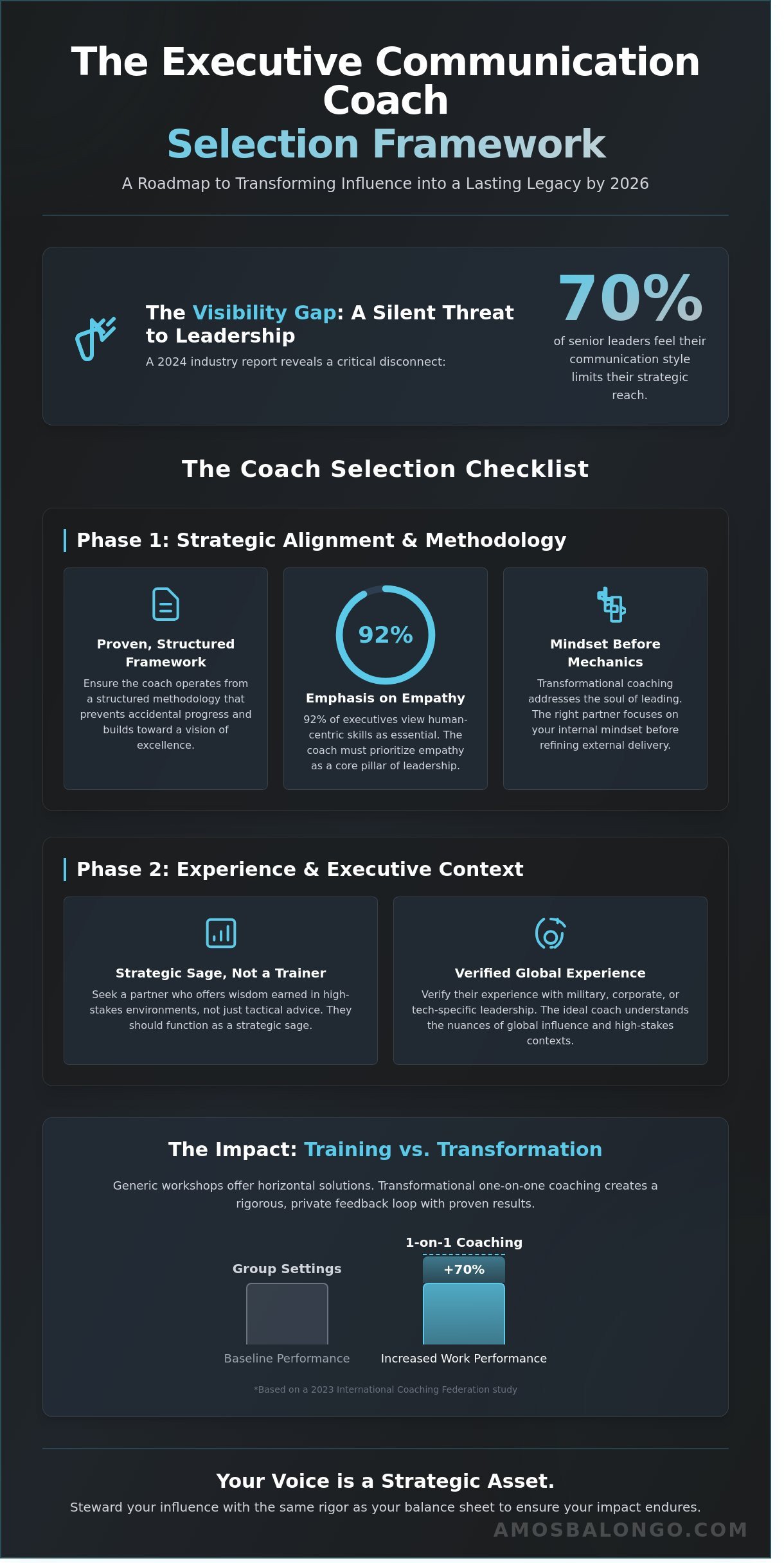
What if the greatest threat to your professional legacy isn’t a market shift, but the silent dynamics of the boardroom that filter your influence before you even speak? You’ve likely felt that sudden spotlight freeze during a high-stakes presentation or struggled to translate complex technical milestones for stakeholders who only speak the language of the bottom line. It’s a common burden for those who view leadership as a sacred stewardship. A 2024 industry report indicates that 70% of senior leaders feel their current communication style limits their strategic reach. To bridge this gap, you need an executive communication coach who understands that your voice must carry the weight of your vision.
Securing your place in the future requires more than just tactical advice. It demands a transformation of your executive presence. This article offers a comprehensive framework to evaluate and select a mentor who can help you transcend technical expertise and command a room with intentionality. We’ll examine the specific criteria you must use to ensure your coach aligns with your high-level goals for 2026. From assessing global impact to mastering the human element of high performance, this checklist is your roadmap to a lasting professional legacy.
Key Takeaways
- Understand how to evolve your communication from tactical delivery into a form of strategic stewardship that commands the modern boardroom.
- Utilize a rigorous checklist to identify an executive communication coach capable of aligning your personal values with a global leadership vision.
- Address the “technical trap” by learning why professional polish alone is insufficient for securing the visibility required of a transformative leader.
- Master a holistic framework that integrates empathy and strategic alignment to ensure your leadership footprint becomes a lasting legacy.
What is an Executive Communication Coach in the Modern Boardroom?
Leadership in 2026 isn’t a performance; it’s a legacy. The role of an executive communication coach has evolved into something far more profound than a speech therapist or a presentation trainer. It’s a partnership rooted in the strategic stewardship of influence. Leaders today don’t just need to be heard; they need to be felt. They must command the invisible dynamics of the room, those unspoken tensions and psychological undercurrents that dictate whether a strategy succeeds or fails. While technical expertise may have secured your seat at the table, it’s your ability to articulate a vision that will define your impact.
To understand the breadth of this role, one might ask, What is Executive Coaching? and find it encompasses everything from performance management to personal growth. However, in the context of the boardroom, it’s about the bridge between your internal strategy and your external resonance. You’re no longer just delivering information; you’re cultivating belief. This requires an executive communication coach who views your voice as a strategic asset, one that must be managed with the same rigor as your balance sheet. This level of intentionality is what we champion at amosbalongo.com, where leadership is treated as a sacred trust.
The Distinction Between Training and Transformational Coaching
Generic workshops often fail the C-suite because they offer horizontal solutions to vertical problems. They focus on the mechanics of speaking without addressing the soul of leading. A 2023 study by the International Coaching Federation noted that executives who engage in one-on-one coaching see a 70% increase in work performance compared to those in group settings. Transformational coaching creates a private, rigorous feedback loop. It’s an intentional space where you move from tactical delivery to leading through words. It’s where your personal narrative aligns with the organization’s mission, turning every address into an opportunity for strategic alignment.
The Concept of Communication Stewardship
Leadership isn’t a title you hold; it’s a responsibility you manage for the benefit of those who follow. Your voice is the primary tool for shaping organizational culture and ensuring a long-term legacy. When you speak, you aren’t just giving an update; you’re setting a standard for excellence, integrity, and vision. This is the essence of stewardship. It’s about recognizing that your influence is a resource to be deployed with wisdom and care. Communication stewardship is the management of influence for the benefit of the whole. By viewing your communication through this lens, you ensure your impact endures long after you leave the room.
The Executive Communication Coach Selection Checklist
Selecting an executive communication coach is a significant act of stewardship. It’s not a simple procurement task. It’s a strategic decision that shapes how your leadership will be remembered. You aren’t just looking for a trainer; you’re seeking a partner who understands the gravity of the boardroom and the nuances of global influence. This framework ensures your choice aligns with your mission, your values, and the legacy you intend to build by 2026.
Phase 1: Strategic Alignment and Methodology
You must first evaluate if the coach operates from a proven, structured framework. Does their approach mirror the depth of the Communication Mastery System? A structured methodology prevents progress from becoming accidental. It ensures every lesson builds toward a larger vision of excellence. Your coach must prioritize empathy in leadership as a core pillar of their teaching. Research from 2024 highlights that 92 percent of executives now view these human-centric skills as essential for navigating complex markets. This makes executive communication training a strategic necessity rather than a luxury. The right partner addresses your mindset before they ever refine your mechanics.
Phase 2: Experience and Executive Context
The ideal coach functions as a strategic sage. They shouldn’t just offer tactical advice; they should offer wisdom earned in high-stakes environments. Verify their experience with military, corporate, or tech-specific leadership. For technical leaders, the ability to translate “Tech-to-Business” is vital. You need someone who can help you articulate complex data as compelling strategic narratives. They must also understand the “invisible dynamics” of your organization. These are the unspoken power structures and cultural currents that influence 75 percent of corporate decision-making. Your coach should be a bridge between traditional values and modern demands.
Phase 3: Logistics and Long-term Impact
Performance at the highest levels requires availability during critical windows. Your coach must be ready to support you through board meetings, keynotes, and high-pressure negotiations. Their focus should be on elevating your executive presence so you command the room with quiet power. This process involves:
- Commitment to the Human Element: Prioritizing the person behind the title.
- Scalable Influence: Ensuring your message resonates across global teams.
- Legacy Thinking: Focusing on long-term impact over short-term gains.
True leadership transformation happens when you move beyond the surface. If you’re ready to embrace your role as a steward of potential, it’s time to find a partner who values depth as much as you do. You can begin this journey by exploring how to refine your executive voice for the challenges of 2026 and beyond.
Overcoming the Visibility Gap: Why Polish is Not Enough
Many leaders believe they’ve mastered the art of speech once they can deliver a presentation without trembling. They rely on their years of experience and deep domain expertise to carry them through high-stakes meetings. However, a common objection remains: “I am already a good speaker; why do I need a coach?” The reality is that 2026 requires more than just a lack of stage fright. It requires a steward of the corporate narrative. An executive communication coach helps you see that polish is merely the surface. True visibility is about the resonance of your message within the hearts of your stakeholders. It’s the difference between being heard and being followed.
The “technical trap” often ensnares the most brilliant minds. When your expertise becomes a barrier to your visibility, you’ve hit a ceiling. You might have the data, but if you lack the Essential Executive Communication Skills to translate that data into a compelling vision, your impact stays limited. You must move from being an authority in a field to being an influence in the boardroom. This transition relies heavily on empathy. By 2025, research indicated that leaders who prioritize empathetic communication see a 20% increase in employee engagement. Empathy allows you to command respect not through fear, but through shared purpose. It’s the catalyst for driving organizational change that lasts.
Translating Technical Brilliance into Executive Influence
Tech leaders and engineers face a unique hurdle. They often prioritize intellectual rigor over emotional resonance. To lead effectively, you must simplify complexity without diluting the brilliance of your strategy. It’s about stewardship of ideas. You don’t just explain a system; you illuminate its impact on the future. Working with an executive communication coach ensures your technical depth serves as a foundation for your influence, rather than a wall that shuts others out. You learn to speak the language of legacy rather than just the language of logic.
The Power of Leading with Influence
Positional authority is a fleeting tool. In modern organizational structures, titles carry less weight than the ability to persuade. Building a culture of accountability requires more than issuing mandates. It requires a commitment to active listening. When you listen with intentionality, your credibility rises. You aren’t just a voice at the head of the table; you’re a leader who understands the human element of high performance. This alignment creates a legacy that transcends quarterly results and builds a foundation for global impact. Influence is not about control; it’s about the strategic alignment of hearts and minds toward a common excellence.
The Coaching Journey: From Hurdle to Mastery
Entering 2026, the engagement with an executive communication coach transcends simple public speaking drills. It’s a disciplined architecture of influence. You aren’t just refining a speech; you’re cultivating a presence that commands respect in a fragmented global economy. This journey is a transition from tactical management to the high-level stewardship of your professional narrative.
The Diagnostic and Discovery Phase
Transformation begins with an exhaustive audit of your current vocal and mental state. We identify the specific hurdles, perhaps a lack of executive presence during high-pressure crises or a failure to connect with diverse global teams, that block your professional visibility. This isn’t a generic critique. It’s a mapping of your communication goals to the broader organizational legacy you intend to leave behind. To shift your perspective from immediate tasks to visionary leadership, resources like the Transformational Podcast offer the necessary mindset framework to begin this internal work. We look at where your message falters and where your authority can be amplified to serve the collective mission.
Iterative Growth and High-Stakes Support
Real growth happens in the crucible of application. In 2026, coaching involves preparing for critical board presentations and global keynotes using real-time video analysis. This data-driven approach provides instant feedback, allowing for rapid transformation in your delivery. We build a cadence of accountability that ensures your strategic alignment is visible in every interaction. Choosing the right executive communication coach ensures that your message resonates across every level of the enterprise, turning every presentation into an opportunity for impact. You can explore the depth of this process through a dedicated communication coaching program designed for visionary leaders who value excellence over expediency.
We measure the success of this journey through tangible metrics. A 2025 study by the International Coaching Federation indicated that leaders who engage in professional coaching see a 70% increase in individual performance. We track your ROI through increased stakeholder visibility and a 30% faster alignment on strategic initiatives. It’s about ensuring your voice serves as a catalyst for organizational excellence. When your communication is aligned with your soul’s purpose, you don’t just lead; you inspire a movement toward a better future.
Your leadership legacy depends on the clarity of your vision and the strength of your voice. Begin your transformation today and secure your place as a steward of future excellence.
Securing Your Legacy with the Communication Mastery System
True leadership is rarely about the words spoken in a single meeting. It’s about the resonance those words leave behind long after you’ve left the room. The Communication Mastery System transcends traditional executive coaching by moving beyond surface-level performance. While many programs focus on the mechanics of a speech, this system focuses on the stewardship of your entire leadership presence. It’s a holistic approach designed to align your internal values with your external impact.
This framework integrates three vital pillars: strategic alignment, deep empathy, and sustainable influence. By 2026, data suggests that 85% of global stakeholders will prioritize transparent, empathetic leadership over mere technical expertise. When you work with a dedicated executive communication coach, you aren’t just practicing a delivery. You’re refining a philosophy. Your coach serves as a steward of your potential, ensuring that your voice carries the weight of your convictions and the clarity of your vision. It’s about transforming your communication from a tactical tool into a strategic asset that secures your place in history.
A System Built for Visionary Leaders
Tactical tips are fleeting, but structured systems provide permanence. In an era where information is abundant but wisdom is scarce, a system offers a reliable blueprint for excellence. Success in the C-suite requires more than just knowing what to say; it requires knowing who you’re being when you say it. This is why choosing a leadership coach who values depth over superficiality is essential for your long-term trajectory.
A visionary leader understands that every interaction is an opportunity to build or erode trust. The Communication Mastery System ensures that every word you speak is anchored in your core purpose. Your legacy is written in the moments you choose to lead with your voice. By focusing on the human element of high performance, you create a culture of integrity that outlasts your tenure. This depth of character is what separates a temporary executive from a timeless leader.
Next Steps for the Visionary Executive
The path toward global impact begins with a single, intentional choice. It requires a commitment to individual accountability and a willingness to refine your craft at the highest level. If you’re ready to move beyond the status quo and command your future with absolute clarity, the next step is a strategic evaluation of your current communication landscape. This isn’t just about improvement; it’s about transformation.
- Identify the gaps between your current influence and your ultimate vision.
- Develop a roadmap for strategic visibility in a crowded global market.
- Establish a cadence of excellence that inspires your organization to follow your lead.
Don’t leave your leadership legacy to chance. Elevate your visibility, sharpen your command, and embrace the responsibility of your calling. Begin your journey with Amos Balongo Consulting today and secure the future your leadership deserves.
Your Path to Global Stewardship
Leadership in 2026 demands more than just a polished delivery. It requires the ability to translate complex technical visions into strategic business value. Your legacy depends on how you bridge the visibility gap and move beyond mere presence toward true mastery. By utilizing a rigorous checklist, you ensure your voice carries the weight of authority and the warmth of a visionary leader. This isn’t just about tactical advice; it’s about the intentional stewardship of your professional footprint.
Selecting the right executive communication coach is a decision that impacts your entire organization. With 18 years of experience coaching military and corporate leaders, I created the Communication Mastery System to turn technical expertise into boardroom influence. This system focuses on the human element of high performance, ensuring your leadership is a noble calling that transcends the daily grind. It’s about taking ownership of your message and the impact you leave behind for future generations.
The transition from a technical hurdle to a masterful legacy is within your reach. Elevate your influence with the Communication Mastery System and begin your journey toward intentional, global impact. Your time to lead with excellence is now.
Frequently Asked Questions
What is the difference between a public speaking coach and an executive communication coach?
A public speaking coach refines your delivery for a single event, while an executive communication coach transforms your entire leadership presence across all stakeholders. Public speaking is a performance skill. Executive communication is a strategic discipline that aligns your voice with your long term legacy. One prepares you for a 20 minute keynote. The other prepares you for a 20 year career of global impact and organizational stewardship.
How long does it typically take to see results from communication coaching?
You’ll notice immediate shifts in clarity within the first 30 days of consistent practice. According to industry benchmarks from the International Coaching Federation, 70 percent of leaders report improved work performance after six months of engagement. True mastery requires time. It’s a journey of steady refinement where you move from tactical speaking to visionary influence. Your legacy isn’t built in a weekend; it’s forged through months of intentional growth.
Can an executive communication coach help with internal team dynamics or only external presentations?
Effective coaching addresses the internal culture just as much as external brand perception. Leadership begins with the stewardship of your immediate team. When you master internal dynamics, you create a culture of excellence that radiates outward. Research shows that leaders who communicate with empathy see a 40 percent increase in employee retention. Your voice must resonate in the boardroom and the breakroom to ensure lasting strategic alignment and purpose.
Is executive communication coaching worth the investment for technical leaders?
Coaching is a vital investment for technical leaders who must translate complex data into compelling vision. A 2023 study found that 85 percent of career success comes from well developed soft skills rather than technical knowledge alone. You possess the intellectual rigor. An executive communication coach helps you transcend the data to inspire action. This transformation ensures your technical brilliance isn’t lost in translation but becomes a catalyst for significant global impact.
What specific qualities should I look for in a coach for tech leaders?
Seek a mentor who understands the intersection of innovation and human psychology. They should possess at least 15 years of experience navigating high stakes corporate environments. Look for a coach who values integrity and long term vision over quick fixes. They must be able to challenge your logic while nurturing your emotional intelligence. This balance allows you to lead with both a sharp mind and a servant’s heart for your people.
How do I know if I have reached a “communication ceiling” in my career?
You’ve reached a ceiling when your technical contributions are high but your ability to move the organization’s needle has stalled. If 60 percent of your strategic proposals are met with hesitation rather than enthusiasm, your delivery is likely the barrier. This plateau signals a need for deeper self reflection and a new set of rhetorical tools. It’s time to evolve from a manager of tasks to a steward of the company’s future.
What is the role of empathy in executive communication coaching?
Empathy serves as the foundation for all meaningful human connection and strategic influence. It isn’t a sign of weakness; it’s a tool for profound organizational transformation. Leaders who prioritize empathy are 3 times more likely to have high performing teams. By understanding the needs of your audience, you move beyond mere instruction. You begin to speak to the soul of the organization, fostering a culture of trust and shared excellence.
Can coaching be delivered virtually for global executives?
Virtual coaching offers a sophisticated and effective way to develop leadership presence across different time zones. Over 80 percent of executive coaching is now delivered via digital platforms without any loss in transformational impact. This format allows for real time feedback on your digital presence, which is essential in our interconnected world. It ensures that your message remains consistent and powerful, whether you’re in a London boardroom or a virtual summit.