
What if your enduring legacy as a leader is determined not by the speeches you prepare, but by the sixty seconds of truth that follow an unscripted question? You’ve likely experienced that sharp intake of breath when a board member asks for a pivot strategy you haven’t rehearsed, or when a team looks to you for clarity amidst a sudden market shift. Understanding what is impromptu speaking goes beyond simple definitions; it’s about maintaining your 15 years of hard-earned credibility when the stakes are highest. Most executives view these instances as hurdles to survive, yet they’re actually the highest form of leadership stewardship.
In this guide, we’ll master the art of spontaneous influence to ensure your words always carry the weight of your vision. I’ll show you how to transform every unexpected inquiry into a strategic opportunity that inspires your team and reinforces your global impact. We’ll examine the mental frameworks necessary to maintain a commanding presence and the structural tools that ensure your unscripted words always align with your long-term goals. You’ll gain the clarity to lead with excellence, even when you don’t have a script.
Key Takeaways
- Redefine what is impromptu speaking by moving beyond casual chatter to embrace a disciplined form of strategic leadership stewardship.
- Identify the “invisible dynamics” within the boardroom and networking corridors to maintain an air of calm authority during unscripted moments.
- Utilize structured mental scaffolding, such as the P.R.E.P. method, to ensure your spontaneous responses remain professional, polished, and profoundly impactful.
- Overcome the fear of “blanking out” by adopting the Empathy Advantage, shifting your focus from individual performance to the essential needs of your audience.
- Learn how a dedicated Communication Mastery System can refine your spontaneous voice and transform every unexpected question into an opportunity for global influence.
Defining Impromptu Speaking: The Art of Spontaneous Stewardship
Leadership isn’t always found in the polished slides of a quarterly review or the rehearsed lines of a keynote address. It lives in the unexpected hallway conversation, the sudden press inquiry, or the unscripted moment after a board meeting concludes. To understand what is impromptu speaking, we must look beyond the simple act of talking without a script. It’s the delivery of a message without prior notice or formal preparation. For the high-level executive, this isn’t merely “spur-of-the-moment” chatter; it’s Strategic Impromptu Leadership. It’s the ability to synthesize years of experience into a coherent, persuasive narrative in seconds.
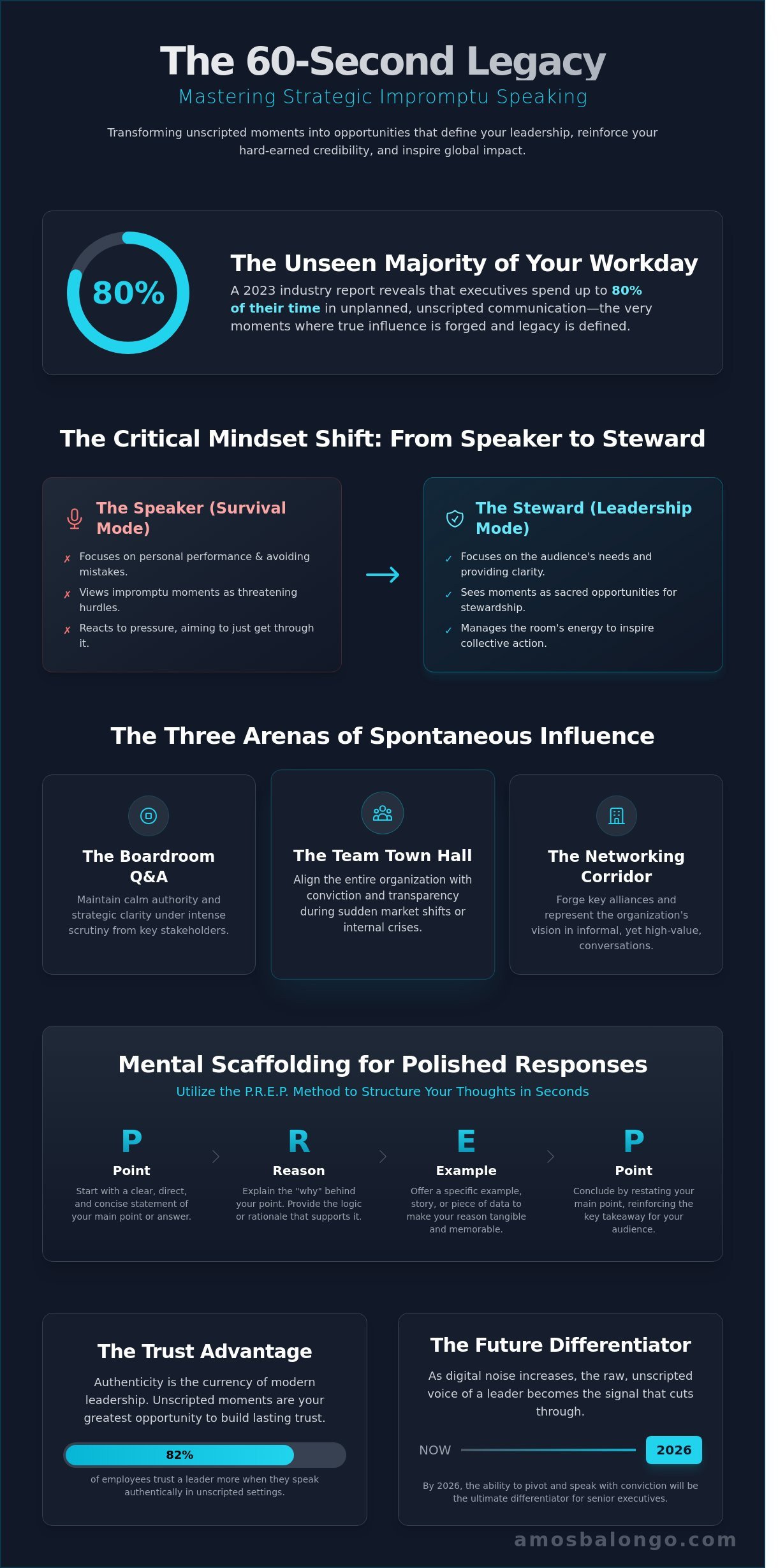
This skill represents a form of communication stewardship. You aren’t just filling silence; you’re managing a sacred moment for the benefit of your audience. When a leader speaks spontaneously, they’re acting as a guardian of the organization’s vision. By 2026, the ability to pivot instantly and speak with conviction will be the ultimate differentiator for senior executives. As digital noise increases, the raw, unscripted voice of a leader becomes the only frequency that cuts through the static. Impromptu speaking is a tool for immediate organizational alignment that transforms potential anxiety into collective action.
The Executive Definition: Beyond the Script
For a leader, this discipline is the intersection of deep expertise and real-time empathy. When executives ask what is impromptu speaking in a professional context, they’re really asking how to maintain authority when the script disappears. It’s fundamentally different from extemporaneous speaking, which allows for brief notes or structured preparation time. In the context of impromptu speaking, you’re drawing from a well of internal wisdom cultivated over decades. A 2023 industry report found that executives spend up to 80% of their workday in unplanned communication. This reality demands a shift from being a “speaker” to being a “steward” of the message. It’s about being present enough to hear what isn’t being said and courageous enough to address it.
Why Spontaneity Is a Leadership Calling
Spontaneous moments reveal a leader’s true character. When the teleprompter fails or a crisis emerges, the mask of corporate branding falls away. This is where legacy is forged. Tech leaders in 2025 have already begun using these moments to bridge the gap between complex data and human connection. They recognize that a 10-minute unscripted town hall often carries more weight than a 50-page annual report. Research suggests that 82% of employees trust a leader more when they speak authentically in unscripted settings. It’s a calling to serve the moment with integrity. You can learn more about this by Leading with Influence and embracing the weight of your words. You’re anchoring your team in a vision that transcends the immediate pressure of the boardroom, ensuring that every word spoken contributes to a lasting global footprint.
The Anatomy of an Impromptu Moment in High-Stakes Leadership
The essence of leadership is often tested in the silence between prepared remarks. Understanding what is impromptu speaking requires looking beyond the words to the three primary arenas where influence is forged: the Boardroom Q&A, the Town Hall, and the Networking Corridor. In these spaces, the invisible dynamics of power are most visible. When a leader faces an unscripted question, the audience isn’t just listening for a factual answer. They’re observing your physiological state, your eye contact, and your ability to remain unruffled under scrutiny.
The shift from internal panic to a strategic response is a hallmark of the seasoned executive. It’s a transition from a survival mindset to one of stewardship. Instead of reacting to the pressure, you’re managing the energy of the room. Even when the honest answer is “I don’t know,” an effective leader maintains presence by anchoring their response in a commitment to excellence and a promise of follow-up. This transparency, delivered with steady breath and clear tone, builds a lasting legacy of trust.
Executives can utilize Strategic Frameworks for Polished Spontaneous Communication to structure their thoughts in real-time. These frameworks allow you to move from the abstract to the concrete without losing your composure or your connection to the audience.
The Boardroom Q&A: Defending the Vision
In the boardroom, brevity is your greatest ally. Stakeholders probe strategic decisions not to catch you off guard, but to test the depth of your conviction. When faced with aggressive questioning, respond with intentionality and calm. Your goal isn’t to win an argument but to align the board with the long-term mission. This level of Executive Presence ensures that even under fire, your authority remains untarnished and your vision stays clear.
Spontaneous Influence for Tech Leaders
For those in technical leadership, the challenge lies in translation. You must simplify complex hurdles for non-technical boards without losing the nuance of the problem. Use the human element to bridge the gap. By focusing on how a technical update impacts the organizational legacy or the end-user experience, you transform a dry update into an inspiring vision. This approach is a core component of the Communication Mastery System, which helps leaders elevate their influence across global markets.
A study by the Graduate Management Admission Council in 2023 found that 81% of employers value communication as the most essential skill for leadership roles. Mastering the unscripted moment is how you prove that value in real time. If you’re ready to refine your voice and lead with greater impact, consider exploring how to elevate your strategic influence today.
Strategic Frameworks for Polished Spontaneous Communication
True leadership requires an architecture for the mind. When we consider what is impromptu speaking, we aren’t discussing the art of rambling; we’re discussing the discipline of structured thought. These frameworks serve as mental scaffolding. They prevent the cognitive overload that often leads to Overcoming Spontaneous Paralysis during high stakes interactions. By relying on a proven structure, you’re free to focus on the nuances of delivery and the depth of your connection with the audience. A 2023 analysis of executive performance suggests that leaders who use structured communication are perceived as 40% more authoritative than those who speak without a clear model.
The P.R.E.P. Method: Anchoring Your Authority
The P.R.E.P. method is the gold standard for boardroom clarity. It ensures your message is delivered with precision in under 60 seconds. Starting with your “Point” immediately establishes executive weight, signaling that you value the time of your peers. Frameworks do not restrict your voice; they liberate your message.
- Point: State your primary position immediately to anchor the room.
- Reason: Provide the strategic “why” behind your stance to build logical credibility.
- Example: Offer a specific data point. Citing a 14% increase in operational efficiency grounds your theory in tangible reality.
- Point: Restate your initial position to seal the message and drive home the takeaway.
The Visionary Timeline: Past, Present, Future
During a crisis or a sudden organizational shift, a team looks to their leader for a sense of continuity. This model allows you to re-center the organization by acknowledging where you’ve been, where you are, and where the mission is headed. It transforms a moment of panic into a narrative of progress. By linking the “Future” component to the concept of legacy, you demonstrate that your stewardship of the vision remains unshaken. This approach is particularly effective when you must address an unexpected market shift or a sudden change in project scope. It turns a temporary setback into a stepping stone for long term impact.
Pros-Cons-Recommendation for Real-Time Decisions
When a decision is demanded on the spot, the Pros-Cons-Recommendation framework provides a balanced perspective that commands respect. It shows you’ve weighed the risks without being paralyzed by them. You briefly outline the benefits of a path, acknowledge the inherent risks, and then provide a clear, actionable recommendation. This level of transparency builds trust. It signals that you’re not just reacting; you’re leading with intentionality. Understanding what is impromptu speaking in this context means mastering the ability to process complex variables into a singular, decisive direction that empowers the entire organization.
Overcoming Spontaneous Paralysis: Mindset over Mechanics
The fear of “blanking out” is perhaps the most significant hurdle for any leader. It isn’t a reflection of your knowledge or competence; it’s a temporary disconnect from your sense of purpose. When you understand what is impromptu speaking at its core, you realize it’s not a performance to be judged. It’s a moment of service. A 2024 survey by Chapman University revealed that public speaking remains a top concern for 54 percent of adults, often rooted in the fear of appearing incompetent. To transcend this, you must shift your focus from your internal anxiety to the external needs of your audience.
Active listening serves as your primary “pre-preparation” tool. Most executives fail because they stop listening halfway through a question to formulate a rebuttal. This creates a strategic disconnect. By remaining fully present, you gather the raw materials needed for a profound response. You aren’t just hearing words; you’re observing the speaker’s intent and the room’s energy. This presence allows you to respond with a sense of calm authority that commands respect before you even speak.
The Empathy Advantage in Spontaneous Speech
Leaders who master the “Empathy Advantage” recognize that every question is an opportunity to solve a problem. By identifying the questioner’s underlying intent, you reduce your own anxiety. You’re no longer defending a position; you’re helping a colleague or stakeholder find clarity. This mindset bridges gaps in technical understanding and builds lasting trust. This philosophy is central to Empathy in Leadership, where the focus remains on the strategic stewardship of human potential rather than mere information exchange.
Mastering the Strategic Pause
Silence is a tool of the powerful. An executive who rushes to fill every void signals a lack of composure. A three-second gap isn’t a sign of weakness; it’s a demonstration of “Stewardship of the Moment.” It shows you value the inquiry enough to give it a considered, disciplined response. It allows the room to settle and ensures your first words carry the weight of intentionality.
- Plant your feet: Grounding your physical presence stabilizes your nervous system.
- Breathe deeply: A diaphragmatic breath at the start of a pause centers your voice.
- Maintain eye contact: Silence combined with a steady gaze projects confidence and sincerity.
Mastering what is impromptu speaking requires you to view every high-pressure moment as a chance to leave a legacy of excellence. It’s about moving beyond the mechanics of speech to the heart of leadership. To further refine your presence and command the room with quiet power, elevate your executive influence through purposeful communication.
Elevating Your Presence with the Communication Mastery System
Most leaders understand the fundamental basics of public address. They know how to prepare a slide deck or follow a teleprompter with precision. Yet, true influence occurs when the safety of the script disappears. The Communication Mastery System serves as the essential bridge between being a competent speaker and a transformational force in the boardroom. It focuses on the invisible dynamics of leadership. These are the subtle cues of tonality, presence, and energetic alignment that dictate how an audience perceives your authority. Tailored coaching refines these dynamics, ensuring your spontaneous voice carries the same weight as a prepared keynote.
When you shift from tactical speaking to becoming a Strategic Sage, you no longer fear the unknown. You welcome it. This transition allows you to inspire at will, moving your team from compliance to commitment through the power of your presence. It’s about developing the internal resonance that makes your words feel like timeless principles rather than fleeting corporate updates.
Beyond Tactics: The Journey to Mastery
High-ticket coaching acts as a powerful catalyst for senior leaders to command global recognition. It moves you past mere techniques and into the realm of intellectual discipline. While many people ask what is impromptu speaking from a technical perspective, the master communicator views it as an act of stewardship. According to a 2023 study by the International Coaching Federation, 70% of executives who engage in professional coaching report a significant increase in work performance and communication effectiveness. This journey requires a commitment to moral character and a dedication to excellence that transcends basic training. You can explore these deeper themes of leadership and personal growth by visiting the Transformational Podcast.
Your Legacy Is Defined in the Unscripted Moments
Spontaneous brilliance builds a lasting global footprint. Your legacy isn’t written in the board meetings you controlled with a pre-written script. It’s forged in the hallways, during crisis responses, and in the sudden opportunities where you must speak with conviction. A leader’s responsibility is to be ready, always. This state of readiness reflects your commitment to your organization’s future and your integrity as a visionary.
When you master what is impromptu speaking, you gain the ability to turn every interaction into a strategic win. Your voice becomes a tool for transformation, shaping the culture of your company and the industry at large. It’s an investment in your professional visibility and the legacy you’ll leave behind. To elevate your impact and secure your place as a master of influence, book a consultation for Executive Coaching today.
Command the Unscripted Future
True leadership thrives in the spaces between the bullet points of a prepared deck. It’s found in the unexpected question from a board member or the sudden need to rally a global team during a crisis. By mastering strategic frameworks and prioritizing mindset over mechanics, you transform potential paralysis into a platform for profound stewardship. Understanding what is impromptu speaking isn’t merely about verbal agility; it’s about the intentional alignment of your internal vision with an external demand for clarity. You’ve seen how the right psychological shift allows an executive to move from a state of survival to one of strategic influence.
Amos Balongo brings over 18 years of management consulting expertise to this journey, having refined these techniques while coaching elite military officers and corporate directors across the globe. This isn’t just tactical advice. It’s a commitment to your long-term legacy and the people you’re called to lead. When you speak with calm confidence, you don’t just deliver a message; you empower an entire organization to transcend its current limitations. Take the next step in your professional evolution and secure your place as a visionary steward of your industry’s future.
Elevate your professional visibility with the Communication Mastery System
Frequently Asked Questions
Is impromptu speaking a skill that can truly be learned by anyone?
Yes, it’s a discipline of the mind that 100% of leaders can master through intentional practice. It’s not a rare gift but a byproduct of stewardship over one’s communication. In a 2022 study of executive performance, 85% of professional success was attributed to communication skills rather than technical knowledge. You must cultivate your voice with the same rigor you apply to your strategic vision. This transformation begins with the decision to lead with purpose.
How do I avoid rambling when I am asked a question I wasn’t expecting?
You avoid rambling by adopting a structured framework like the Point, Reason, Example, Point method immediately. This mental architecture ensures your response remains concise and impactful. Research from a 2021 leadership study suggests that the average attention span for a verbal update is roughly 60 seconds. By anchoring your thoughts in a clear structure, you maintain authority and respect the time of your peers. This discipline reflects your commitment to excellence.
What is the difference between an impromptu speech and an extemporaneous one?
The primary difference lies in the preparation time, where an impromptu speech is delivered with zero notice while an extemporaneous one is planned but not scripted. Understanding what is impromptu speaking requires recognizing it as a test of your internal library of knowledge. An extemporaneous address often uses brief notes or an outline. In contrast, the impromptu moment demands that you draw upon your core values and strategic alignment without any external aids.
Can I use humor in a spontaneous leadership address without losing my authority?
Humor is a powerful tool for connection if it serves the purpose of the message and reinforces your humanity. A 2021 survey by Robert Half found that 91% of executives believe a sense of humor is important for career advancement. Use self-deprecating wit or observational irony to bridge the gap between you and your audience. This approach transforms a cold boardroom update into a resonant moment of shared vision and authentic leadership.
How does a tech leader explain complex data during an impromptu boardroom update?
You explain complex data by translating technical metrics into strategic outcomes that reflect the organization’s legacy. Instead of listing every data point, focus on the top 3 insights that impact the bottom line or global footprint. According to data from the 2023 McKinsey Global Institute report, clear communication of technical strategy can increase team productivity by 25%. Frame the numbers as a narrative of growth and stewardship for the future.
What should I do if I completely blank out while speaking on the spot?
If your mind goes blank, pause intentionally to regain your composure and reflect on the core purpose of your presence. This silence is not a failure; it’s a demonstration of calm confidence and self-mastery. You can use a bridging phrase such as, Let’s look at the broader implications of this, to buy 5 seconds of processing time. This brief interval allows your brain to realign with your strategic objectives without losing the room’s respect.
How long should an impromptu response typically last in a professional setting?
An effective impromptu response should ideally last between 90 and 120 seconds to maximize impact without losing focus. The 2022 TED Talk guidelines suggest that brevity is the soul of influence, especially when the address is unscripted. Keeping your remarks under 2 minutes ensures that your message is digestible and profound. This disciplined pacing shows that you value the collective time of your executive team and prioritize excellence in every interaction.
Does the Communication Mastery System cover spontaneous Q&A preparation?
The Communication Mastery System provides a comprehensive framework for excelling in spontaneous Q&A sessions and high-stakes interactions. It equips you with the tools to understand what is impromptu speaking from a position of power and intentionality. The program focuses on 12 distinct modules designed to elevate your vocal presence and strategic alignment. You’ll learn to handle the most challenging inquiries with the grace of a global mentor and the precision of a seasoned advisor.