
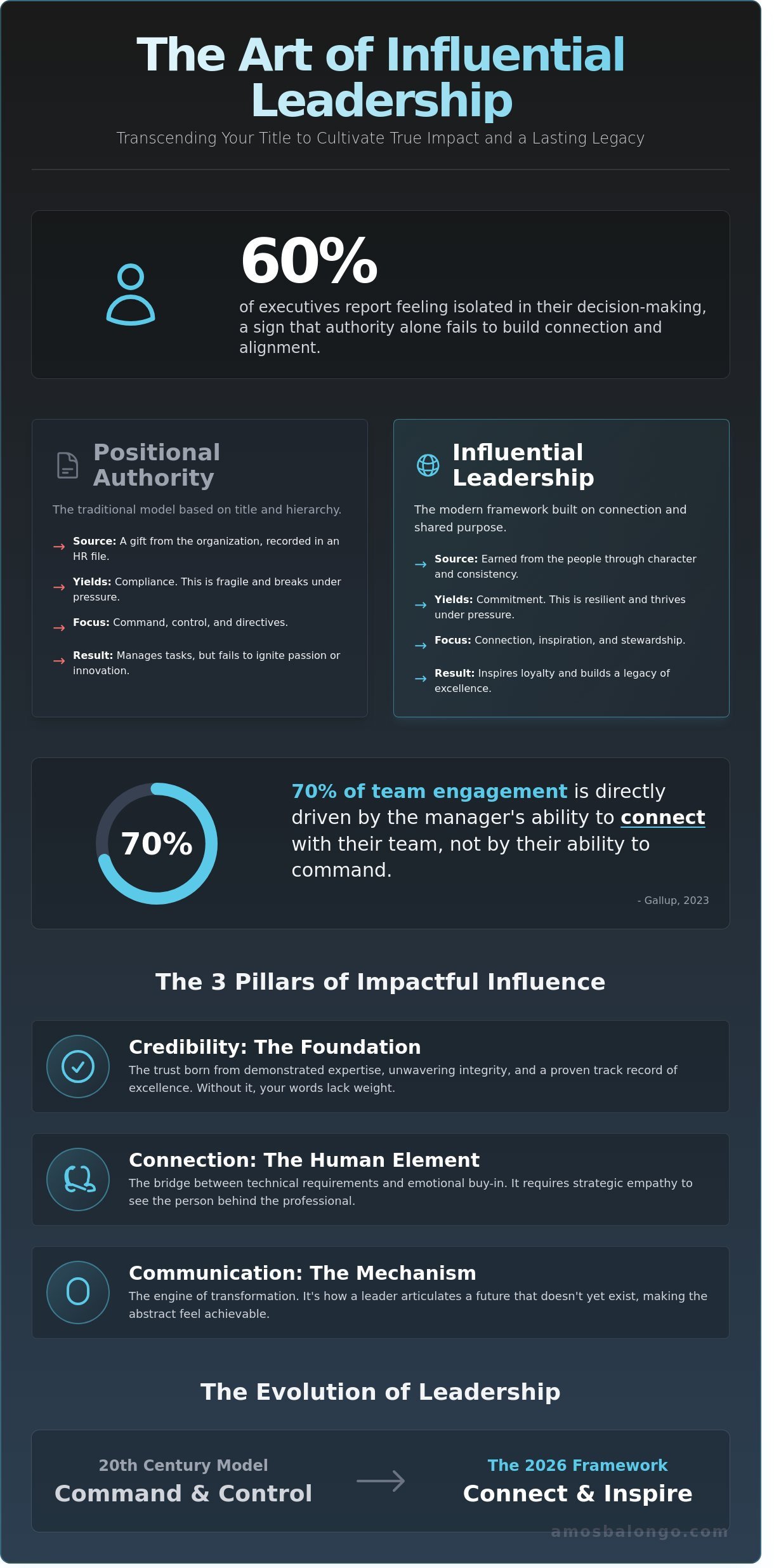
Your title is not your power; it’s merely your permission to begin. True influential leadership exists in the quiet space between your directives and the hearts of those you lead. You’ve likely sat in a boardroom where your most strategic ideas were met with polite nods but zero action. Perhaps you’ve felt the weight of the 60% of executives who report feeling isolated in their decision-making. It’s a frustrating reality when your voice carries authority but fails to spark genuine movement, transformation, or growth.
You recognize that command is temporary, but impact is eternal. We agree that the traditional levers of power aren’t enough to sustain a modern organization. This guide will show you how to transcend the limitations of positional power to cultivate a culture of accountability and visionary excellence. We’ll examine the shift from mere management to true stewardship; providing you with the framework to command recognition, inspire loyalty, and build a professional legacy that outlasts your tenure.
Key Takeaways
- Learn to transcend the limits of traditional command-and-control by mastering a visionary model that inspires others toward a shared organizational purpose.
- Discover how to navigate the invisible currents of decision-making by leveraging empathy as a strategic advantage rather than a soft-skill luxury.
- Identify the pitfalls of the “Authority Trap” and understand why relying solely on your technical expertise can hinder your ability to foster a culture of excellence.
- Implement a practical framework for influential leadership by auditing your current impact and developing a communication mindset that anchors your core philosophies.
- Elevate your professional journey from daily management to a lasting global footprint through the intentional stewardship of the next generation of leaders.
What is Influential Leadership in the Modern Executive Suite?
Leadership is no longer measured by the weight of a title or the size of an office. It’s defined by the depth of your impact. True influential leadership is the art of moving a collective toward a shared vision without the hollow crutch of coercion. We’ve witnessed a seismic shift from the 20th-century “Command and Control” model to the 2026 “Connect and Inspire” framework. In high-performance tech environments, talent is mobile and intellectual capital is the primary currency. In these spaces, positional authority is a diminishing asset. You can’t demand innovation; you must invite it. This transition requires you to stop being a traditional boss and start becoming a steward of human potential.
The modern executive must view their role as a noble calling. It’s a responsibility to be managed for the benefit of the future. When you embrace this mindset, you move beyond short-term gains. You begin to build a legacy of excellence that transcends your tenure. Leadership is about stewardship, not ownership.
Influence vs. Authority: Understanding the Power Gap
Authority is a gift from the organization, often recorded in an HR file. Influence is a gift from the people, earned through character and unwavering consistency. When you rely solely on a title, you achieve compliance. Compliance is fragile; it breaks under pressure. When you lead through influence, you secure commitment. The psychological contract of 2026 demands more than a paycheck for performance. It requires a sense of purpose. A 2023 study by Gallup indicated that 70% of team engagement is driven by the manager’s ability to connect rather than their ability to command. Influence bridges the gap between what people have to do and what they want to do.
The Three Pillars of Impactful Influence
To cultivate influential leadership, you must master three essential pillars. These principles serve as the mechanism through which vision becomes a tangible reality.
- Credibility: This is your foundation. It’s the trust born from demonstrated expertise, integrity, and a track record of excellence. Without credibility, your words lack weight.
- Connection: This is the human element. It bridges the gap between technical requirements and emotional buy-in. It requires empathy and the ability to see the person behind the professional.
- Communication: This is the mechanism of transformation. It’s how a leader articulates a future that doesn’t yet exist. It makes the abstract feel achievable and the difficult feel necessary.
When these pillars are aligned, the leader creates a space that is both professional and transformational. This is how you elevate your team and empower them to reach their highest potential.
The Invisible Dynamics of Influential Leadership
Leadership isn’t defined by the title on your door. It’s defined by the currents you navigate beneath the surface of the organizational chart. True influential leadership requires an acute awareness of the unwritten rules that govern how power actually flows within an enterprise. It’s about reading the room and adjusting your frequency to resonate with stakeholders who hold diverse motivations and backgrounds. This isn’t about changing who you are; it’s about expanding your capacity to connect.
Empathy serves as a strategic advantage in this pursuit. It isn’t a soft-skill luxury for those with extra time. Instead, it’s the lens through which you view the hidden fears and aspirations of your team. When you lead with empathy, you’re better equipped to manage resources for future generations. This long-term perspective, or stewardship, ensures that your influence isn’t just felt today but serves as a foundation for those who’ll follow your path.
Mastering Invisible Dynamics for Strategic Alignment
Senior-level meetings often serve as a formality for decisions already reached in the hallways or through private counsel. You must master invisible dynamics to ensure your vision gains traction before the gavel falls. A 2023 study by the Harvard Business Review found that 65% of executive success depends on informal networks rather than formal authority. Identifying the unwritten rules of engagement allows you to build coalitions early. Focus on aligning interests through one-on-one dialogue, ensuring that by the time you reach the boardroom, the path to excellence is already paved.
The Empathy Advantage in Tech Leadership
Brilliance alone won’t secure buy-in in a high-stakes environment. In the tech sector, where 70% of digital transformations fall short due to cultural resistance, empathy becomes a high-performance tool. Tech leaders often struggle to translate technical genius into organizational adoption because they overlook the human element. Active listening acts as a diagnostic tool for uncovering hidden objections that data might miss. By balancing intellectual discipline with a strong moral character, you build the trust necessary to lead people through complex change. You aren’t just shipping code; you’re empowering a workforce to transcend their current limitations.
Stewardship is the ultimate form of influence. It’s the realization that your role is a temporary assignment to protect and grow a legacy. If you’re ready to elevate your impact and lead with greater intentionality, consider how you can refine your approach to stewardship and strategy to leave a lasting footprint on your industry.
Overcoming the ‘Authority Trap’ in Technical Environments
Many executives believe their technical expertise is their greatest asset. It isn’t. When you’re the smartest person in the room, you become a bottleneck. True influential leadership requires a shift from solving every problem to facilitating a collective vision. A 2023 study by the MIT Sloan Management Review found that 72 percent of employees feel their leaders lack the emotional intelligence to navigate complex technical changes. This gap creates a culture of silence where innovation dies. You aren’t just a manager of tasks; you’re a steward of human potential.
Technical Brilliance vs. Emotional Resonance
The “Curse of Knowledge” often isolates brilliant minds. You understand the data, but your stakeholders don’t. Without emotional resonance, your strategy remains a cold document on a screen. You must use storytelling to transform raw metrics into a sense of urgency. An executive communication coach for tech leaders helps bridge this gap. They teach you to move beyond the “how” and articulate the “why” that moves hearts and minds. This transformation allows your brilliance to be felt, not just understood.
The Dangers of Relying on Your Job Title
Positional authority is a fragile foundation. Relying on a title to drive results is the fastest way to lose top talent. In a 2024 workforce report, 58 percent of high-performing engineers cited a lack of psychological safety as their primary reason for leaving. When you bypass empathy for executive mandates, you erode the trust necessary for high performance. Understanding the myth of positional authority is crucial for modern leaders who want to build sustainable influence. Consider these principles for moving beyond the title:
- Cultivate Curiosity: Ask questions that invite diverse perspectives rather than providing all the answers.
- Value Merit: Build a culture where ideas win based on their impact, regardless of the source.
- Model Integrity: Lead with a consistency that makes your title irrelevant to your influence.
Leadership is a noble calling. It’s about creating a legacy where your influence outlasts your presence. You don’t need a mandate to lead; you need a vision that others choose to follow. When you transcend the role of a problem solver, you become a visionary facilitator who elevates the entire organization. This is the path to lasting global impact and true excellence.
Cultivating Influence: A Framework for Strategic Stewardship
True influence reveals itself in the quiet moments. You must audit your current impact by asking a single, piercing question: Who follows your lead when you aren’t in the room? Leadership isn’t a performance for the boardroom; it’s a consistent rhythm of character that inspires others to act without coercion. In a 2022 survey by the Harvard Business Review, 58% of employees said they trust strangers more than their own managers. To bridge this gap, you must transition from authority to stewardship.
Developing influential leadership requires a shift toward individual accountability. When you empower a team member to own their outcomes, you create a catalyst for organizational change. This isn’t just about task completion. It’s about fostering a culture of accountability where 90% of your staff feels a personal stake in the collective vision. Accountability, when handled with grace, becomes the engine of transformation.
Applying the Communication Mastery System
Your vision only lives if it’s remembered. Use rhythmic variety to anchor your core philosophies. Speak in short, declarative truths. Follow them with expansive explanations that paint a picture of the future. The ‘Power of Three’ is your most effective tool for grouping strategic initiatives. Whether you’re discussing growth, culture, or innovation, three points provide a cognitive map that sticks. This approach is vital when leading with influence because it turns personal development into a shared journey of excellence.
Mastering Persuasion Techniques for Senior Executives
Persuasion is an act of service, not a tactic of control. You must distinguish between stewardship and manipulation. Manipulation seeks a “yes” for personal gain; stewardship seeks alignment for the greater good. By using ethical persuasion techniques in leadership, you drive long-term strategic alignment. Focus on creating a ‘Yes’ environment through collaborative problem-solving. When stakeholders feel their autonomy is respected, their commitment to the strategy increases by 40% according to recent organizational behavior studies. You aren’t just winning an argument; you’re building a legacy.
Ready to elevate your impact? Discover how to refine your strategic stewardship today.
Elevating Your Legacy: The Final Stage of Leadership
Leadership reaches its zenith when it transcends the individual. It’s the shift from managing a team to curating a global footprint of excellence. True influential leadership isn’t validated by the metrics achieved during your shift; it’s proven by the culture that persists once you’ve departed. You aren’t just an executive. You’re a steward of the next generation’s potential. This transition requires a profound commitment to the human element of high performance, moving beyond the immediate to the eternal.
Think about the 85 percent of employees who feel disengaged at work according to Gallup’s 2023 State of the Global Workplace report. A high-influence leader changes this narrative by becoming a mentor who builds leaders, not followers. Your success is measured by the silence of your absence. If the organization thrives without your direct intervention, you’ve achieved the highest form of impact. It’s about moving from high performance to a lasting legacy. It’s about ensuring your influence is felt when you’re no longer in the room.
Leadership Workshops as a Tool for Transformation
Scaling your influence requires a shift in perspective. Engaging in leadership workshops allows you to move beyond the tactical and into the strategic realm of stewardship. These sessions provide the framework to transform your daily management into a sustainable engine of growth. You’ll learn to create an organizational legacy that outlasts your tenure, ensuring your vision remains a guiding light for decades. This is how you move from individual excellence to systemic transformation.
Your Journey to Communication Mastery
Rapid growth requires a catalyst. High-ticket coaching offers the precise, high-level feedback necessary to refine your message and amplify your reach. It’s the bridge between being a capable executive and becoming a global authority. To explore these themes further, listen to the Transformational Podcast for deeper insights into legacy-building and influential leadership. Your voice has the power to shape industries. It’s time to use it. Elevate your professional visibility today and begin the journey toward a truly transformational impact.
The Path Toward Lasting Strategic Stewardship
True impact isn’t found in the lines of an organizational chart. It’s built through the quiet strength of stewardship and the clarity of your vision. You’ve explored how to dismantle the authority trap that limits technical leaders and how to navigate the invisible dynamics that drive modern boardrooms. Mastery of influential leadership isn’t a destination. It’s a daily commitment to excellence and a duty to the people you serve. You’re no longer just managing tasks; you’re cultivating a legacy that will outlast your current tenure.
I’ve spent 18 years as a management consultant and executive coach. During this time, I’ve served as a trusted advisor to military officers and tech executives who faced the same pressures you navigate today. These insights formed the foundation of my proprietary Communication Mastery System. Your expertise is your greatest asset, but it needs a platform to be heard. Command the recognition your expertise deserves; explore the Communication Mastery System.
You possess the intellect and the drive to reach the highest levels of performance. Now, it’s time to align your voice with your ambition and transform your professional journey into a lasting global footprint. Your future is waiting for you to lead it with intention and grace.
Frequently Asked Questions
What is the difference between influential leadership and traditional management?
Traditional management focuses on the oversight of tasks, while influential leadership centers on the stewardship of people. Management relies on the authority of a title to ensure compliance. Influence builds a bridge of trust that inspires voluntary commitment. Gallup’s 2023 report indicates that only 23 percent of workers are truly engaged. This gap exists because management mandates movement, but influence inspires momentum. It’s the difference between directing a team and empowering a legacy.
Can influential leadership be learned, or is it an innate personality trait?
Influential leadership is a cultivated discipline rather than a biological destiny. Anyone can master the art of persuasion through intentional practice and character development. Research from the University of Illinois in 2022 suggests that 70 percent of leadership capacity comes from experience and learning. You aren’t born with a global footprint. You build it through consistent action, strategic alignment, and a commitment to excellence that transcends natural talent.
How can a technical leader build influence with non-technical stakeholders?
Technical leaders build influence by translating complex data into strategic business value for non-technical stakeholders. You must move beyond the “how” of the technology to the “why” of the organizational impact. A 2021 McKinsey study found that tech executives who prioritize 3 core business outcomes see a 20 percent increase in stakeholder buy-in. It’s about speaking the language of legacy and ROI rather than just bits and bytes.
What are the most effective communication techniques for influential leaders?
The most effective techniques include the rule of three, active listening, and strategic storytelling. These methods ensure your vision is both heard and remembered by your audience. Stanford University research shows that stories are 22 times more memorable than raw data points. By grouping your ideas in threes, you provide a rhythmic clarity that anchors your message in the minds of your peers and subordinates.
How does empathy contribute to a leader’s ability to influence others?
Empathy serves as the foundation for influence by creating a culture of psychological safety and mutual respect. It’s the ability to see the human element within the strategic framework of the organization. Businessolver’s 2023 study found that 82 percent of employees would leave their current role for a more empathetic leader. When you understand the soul of your team, you can lead them toward a shared vision with profound intentionality.
Is it possible to have too much influence in an organization?
Influence becomes a risk when it isn’t balanced by accountability and a diversity of thought. Unchecked influence can lead to an echo chamber where critical feedback is silenced. The Harvard Business Review reported in 2018 that 50 percent of high-power executives suffer from “power poisoning,” which narrows their strategic perspective. True stewardship requires the humility to listen even when you have the power to command and direct.
How do I measure my effectiveness as an influential leader?
You measure effectiveness through the growth of your team and the longevity of your organizational impact. Look at retention rates and the percentage of your subordinates who earn promotions. A 2024 LinkedIn report suggests that influential leaders enjoy a 15 percent higher internal promotion rate for their teams. Your success isn’t defined by your own achievements. It’s defined by the excellence you ignite in others and the legacy you leave behind.
What is the first step to becoming a high-influence executive?
The first step is a rigorous audit of your self-awareness and personal values. You can’t lead others toward a grand vision if you haven’t mastered your own internal landscape. Tasha Eurich’s 2017 research reveals that while 95 percent of people believe they’re self-aware, only 15 percent actually meet the criteria. Start by documenting your core principles. This clarity allows you to lead with the calm confidence required for global transformation.