
What if the moments you fear most are actually the keys to your enduring influence? Research from CPP Inc. reveals that the average employee spends 2.8 hours every week navigating friction, yet 70% of managers still admit to avoiding difficult conversations at work due to emotional anxiety. You’ve likely felt that familiar tension between maintaining team harmony and achieving rigorous business objectives. It’s a heavy burden to carry, especially when you value the human element of your organization as much as the bottom line.
I’ll show you how to transform these high-stakes encounters into a masterclass in leadership stewardship and strategic alignment. By leaning into these challenges, you don’t just resolve a temporary dispute; you craft a legacy of integrity that inspires your peers. We’ll examine the specific mindset shifts and communication frameworks you need to command respect, preserve deep trust, and elevate your professional footprint through the power of intentional, visionary dialogue.
Key Takeaways
- Understand leadership as the stewardship of truth and discover why avoiding friction erodes your professional integrity and personal influence.
- Shift from positional authority to the “Empathy Advantage,” creating a safe space for dialogue that balances intellectual discipline with emotional resonance.
- Master the art of difficult conversations at work by moving beyond tactical problem-solving toward a strategic approach that builds a lasting professional legacy.
- Execute high-stakes dialogues with a sophisticated framework designed to anchor every interaction in mutual respect and clear, declarative purpose.
- Learn the essential “after-care” techniques to steward your professional relationships and integrate conflict into a broader system of communication excellence.
The Stewardship of Silence: Why Difficult Conversations at Work Matter
Leadership isn’t defined by the ease of the boardroom, but by the weight of the silence a leader chooses to break. Too often, we view friction as a sign of failure. We see a clash of perspectives as a threat to the delicate peace we’ve worked so hard to maintain. This is a fundamental misunderstanding of high-performance culture. True leadership demands that we view these moments not as obstacles, but as the essential bridge between current friction and future transformation. When you step into a room to address a performance gap or a cultural misalignment, you aren’t just solving a problem. You’re building a path toward a more resilient version of your organization.
A difficult conversation is a moment of high-stakes stewardship for a leader. It’s a sacred trust. To understand what are difficult conversations, one must look past the surface level discomfort and recognize them as an essential mechanism for organizational health. These dialogues involve high stakes, varying opinions, and strong emotions. Yet, they’re the only way to ensure that the vision you’ve cast remains untarnished by the slow decay of unspoken resentment. When you master difficult conversations at work, you stop being a mere manager of tasks and start becoming a steward of potential.
The High Cost of Executive Avoidance
The habit of “peace-keeping” is often a mask for professional cowardice. While it feels like you’re protecting the team’s harmony, you’re actually eroding organizational integrity. A 2023 report from Bravely indicated that 70% of employees are actively avoiding difficult conversations at work. This avoidance creates “invisible dynamics.” These are the underlying tensions that stifle innovation because people are too afraid to challenge the status quo. When senior leaders fail to lead the charge in radical honesty, they send a message that comfort is more valuable than excellence. This ripple effect destroys accountability. If the executive won’t speak the truth, the manager won’t enforce the standard, and the front-line contributor won’t feel the need to perform. You must lead the charge. You must set the tone. You must be the one who values the truth more than the temporary comfort of a quiet, yet failing, office.
Conflict as a Catalyst for Transformation
It’s time to shift the paradigm. We must stop viewing the “difficult” as a threat and start viewing it as the “necessary.” Reframing these talks as strategic assets allows you to achieve long-term alignment that “polite” organizations can never reach. Mastering these dialogues doesn’t just fix a team; it enhances your professional visibility. It commands recognition because it shows you possess the emotional intelligence to handle the heat of the moment without losing sight of the goal. This approach aligns perfectly with the Amos Balongo philosophy of leading with influence. Influence isn’t about control. It’s about the ability to move people toward a higher standard of existence. Every difficult dialogue is an opportunity to elevate your team and empower your peers. When you speak with empathy and authority, you transcend the limitations of your title. You begin to build a legacy that’s rooted in growth, fueled by integrity, and sustained by the courage to say what needs to be said for the benefit of the whole.
The Anatomy of High-Stakes Dialogue: Mindset Over Tactics
The core of leadership isn’t found in the ease of a celebratory banquet; it’s forged in the furnace of conflict. When you approach difficult conversations at work, your mindset dictates the legacy of that interaction. Resonance carries more weight than positional authority in any boardroom. While a title can demand compliance, only empathy commands commitment. You must balance intellectual discipline with emotional warmth to create a sanctuary where truth can breathe. This is the empathy advantage. It isn’t about being soft; it’s about being effective. According to a 2023 study by the Carnegie Institute, 85% of financial success in leadership is generated by “human engineering” and emotional intelligence rather than technical knowledge alone.
Executive presence during these moments rests on three pillars: Calm, Clarity, and Connection. Calm is the ability to remain centered when the storm of emotion rises. Clarity is the precision of thought that cuts through ambiguity. Connection is the bridge that ensures the other person feels seen. Leadership is a noble calling that requires the courage to speak the unspoken. You aren’t just managing a task; you’re honoring the human potential within your organization. When you speak with intentionality, you move beyond the surface level to address the soul of the enterprise.
Internal Stewardship: Preparing Your Soul for the Talk
Before you step into the room, you must govern your own spirit. This is internal stewardship. Managing your emotional state ensures intentionality rather than reactivity. You’ve got to shift your perspective from a fixed judgment to a growth mindset regarding the other person’s intentions. Ask yourself if you’re trying to control the outcome or steward the relationship. A 2023 Bravely report found that 70% of employees avoid difficult conversations at work. Your goal is to be the leader who steps into that gap with purpose. You’re not there to win an argument; you’re there to advance a vision.
This preparation is both mental and physical. Being calm, alert, and focused is paramount. For many executives, the ritual of preparing and drinking a quality cup of coffee provides the clarity needed for these high-stakes moments. It’s a small act of self-stewardship before stewarding a difficult dialogue. Sourcing high-quality options like freshly roasted coffee beans Oklahoma can be a small but powerful part of a routine that ensures you bring your sharpest self to the table.
The Human Element in Technical Leadership
Technical leaders often prioritize logic over feeling. They see the messiness of human emotion as a bug in the system rather than a feature of the human soul. To achieve true buy-in, you must bridge the gap between cold data and human resonance. You can use active listening techniques for leaders to uncover the root causes of friction. When you listen to understand instead of to refute, you transform a technical hurdle into strategic alignment. This approach requires you to transcend the binary of right and wrong to find a higher path of excellence. It’s about creating a lasting leadership legacy that values the person as much as the process.
True transformation begins when the leader decides that the relationship is worth the discomfort of the truth. You must view every high-stakes dialogue as an opportunity to reinforce the integrity of your culture. When you lead with this level of depth, you don’t just solve problems; you elevate the entire organization. Every conversation is a seed planted for the future. Make sure you’re planting seeds of clarity and respect.
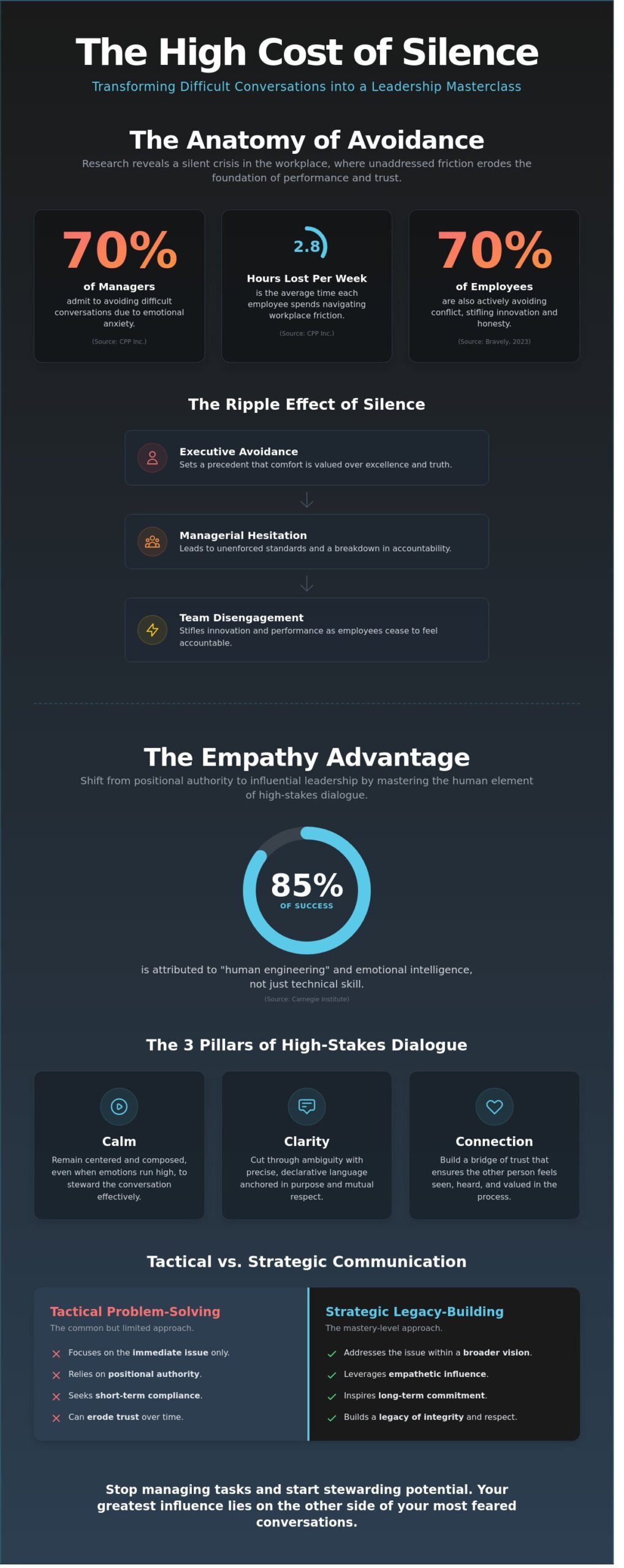
Tactical vs. Strategic Communication: A Comparison Framework
Leadership isn’t a title; it’s a stewardship. When you engage in difficult conversations at work, you aren’t just managing a crisis. You’re crafting a legacy. Tactical communication focuses on the immediate correction. It’s the “what” and the “how” of a singular task. Strategic communication, however, addresses the “why” and the “who.” It’s the difference between fixing a broken process and refining a broken culture. Every word you speak leaves a footprint on the organizational soul. You must choose whether that footprint leads toward growth or toward stagnation.
The traditional feedback sandwich often fails because it feels like a hollow ritual. Executives don’t want sugar-coated critiques. They want truth. A 2022 Gallup report indicated that 70% of high-performing employees prefer direct, actionable feedback over softened praise. When you hide the core message between layers of fluff, you dilute your authority and your impact. You’re not protecting the employee’s feelings; you’re protecting your own comfort. High-level leadership requires the courage to be clear. It demands a rhythmic variety in speech, using short, declarative anchors to establish truth, followed by expansive vision to provide hope.
- Tactical focus: Solving the immediate error to maintain current output.
- Strategic focus: Aligning the individual’s growth with the company’s long-term mission.
- Legacy focus: Ensuring the conversation strengthens the professional relationship for years to come.
Moving Beyond the Feedback Loop
Senior professionals need more than standard HR templates. You should utilize parallel structure to deliver profound messages. Speak to the vision. Speak to the performance. Speak to the person. This triple focus ensures your message transcends the immediate moment. In a 2023 study by the Harvard Business Review, clarity was cited as the number one trait of effective executive communication. When you’re clear, you empower. When you’re vague, you confuse. Don’t just close a loop; open a door to future excellence.
Strategic Alignment Through Empathy
Empathy isn’t a soft skill; it’s a strategic tool for alignment. Sympathy is feeling for someone, which can lead to pity. Empathy is understanding with someone, which leads to partnership. It’s about seeing the project’s failure through their eyes while keeping your feet planted in the firm’s objectives. Consider the 2014 transformation of Microsoft under Satya Nadella. By shifting the culture from “know-it-alls” to “learn-it-alls” through empathetic, direct difficult conversations at work, he increased the company’s market value by over $2 trillion in less than a decade. He didn’t just solve technical problems; he transformed the human element of high performance. This is the essence of stewardship. You’re responsible for the person as much as the profit. When you align their personal purpose with the organizational vision, you create an unstoppable momentum that transcends any temporary setback. Understanding empathy in leadership as strategic stewardship enables you to transform perceived weaknesses into your greatest competitive advantages.
The Mastery Framework: Executing Your Most Difficult Conversations
Leadership is a sacred trust. It requires you to act as a steward of both the organization’s goals and the individual’s potential. When you approach difficult conversations at work, you aren’t merely solving a friction point; you’re refining a legacy. A 2023 study by the Society for Human Resource Management revealed that 57% of employees who quit cite poor communication as a primary factor. To lead effectively, you must master the mechanics of the high-stakes dialogue with intentionality and calm confidence.
- Step 1: Set the Stage. Establish an environment of global sophistication and mutual respect. This isn’t a casual chat. It’s a strategic alignment. Ensure the setting reflects the gravity of the mission and allows for uninterrupted focus.
- Step 2: The Opening. Use clear, declarative statements to anchor the purpose. Instead of “I want to talk about your performance,” try “We are here to align your current output with our standard of excellence.” This anchors the talk in vision rather than critique.
- Step 3: The Inquiry. Listen for the invisible dynamics. A 2022 report from the Center for Creative Leadership suggests that 85% of workplace conflict stems from unmet emotional needs. Seek the “why” beneath the “what” by asking open-ended questions that invite depth.
- Step 4: The Pivot. Shift the focus from the past failure to a shared vision of the future. Transformation happens when the leader points toward the horizon of possibility. You’re moving the narrative from a problem to be solved to a standard to be achieved.
- Step 5: The Commitment. Establish individual accountability as a catalyst for change. Without a clear agreement, the conversation is just noise. Set a follow-up date within 72 hours to maintain momentum and show you’re invested in their growth.
Orchestrating the Conversation
Control the cadence of the room with a measured, intentional pace. You don’t need to fill every gap with words. Silence is a strategic tool that allows your key points to take root in the other person’s mind. When you encounter defensiveness, don’t retreat or become aggressive. Maintain your executive authority by staying calm and reflective. A 2021 study on executive communication found that leaders who paused for three seconds before responding were perceived as 40% more authoritative than those who rushed to speak. Implementing active listening techniques for leaders during these pauses allows you to uncover the deeper concerns that drive resistance and transform opposition into collaboration.
Navigating Tough Q&A and Objections
Handle pushback with intellectual rigor and visionary grace. When an objection arises, view it as an invitation to collaborate rather than a challenge to your power. You don’t have to win an argument; you have to win a commitment to excellence. Research from the Center for Talent Innovation in 2022 shows that executive presence, which includes the ability to stay composed under fire, accounts for 26% of what it takes to reach the C-suite. Use every question as a bridge to your shared strategic goals, turning resistance into a roadmap for improvement.
Your ability to guide these moments defines your long-term impact as a leader. If you’re ready to elevate your leadership and master these high-level interactions, you should explore my executive coaching programs to refine your strategic voice and impact.
Beyond the Talk: Building a Legacy of Communication Excellence
The true measure of a leader isn’t found in the heat of a confrontation. It’s found in the silence that follows. When you master difficult conversations at work, you’re doing more than resolving a grievance; you’re planting seeds for a more resilient future. This period of after-care requires a stewardship mindset. You must nurture the relationship in the 14 to 21 days following the initial dialogue to ensure the emotional bridge remains intact. Every interaction during this window is a brick in the monument of your reputation. It’s about consistency. It’s about integrity. It’s about showing your team that your empathy wasn’t a tactical maneuver but a core value.
By integrating these lessons into your broader strategic communication framework, you ensure that every conflict becomes a catalyst for strategic alignment. One well-handled conversation can ripple through an entire organization. A 2023 study by the Queen’s University of Charlotte found that nearly 75% of employees rate collaboration and teamwork as very important; yet, only 18% receive communication evaluations in their performance reviews. You can close this gap. When you scale your influence through transparent dialogue, you transform the organizational culture from one of fear to one of psychological safety. This shift often leads to a measurable 20% increase in team productivity as hidden frictions dissolve.
Your global footprint is defined by these moments of clarity. Every time you choose courage over comfort, you reinforce your commitment to a vision that transcends the immediate bottom line. High-performance leadership is a noble calling. It demands that your external strategy matches your internal character. When these two forces align, your leadership soul expands, allowing you to carry the weight of global impact with ease and grace.
Cultivating Individual Accountability
True transformation happens when you move your team from mandated compliance to inspired commitment. It’s not enough for an employee to follow instructions because they’re afraid of the consequences. They should lead because they’re inspired by the vision you’ve shared. Establish a 30-day follow-up rhythm to check on progress without micromanaging. This approach maintains the stewardship mindset while empowering the individual to own their growth. Celebrating the small wins that emerge from the discomfort of difficult conversations at work reinforces the idea that struggle is merely a precursor to excellence. A 2022 Gallup report suggests that teams with high engagement see a 10% increase in customer loyalty; this starts with the accountability you foster today.
Your Invitation to Mastery
High-level coaching is the secret weapon of the world’s most influential tech leaders. They don’t seek advice because they’re lost; they seek it because they’re committed to staying at the peak of their powers. To continue your growth, immerse yourself in the insights shared on the Transformational Podcast. It’s a resource designed to sharpen your strategic edge and deepen your emotional intelligence. Leadership isn’t a destination. It’s a continuous journey of refinement and soul-searching. Every difficult conversation is a chance to elevate your leadership soul. You’re not just managing people; you’re stewarding human potential for the benefit of future generations. Embrace the challenge. Lead with vision. Leave a legacy that speaks of excellence in every word.
Stepping Into Your Legacy of Communication
Leadership isn’t a mere title; it’s a profound responsibility to the people and the vision you serve. You’ve seen how mastering difficult conversations at work requires moving beyond simple tactics to embrace a mindset of strategic stewardship. By applying the Mastery Framework, you transform moments of friction into catalysts for long-term organizational alignment. True excellence isn’t found in avoiding conflict but in the intentionality and grace of your response.
I’ve dedicated 18 years to coaching elite corporate and military leaders to navigate these high-stakes dialogues with calm confidence. Drawing on my experience as a management consultant for global organizations, I created the Empathy Advantage framework to bridge the gap between tactical execution and genuine human connection. Your legacy is built on the words you choose today. Don’t leave your professional influence to chance.
Elevate your leadership influence with the Communication Mastery System.
The horizon of your leadership is vast. Your commitment to this level of mastery ensures a lasting, positive impact on every life you touch and every organization you guide.
Frequently Asked Questions
How do I start a difficult conversation at work without sounding accusatory?
Begin with a neutral observation of facts and a statement of your shared goals. For example, you might say, “I noticed the last three reports were submitted 24 hours past the deadline, and I want to ensure we maintain our team’s reputation for excellence.” This approach shifts the focus from personal failure to the stewardship of professional standards. It invites a partnership in problem solving rather than creating a defensive barrier.
What is the best way to handle an employee who becomes emotional or defensive?
Allow the individual 90 seconds to process their physiological response before you continue the dialogue. Research by Dr. Jill Bolte Taylor indicates that the chemical surge of an emotion lasts less than two minutes if it’s not reinforced. Offer a brief five minute pause or a glass of water to reset the room’s energy. This intentional stillness demonstrates your commitment to their dignity while you maintain the integrity of the discussion.
How can I balance being empathetic with the need to be firm about performance?
You balance these by viewing high standards as a profound form of respect for the individual’s potential. Empathy doesn’t mean lowering the bar; it means helping the person find the ladder to reach it. When managing difficult conversations at work, clearly state the three specific performance metrics that aren’t being met. Explain that your leadership role is to ensure their professional legacy remains untarnished by mediocre results.
Is it better to have difficult conversations in person or via video call for remote teams?
Prioritize video calls over audio or text because 55% of human communication is conveyed through body language. If a face to face meeting isn’t possible due to global distribution, a high quality video connection preserves the essential human element. Seeing a leader’s facial expressions builds trust and reduces the risk of painful misinterpretation. It ensures that your message of transformation is received with the intended warmth and strategic gravity.
How long should a difficult conversation typically last to be effective?
Aim for a duration of 30 to 45 minutes to ensure clarity without causing emotional exhaustion for either party. A 2021 study on workplace communication suggests that focus declines significantly after the 50 minute mark. Use the first 10 minutes for data, the middle 20 for collaborative problem solving, and the final five for setting clear action items. This structure respects the time of both parties and keeps the focus on strategic alignment.
What should I do if a difficult conversation doesn’t lead to a resolution?
Schedule a follow up meeting exactly 48 hours later to allow for reflection and emotional regulation. Sometimes the initial shock of a tough talk prevents immediate problem solving. If the second meeting also fails to produce a 100% agreement on the path forward, involve a neutral third party or an HR advisor. This protects the organizational culture and ensures that the stewardship of the team remains your highest priority.
How can I improve my executive presence when I feel nervous about a tough talk?
Focus on your breathing and your core purpose to ground your presence in duty rather than anxiety. Studies show that a four second inhale followed by a six second exhale lowers the heart rate by 10 beats per minute. Remind yourself that you’re serving the person’s long term growth. When you view difficult conversations at work as an act of service, your nervousness transforms into a focused, quiet power.
Can empathy actually help in a high-stakes termination or redundancy discussion?
Empathy is essential in high stakes exits because it preserves the dignity of the departing individual and the morale of the remaining 95% of the staff. Treat the person with the same respect on their last day as you did on their first. Provide a clear transition package and offer a genuine word of encouragement regarding their future impact. Leadership is about managing the human legacy, even when professional paths must diverge.