
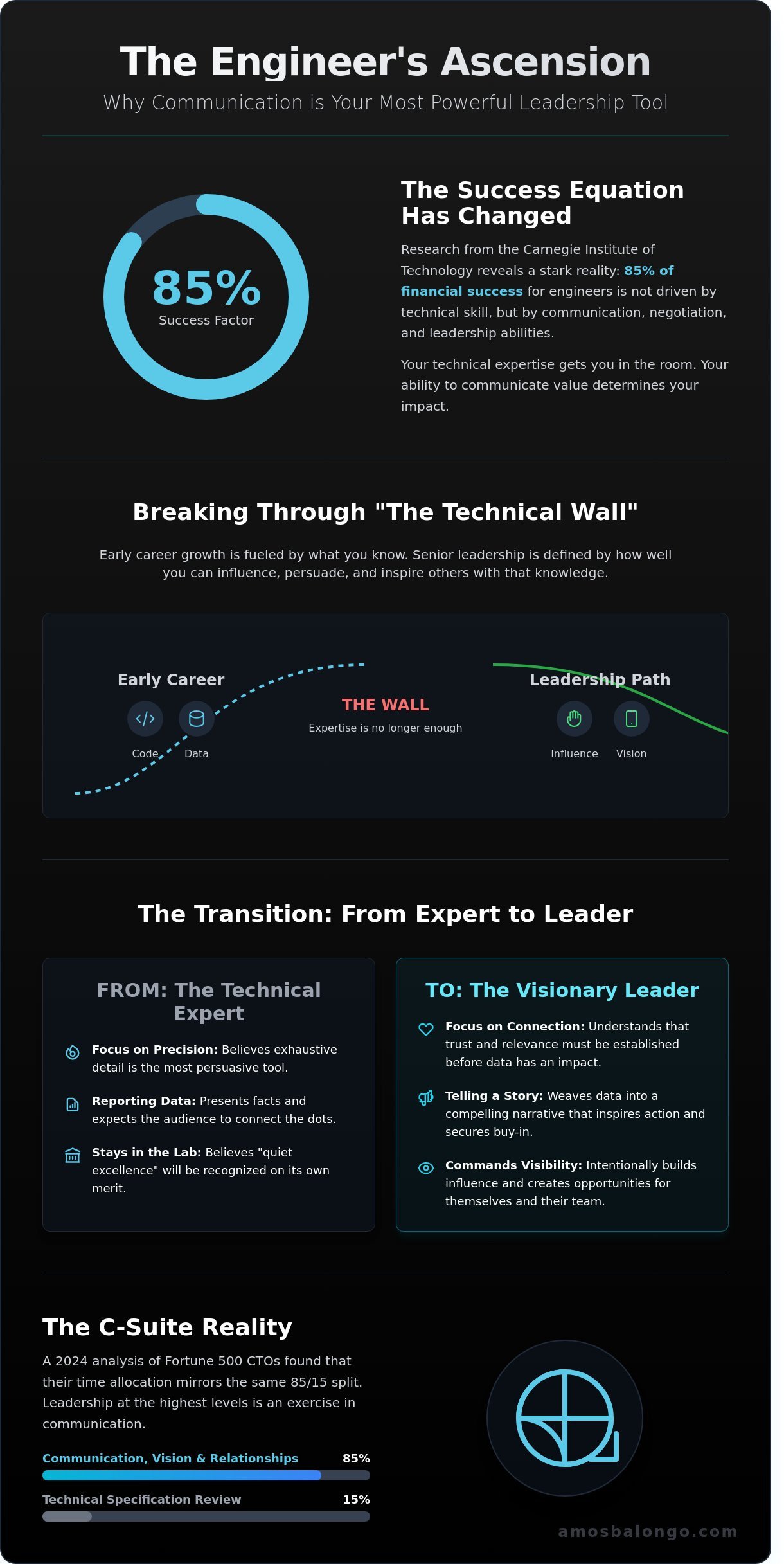
The most brilliant technical mind in the room remains invisible if it cannot translate complex data into a compelling vision. While your expertise is the foundation of your career, it’s your ability to articulate that value that determines your ultimate ceiling. Research from the Carnegie Institute of Technology indicates that 85% of financial success in engineering is driven by communication and leadership skills. Mastering public speaking for engineers isn’t merely a soft skill; it’s a strategic act of stewardship over your own potential.
You’ve likely felt the frustration of watching a peer secure a project’s budget simply because they spoke the language of the boardroom more fluently than the language of the lab. It’s exhausting to feel lost in translation when your ideas deserve to lead. This guide provides a strategic communication framework designed to transform your technical depth into executive influence. We’ll explore how to command respect from stakeholders, secure critical buy-in, and build a legacy as a visionary leader who can transcend the limitations of the spreadsheet to inspire global impact.
Key Takeaways
- Redefine your voice as a strategic leadership asset, shifting from simple technical reporting to the intentional stewardship of executive influence.
- Adopt the Communication Mastery System to bridge the gap between complex data and strategic narrative, ensuring your insights drive organizational transformation.
- Navigate the “Technical Trap” by choosing connection over exhaustive precision, a vital shift in public speaking for engineers that fosters deeper trust with stakeholders.
- Apply a structured blueprint for technical storytelling to simplify complex engineering arguments into a compelling, high-impact vision.
- Transition from a technical expert to a visionary leader by mastering the art of communication, securing your professional legacy through the power of your voice.
Beyond the Podium: Why Public Speaking is the Engineer’s Greatest Leadership Tool
Technical mastery is the foundation of an engineer’s career; however, it is rarely the ceiling. For those who aspire to reach the highest levels of organizational impact, public speaking for engineers must be viewed as a strategic leadership asset rather than a mere performance. You’ve likely encountered “The Technical Wall.” This is the specific point in a professional journey where deep domain expertise ceases to be the primary driver of advancement. At this junction, your ability to influence, persuade, and align stakeholders becomes the new metric of success. Technical brilliance gets you a seat at the table, but communication determines how long you stay there and how much you’re heard.
The Art of public speaking is often misunderstood in technical circles as a theatrical exercise. It’s actually a vital mechanism for translating complex data into actionable strategy. Without this skill, even the most innovative solutions remain trapped in the laboratory. A 2024 analysis of Fortune 500 Chief Technology Officers revealed that 85 percent of their time is spent communicating vision and managing relationships rather than reviewing technical specifications. To reach the C-suite, you must transcend the role of a subject matter expert and become a voice of authority. This transformation requires a shift in mindset from being a processor of information to being a purveyor of vision.
The Duty of Technical Stewardship
Leadership is a noble calling that requires you to protect the integrity of your team’s labor. Clear communication ensures that technical brilliance isn’t diluted or misinterpreted by those who lack your depth. You serve as the essential bridge between raw data and the executive decision-makers who determine the future of your projects. When you speak with clarity, you’re not just presenting; you’re advocating for the truth of the work. Stewardship is the management of technical potential for the benefit of the organization. By mastering public speaking for engineers, you ensure that your team’s innovation receives the resources and recognition it deserves.
Visibility and the Career Ceiling
The myth of “quiet excellence” suggests that if you do good work, the world will eventually find you. In high-stakes corporate environments, this passivity is often a recipe for stagnation. Professional visibility is the currency of the modern executive. If you’re not visible, you’re not considered for the high-impact opportunities that define a legacy. You can explore executive visibility coaching to learn how to command a room with intentionality and grace. When you speak, you aren’t just sharing information; you’re demonstrating your readiness to lead at a global scale. Your career ceiling isn’t defined by what you know, but by your ability to make others believe in the value of what you know. This is how you move from being a valuable employee to an indispensable leader.
- Communication bridges the gap between technical complexity and business value.
- Visibility creates a pathway for mentorship and high-level sponsorship.
- Strategic speaking transforms a technical expert into a visionary leader.
High performance in engineering is no longer measured solely by the precision of the output. It’s measured by the reach of the impact. When you embrace public speaking as a tool for stewardship, you elevate your entire department. You become the catalyst for change, moving the organization toward a future that you’ve helped define. This isn’t about the spotlight; it’s about the light you shed on the work that matters most.
The Communication Mastery System: Bridging the Gap Between Data and Influence
Leadership is a noble calling that requires more than technical proficiency. It demands the ability to translate complex realities into a vision that others can follow. Many technical leaders fall into the trap of information dumping, believing that a mountain of data will naturally lead to a logical conclusion. This approach often fails because facts alone rarely inspire action. This system serves as a bridge, moving you from a state of mere reporting to a position of profound influence. It’s a framework designed for those who recognize that their work is a form of stewardship, requiring a high level of intentionality in every interaction.
Effective public speaking for engineers requires a fundamental shift in mindset. You aren’t just a technician sharing a progress report; you’re a strategist shaping the future of your organization. Every presentation is an opportunity to build your legacy and demonstrate your readiness for higher levels of responsibility. By adopting a system that prioritizes clarity over complexity, you ensure that your intellectual discipline is matched by your communicative power.
Framework: The Strategic Narrative
The Strategic Narrative is a foundational element of this system. It replaces the standard list of features with a rhythmic triad: Problem, Impact, and Solution. You begin by clearly defining the friction point, such as a 22% increase in latency or a $1.5 million budget overage. Next, you explain the impact this has on the company’s long term goals. Finally, you present the solution as a way to restore order and drive growth. This methodology aligns with the rigorous standards found in Stanford’s Technical Communication Program, which teaches students to distill complex systems into actionable insights for diverse stakeholders.
Anchoring data in a relatable context is vital for organizational alignment. Instead of saying “the database is faster,” you say “this optimization allows our global teams to collaborate in real time, saving 400 man hours per month.” This shift moves the conversation from what you built to why it matters for the organization’s collective success. It’s about moving beyond the code and speaking to the heart of the business strategy.
The Human Element in Technical Data
Senior executives don’t invest in spreadsheets; they invest in people and the vision they project. When you stand before a board, your calm confidence serves as a signal of authority. This is the Empathy Advantage. You must demonstrate that you understand the pressures your audience faces, whether they’re concerned about Q4 margins or market volatility. By acknowledging their world, you create a space for genuine connection. True mastery of public speaking for engineers is about recognizing that every piece of data has a human consequence. You can find deeper reflections on these leadership principles by visiting The Transformational Podcast, where we explore the intersection of character and performance.
Visionary leaders understand that their voice is a tool for transformation. They don’t just provide tactical advice; they instill a sense of purpose in their teams. If you seek to transcend the limitations of technical jargon and speak with the gravity of a seasoned advisor, you may wish to elevate your leadership impact through intentional mentorship. Your ability to communicate is the primary driver of your professional footprint. By mastering the human element, you ensure that your technical expertise leaves a lasting mark on the world.
Overcoming the “Technical Trap”: Precision vs. Connection in High-Stakes Talks
Many engineers believe that reducing complexity is a betrayal of the truth. They view precision as a moral obligation; a shield against inaccuracy. However, in the realm of public speaking for engineers, excessive detail often acts as a barrier to influence. True leadership requires you to transcend the role of a technical expert and embrace the responsibility of a strategic communicator. You aren’t just presenting data. You’re stewarding a vision that others must follow. When you prioritize the “Expert Mindset,” you focus on being right. When you adopt the “Leader Mindset,” you focus on being heard.
The “Curse of Knowledge” is a silent killer of executive presence. It happens when an expert assumes their audience possesses the same depth of background knowledge as they do. A 2022 report by the Project Management Institute revealed that 56% of project failures are linked to poor communication. When you alienate stakeholders with jargon, you risk the resources and support your project requires. The University of Illinois Engineer SPEAK Program addresses this specific friction by pairing technical rigor with rhetorical excellence. This model demonstrates that technical integrity doesn’t require exhaustive detail; it requires strategic alignment between your data and your audience’s needs.
Precision vs. Connection: Finding the Balance
Finding the balance between accuracy and resonance is a discipline of leadership. You must decide when to provide the “how” and when to emphasize the “so what.” If your audience can’t see the impact of your work, the precision of your methodology becomes irrelevant. Use the following framework to guide your preparation:
| Technical Detail (The “How”) | Strategic Insight (The “So What”) |
|---|---|
| Focuses on the process and methodology. | Focuses on the outcome and organizational value. |
| Validates the work through granular data points. | Validates the work through its contribution to legacy. |
| Engages the intellect of peers. | Engages the will of decision-makers. |
“Precision informs the mind, but connection moves the hand.”
Navigating the Boardroom Pressure
Speaking to a CEO or CFO requires a shift in cadence. These leaders aren’t looking for a lecture; they’re looking for a partnership in stewardship. Start with a 90-second spoken executive summary. State the problem, the solution, and the required investment immediately. This approach respects their time and signals that you understand the broader business context. It transforms you from a technical resource into a strategic advisor.
High-pressure Q&A sessions are where your executive presence is truly tested. Don’t rush to answer. A three-second pause demonstrates calm confidence and intentionality. If a question is outside your current scope, acknowledge it with integrity rather than guessing. According to a 2021 Harvard Business Review analysis, 70% of executives value communication skills as highly as technical expertise. Your ability to handle pressure with grace ensures your public speaking for engineers becomes a tool for long-term impact and organizational transformation.
From Code to Keynote: A Strategic Framework for Technical Storytelling
Engineering excellence isn’t measured solely by the elegance of your code; it’s defined by your ability to move people with your vision. To master public speaking for engineers, you must view every presentation as an act of stewardship over your organization’s future. You aren’t just reporting data. You’re inviting stakeholders to invest in a transformation. A 2024 report by Gartner highlights that 70% of technical initiatives fail to reach their full potential due to a lack of alignment with business objectives. This gap is closed through intentional communication.
The foundation of a high-impact talk rests on the Rule of Three. This structural principle suggests that information is most memorable when grouped in triads. When you’re presenting a complex architectural change, organize your argument into three distinct pillars: the technical necessity, the operational efficiency, and the long-term strategic value. This creates a rhythmic clarity that allows your audience to follow your logic without getting lost in the weeds of implementation. It’s a method that transforms a dense lecture into a compelling roadmap for success.
Strategic alignment is the bridge between the server room and the boardroom. Every technical milestone you reach must be translated into its business equivalent. If you’ve reduced latency by 150 milliseconds, don’t just state the number. Explain how this performance boost correlates to a 5% increase in user retention or a specific reduction in operational overhead. This approach ensures your technical goals are seen as vital contributions to the company’s global footprint. It’s about demonstrating that your work serves a purpose far greater than the technology itself.
The Anatomy of a Technical Story
Every successful narrative requires a clear protagonist and a formidable obstacle. In the context of public speaking for engineers, the hero is never the software; it’s the user or the client whose life is improved by your solution. The villain is the technical hurdle or the legacy system that stifles progress. Use analogies to make the invisible visible. Compare a fragmented database to a library without a catalog. This humanizes the data, ensuring the human footprint is visible in every line of code you discuss.
Physical Presence and Delivery
Your physical presence must match the authority of your expertise. Ground your stance by keeping your feet shoulder-width apart to project stability and confidence. Engineers often speak too fast because they’re eager to reach the conclusion, but research from the University of Michigan suggests that speakers who utilize 3.5 pauses per minute are perceived as more authoritative. Use the strategic pause to let a complex point land. For more insights on refining your executive presence, visit amosbalongo.net for specialized leadership resources.
Mastering impromptu speaking in technical meetings requires a disciplined mind. When put on the spot, use the “Point-Reason-Example-Point” (PREP) framework. State your technical position clearly, provide the underlying reason, offer a concrete data point from a recent sprint, and restate your conclusion. This prevents rambling and reinforces your reputation as a leader who thinks with precision. Leadership is a noble calling that requires you to transcend the technical and embrace the oratorical.
Elevating Your Legacy: How to Transition from Technical Expert to Visionary Leader
Technical mastery is a formidable foundation; however, it is rarely the final destination for those called to true greatness. You have spent years refining your analytical mind, solving complex equations, and building systems that endure. Now, the challenge shifts. To move from the server room to the boardroom, you must embrace the responsibility of stewardship. This transition requires a fundamental shift in how you project your value. Mastery of public speaking for engineers serves as the definitive bridge between being a tactical asset and a visionary leader who shapes the future of an organization.
Your technical expertise got you a seat at the table. Your voice will determine how long you stay there. When you view communication as a strategic discipline rather than a secondary soft skill, you begin to build a professional legacy that outlasts any single project or product launch. Every presentation, every keynote, and every town hall is a brick in the monument of your career. You aren’t just delivering data; you are transferring belief, instilling purpose, and driving global impact through the power of your spoken word.
The Path to Executive Influence
Executive presence is often treated as a mystery, yet it remains rooted in the ability to command a room with calm intentionality. There is a profound difference between being the smartest person in the room and being the most influential. Influence requires a shift from technical precision to strategic alignment. According to a 2023 survey by the Carnegie Institute of Technology, 85 percent of professional success in engineering environments stems from “human engineering” skills, such as the ability to lead and communicate effectively. The Communication Mastery System is designed to bridge this gap, moving you beyond the “what” of your work into the “why” that inspires stakeholders. It transforms your technical depth into a narrative that resonates with investors, boards, and global teams.
Taking the Next Step in Your Journey
The journey from a tactical expert to a strategic sage is not one you should walk alone. While your intellect has carried you far, the nuances of high-stakes communication require a different kind of discipline. True transformation happens when you move beyond self-study and engage in the rigorous process of professional mentorship. It’s about refining your cadence, sharpening your message, and embracing the weight of your role as a leader. You have a duty to your talent and your team to be heard clearly.
Programs such as Speak Sell Succeed provide this exact type of professional training, offering a structured path for engineers to master public speaking and persuasive communication.
Amos Balongo Consulting Coaching’s Communication Mastery System provides the architectural framework for this growth. It is specifically tailored for tech leaders who refuse to be sidelined by a lack of oratorical presence. By seeking personalized coaching, you accelerate your trajectory and ensure your insights receive the platform they deserve. This is your invitation to step into a higher level of excellence. Invest in your ability to lead, empower your organization through clarity, and begin the work of securing your lasting legacy today. Your transition to a visionary leader starts with the decision to master the art of public speaking for engineers and claim your place as a global voice of authority.
Your Evolution from Technical Expert to Visionary Steward
The transition from a technical expert to an influential leader requires more than just a shift in title. It demands a fundamental transformation in how you communicate. You’ve discovered that bridging the gap between data and influence means prioritizing human connection over raw precision. By utilizing strategic storytelling, you move beyond the “Technical Trap” and ensure your insights resonate with stakeholders at the highest levels of global impact. Mastering public speaking for engineers is not a soft skill; it’s the primary engine of your professional legacy.
With over 18 years of experience coaching elite military officers and corporate leaders, I’ve seen how intentional communication creates profound organizational alignment. As the creator of the Transformational Podcast, I specialize in helping tech leaders like you transcend the boardroom’s pressures. You’re no longer just managing systems; you’re stewarding the future. Elevate your influence with the Communication Mastery System and begin the work of building a legacy that endures. Your voice is the bridge to your next great achievement.
Frequently Asked Questions
How can I explain complex technical concepts to a non-technical audience without losing detail?
Use the 80/20 rule of communication to focus on the 20 percent of data that drives 80 percent of the business outcome. Instead of explaining a 500-line code refactor, explain how it reduces latency by 40 percent. Use analogies like comparing a cloud infrastructure to a city power grid. This approach preserves the integrity of your work while ensuring your audience understands the strategic impact of your technical stewardship.
What is the best way for an introverted engineer to start improving their public speaking?
Start by mastering the Micro-Speech in small team settings of 3 to 5 people. Public speaking for engineers doesn’t begin on a global stage; it begins in the daily stand-up. Commit to sharing one 60-second insight in every meeting for 30 days. This builds the muscle of articulation. It transforms your internal knowledge into an external asset that serves the collective vision of your organization.
How do I handle difficult or aggressive questions during a technical presentation?
Adopt a 3-second pause before responding to any inquiry to demonstrate composure and intentionality. If a stakeholder challenges your 2024 budget projection, acknowledge the validity of their perspective immediately. Provide a data-backed rationale, such as citing the 15 percent increase in server costs since January. This turns a moment of conflict into an opportunity for strategic alignment and shows you’re a leader who remains calm under pressure.
Is there a specific framework I should use to structure my engineering talks?
Use the Problem-Solution-Legacy framework for every technical address you deliver. Start with a challenge, provide the technical resolution, and conclude with the long-term impact on the company’s future. A 2023 study by the Harvard Business Review found that narrative-driven presentations are 22 times more memorable than those using only facts. This structure ensures your technical expertise serves a higher purpose and leaves a lasting footprint.
How can I build executive presence if I spend most of my time in technical work?
Executive presence is built through the intentional stewardship of your non-technical interactions. Spend 15 minutes each morning studying the company’s quarterly earnings report or the 2025 strategic roadmap. When you speak, link your technical tasks to these high-level objectives. Showing that you understand the 12 percent growth target makes you a partner in leadership. You’re no longer just a practitioner of code; you’re a visionary advisor.
How much time should a senior engineer spend on communication vs. technical tasks?
Senior engineers should aim for a 40/60 split between communication and deep technical work. As you ascend, your value shifts from individual output to the empowerment of the entire team. Research from 2022 suggests that top-tier architects spend 16 hours per week on cross-departmental alignment. This investment in public speaking for engineers ensures that technical excellence isn’t lost in silos but is integrated into the organization’s global strategy.
What are the most common mistakes engineers make when presenting to a board?
The most frequent error is drowning the Board of Directors in 50-slide decks filled with granular specifications. Directors typically focus on risk, revenue, and reputation. If you spend 90 percent of your time on the “how” rather than the “why,” you lose their engagement within 4 minutes. Focus on the 3 core metrics that influence the bottom line to demonstrate your maturity as a technical leader and a guardian of company resources.
Can public speaking skills really help me get promoted to a C-suite position?
Mastering the art of the spoken word is the primary catalyst for a 35 percent faster track to the C-suite. Technical skills get you into the room, but communication keeps you at the table. Leaders are stewards of vision, and vision requires an orator’s touch to inspire action. By refining your ability to speak with authority, you transcend the role of an expert and become a transformational architect of the future.