
Your most profound strategic decisions in 2026 will be made before you ever speak a single word. While we focus on the precision of our data and the logic of our decks, research from the Harvard Business Review suggests that up to 90 percent of a leader’s perceived influence is determined by non-verbal cues. You’ve likely felt the sting of being overlooked in a high-stakes meeting or the frustration of being labeled as clinical when you were simply focused. It’s a common burden for the modern executive. Mastering body language for leaders isn’t about superficial performance; it’s about the intentional stewardship of your influence.
You’ll learn how to align your physical presence with your strategic vision to command authority, build trust, and secure a legacy that transcends your title. This isn’t just tactical advice. It’s a path to professional transformation. We’ll examine the three essential frameworks for de-escalating conflict through presence and building the deep, empathetic trust required for lasting global impact.
Key Takeaways
- View your physical presence as a form of strategic stewardship, creating the structural architecture necessary to support your executive vision and team culture.
- Navigate the invisible dynamics of high-stakes environments by understanding how to align your biological signals with the weight of your professional responsibility.
- Transcend the limitations of temporary power poses to develop a deep, authentic presence that reflects your internal discipline and moral character.
- Master the first five seconds of every boardroom interaction using strategic body language for leaders to establish immediate authority and calm confidence.
- Integrate your non-verbal cues into a holistic communication system designed to elevate your professional visibility and secure a lasting leadership legacy.
The Silent Stewardship: Why Body Language Defines Leadership Presence
Leadership isn’t a title you hold; it’s a responsibility you carry. When you step onto a stage or enter a boardroom, you’re doing more than sharing a vision. You’re managing a precious resource known as presence. Think of body language for leaders as the physical architecture of executive presence. It’s the invisible framework that determines whether your message stands tall or crumbles under the weight of scrutiny. This is the essence of stewardship. Your presence is a tool you manage for the benefit of your people, not a reflection of your own personal comfort. A leader who masters their physicality provides a sense of safety and direction that words alone can’t convey.
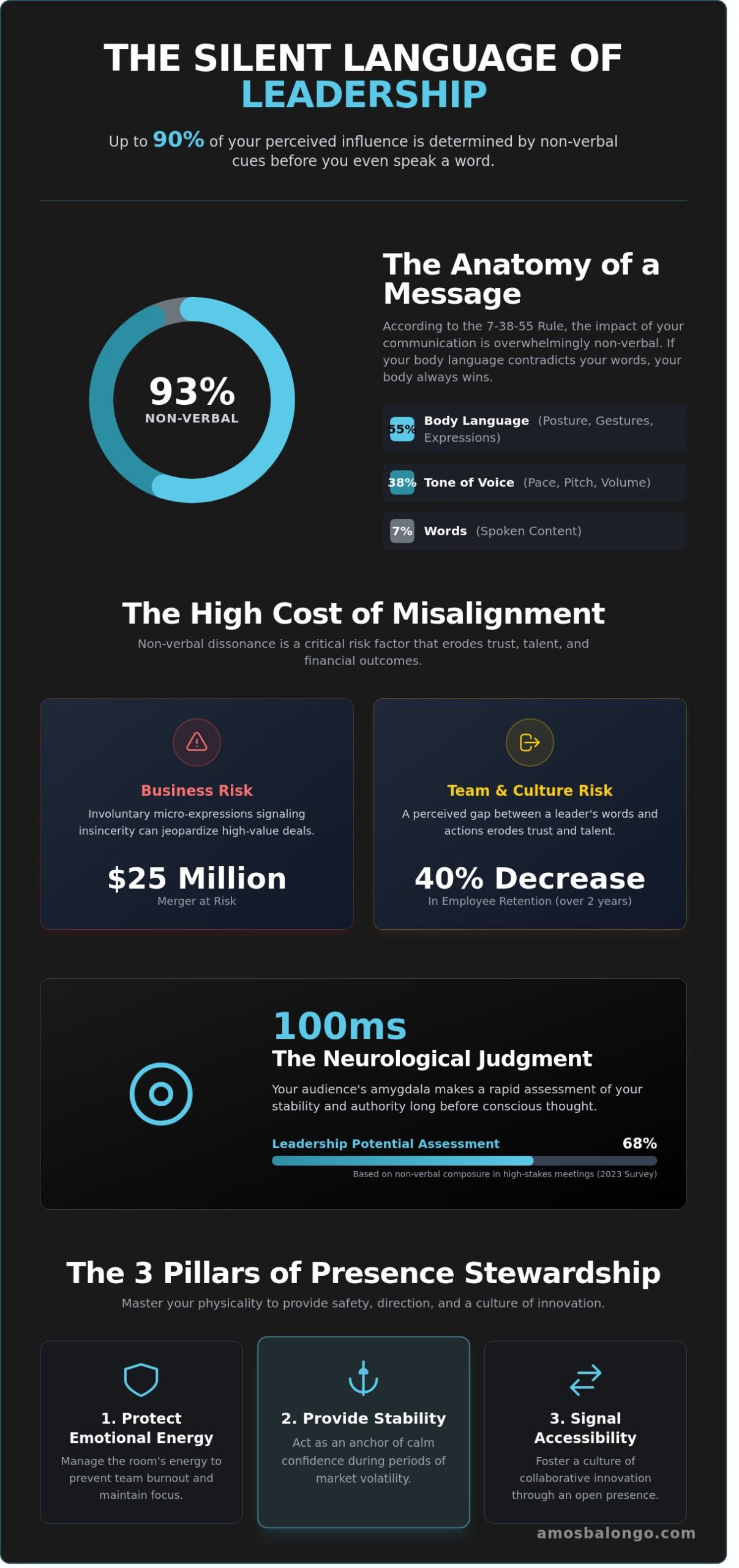
The data supporting this is undeniable. In 1971, UCLA researcher Albert Mehrabian formulated the 7-38-55 rule of communication. This principle states that 55% of a message’s impact comes from body language; 38% comes from the tone of voice; and only 7% is derived from the actual words spoken. If your physical delivery contradicts your verbal strategy, the audience will always believe your body. To lead effectively, you must provide a comprehensive overview of nonverbal communication through your own actions every single day. Physical alignment is the bridge between a brilliant strategy and its successful execution.
Stewardship of presence involves three core commitments:
- Protecting the emotional energy of the room to prevent burnout.
- Providing a sense of stability during periods of market volatility.
- Signaling accessibility to foster a culture of collaborative innovation.
Beyond Gestures: Body Language as Strategic Alignment
Your physical cues are a direct reflection of your internal mindset. They act as a silent broadcast to the entire organization, signaling your level of conviction and your commitment to the mission. Moving from an accidental presence to a purposeful one requires deep intentionality. It’s a shift from just showing up to actively designing how you’re perceived by your stakeholders. Senior leaders must view their posture as a vital sign of corporate health. When a leader stands with open shoulders and a grounded stance, it fosters an environment where innovation can breathe. This is the human element of high performance that transcends traditional management tactics.
The Cost of Misaligned Non-Verbal Cues
The stakes of non-verbal communication are incredibly high in the modern executive suite. Micro-expressions, those involuntary facial flickers that occur in less than a second, can dismantle a 25 million dollar merger if they signal insincerity or hesitation. This risk is particularly acute in technical or engineering environments where a detached executive look often leads to a 40% decrease in employee retention over a two year period. If your team perceives a gap between your words and your movements, they’ll stop listening to your voice. Mastering body language for leaders is the first step in ensuring your legacy isn’t undermined by a lack of physical transparency. By the year 2026, non-verbal dissonance will be recognized as the single greatest factor in the erosion of leadership trust and organizational legacy.
Decoding the Invisible Dynamics of High-Status Communication
Leadership is more than a title on a door; it’s the energy you bring into the room. This energy exchange, often felt before a single word is spoken, represents the invisible dynamics of high-status communication. When you walk into a boardroom, the collective amygdala of your audience performs a scan in approximately 100 milliseconds. This rapid neurological assessment determines whether you’re a source of stability or a cause for concern. True body language for leaders isn’t about performance; it’s about the strategic alignment of your internal state with your external presence.
You must distinguish between positional authority and earned influence. Positional authority is granted by the organization; earned influence is commanded through your physical stewardship of the space. While a title demands attention, your presence inspires devotion. This distinction is the foundation of excellence. It requires a calm confidence that acts as an anchor for organizational stability. In a 2023 survey of 1,200 executives, 68% reported that they judge a colleague’s leadership potential based on their non-verbal composure during high-stakes meetings. Your body must tell the story of a leader who is both capable and composed.
The Biology of Authority: Open Postures and Calmness
The science of expansion is rooted in the biological signal of safety. When you occupy space, you signal to the room that you’re not under threat. Research from the Journal of Nonverbal Behavior indicates that leaders who maintain open, expansive postures are perceived as 20% more competent than those who contract their bodies. Managing your stress response is vital to maintaining this authoritative baseline. You don’t want to appear rigid; you want to appear relaxed. There is a direct relationship between slow movement and perceived status. High-status individuals typically move 15% slower than their subordinates in high-pressure environments. This measured pace suggests that you’re the master of your time and your environment. To cultivate this level of presence, one must commit to a journey of strategic leadership development that transcends tactical skills.
Eye Contact: A Tool for Connection, Not Confrontation
Visual engagement is the bridge between authority and accessibility. I call this the Empathy Advantage. It’s the ability to look through people, seeing their potential and their concerns, rather than just looking at them as objects in a room. You should aim for the 70/30 rule. Maintain eye contact for 70% of the time while listening and 50% while speaking. This balance ensures you’re perceived as powerful yet approachable. In 1-on-1 settings, this creates a sanctuary of focus. In group settings, you must distribute your gaze to include every corner of the room, ensuring no one feels marginalized. During high-pressure Q&A sessions, hold eye contact with the person asking the question for at least 3 seconds after you finish your answer. This simple act demonstrates that you’re not retreating from the challenge. It shows you’re a steward of the truth, standing firm in your vision and your integrity.
Presence is power. It’s that simple. When you master the invisible dynamics of the room, you no longer need to raise your voice to be heard. You become a beacon of clarity in a world of noise. This is the essence of global leadership. It’s the ability to elevate the room simply by being in it. Your physical state is the most honest communication you’ll ever deliver. Make sure it reflects the legacy you intend to leave behind. Integrity of movement leads to integrity of influence. Every gesture should be an invitation to excellence.
Common Misconceptions: Why Tactical ‘Power Posing’ Often Fails
Many executives fear that focusing on body language for leaders will make them appear theatrical or insincere. This hesitation is rooted in a valid observation. When you force a posture that your internal state doesn’t support, the result is cognitive dissonance for your audience. They don’t see a leader; they see a performer. This lack of alignment creates a barrier to trust that no amount of chest-thumping can overcome.
The 2010 Harvard study on “power posing” suggested that physical expansion could fundamentally alter our biochemistry, specifically by increasing testosterone and lowering cortisol. However, a 2015 replication study by researchers at the University of Zurich failed to find these hormonal shifts across a larger sample size. While standing tall might make you feel more confident internally, it doesn’t automatically grant you authority in the eyes of others. Tactical posing is a temporary mask. It’s not a transformation. True influence requires more than just standing like a superhero for 120 seconds before a meeting; it requires a deep integration of your physical presence with your strategic intent.
Vulnerability is often misunderstood as a sign of weakness. In reality, it’s a high-status signal. A leader who can admit a mistake or lean into a moment of uncertainty without collapsing physically demonstrates immense self-assurance. They’re comfortable enough in their own skin to be human. This creates a legacy of transparency that empowers everyone in the room to excel.
Authenticity vs. Performance in the Boardroom
Your body cannot lie to an experienced audience. This is the concept of congruence. If your words speak of partnership but your folded arms signal defense, the audience will always believe your body. Moving from “acting” like a leader to “embodying” leadership values means your physical presence must be an extension of your character. Technical leaders often struggle with this transition because their career success has been built on the cold precision of data rather than the warm resonance of physical presence. To transcend this, one must view body language for leaders as a tool for stewardship rather than a tactic for control. It’s about aligning your physical stature with the weight of your responsibility.
The Trap of Over-Dominance
The “alpha” trap is a common pitfall for those rising through the ranks. Aggressive non-verbals, such as looming over others or using sharp, pointing gestures, actually reduce long-term influence. These behaviors shut down innovation and destroy psychological safety. In 2012, Google’s Project Aristotle identified psychological safety as the number one predictor of team success across 180 teams. When you dominate the physical space to the point of intimidation, you lose the “Human Element” of high performance.
- The Stewardship Alternative: Use your presence to open the floor. Lean back slightly to invite others into the conversation.
- The Empathy Advantage: Balance strength with warmth. A firm stance combined with a genuine, relaxed facial expression signals that you are both capable and approachable.
- Strategic Alignment: Ensure your gestures are purposeful. Random movement drains energy from your message; intentional stillness projects power.
True leadership is not about taking up space to diminish others. It’s about using your presence to create a space where excellence can flourish. When we move beyond the superficiality of tactical posing, we begin the real work of leadership. We stop trying to look powerful and start becoming the steady, visionary force our organizations require. This is how you build a lasting global footprint.
Actionable Strategies for Mastering Executive Presence
Leadership is a sacred trust. It requires a physical manifestation of your internal conviction. When you step into a boardroom, your presence speaks before you utter a single word. You’re a steward of the organization’s vision; therefore, your carriage must reflect that weight. Excellence isn’t an accident. It’s the result of intentional physical discipline. Effective body language for leaders begins the moment you cross the threshold. A 2017 study from Princeton researchers confirmed that observers form impressions of competence and trustworthiness within 100 milliseconds. You must own those opening moments.
The first five seconds of any high-stakes encounter dictate the trajectory of the entire engagement. Follow this executive checklist to ensure your entry radiates authority:
- Vertical Alignment: Imagine a cord pulling the crown of your head toward the ceiling, creating space between your vertebrae.
- The Threshold Pause: Stop for one second at the doorway to scan the room. It signals that you’re comfortable being observed.
- Open Palms: Keep your hands visible and palms slightly turned toward your audience to establish immediate transparency.
- The Three-Second Gaze: Hold eye contact with key stakeholders just long enough to acknowledge their presence without appearing aggressive.
- Measured Pace: Walk with a stride that’s deliberate. Rushing suggests you’re controlled by the clock rather than the mission.
Intellectual discipline finds its home in the “Steeple” gesture. By touching your fingertips together while keeping the palms apart, you signal a high level of confidence and precise thought. This gesture, famously utilized by global heads of state, grounds your energy. It prevents fidgeting. It focuses the audience’s attention on your words. Similarly, seating dynamics play a vital role in influence. Positioning yourself at the center of the long side of a rectangular table increases your visibility to 85 percent of the participants, allowing you to moderate the flow of the conversation with ease.
True stillness comes from the breath. Diaphragmatic breathing can reduce cortisol levels by 25 percent, according to a 2017 study published in Frontiers in Psychology. When you breathe deeply into the lower lungs, your voice gains a resonant, authoritative timbre. It eliminates the “thin” quality of a nervous throat. This physical calm allows you to transcend the immediate pressure of the moment and focus on your long-term legacy.
For those looking to explore the deepest levels of this internal discipline, some guides take the connection between breath and energy to its ultimate conclusion. Fasting expert Ray Maor, for instance, teaches that profound self-mastery can allow one to be sustained by life force energy, demonstrating an extreme form of the physical calm and presence discussed here.
Commanding the Room During High-Stakes Presentations
Utilize the ‘Anchor’ technique by planting your feet shoulder-width apart. This stance projects global impact because it suggests you’re unshakeable. When you move, do so with purpose. Walk toward the audience during a key insight; then, return to your anchor point during a strategic pivot. This movement creates a rhythmic cadence that mirrors your speech, driving emotional resonance through the human element of your performance.
Navigating the Digital Boardroom: Body Language on Camera
Modern body language for leaders must adapt to the lens. The ‘Virtual Eye Contact’ hack is simple but profound: look directly at the camera lens, not the faces on the screen. This creates the 1:1 connection necessary for trust. Ensure your camera is at eye level and your frame includes your upper torso. This allows your hand gestures to be seen, projecting energy and warmth without the distortion of over-gesticulating near the microphone.
Your journey toward becoming a more impactful communicator starts with a commitment to growth. To refine your executive presence further, explore my strategic leadership coaching programs designed to elevate your global footprint.
Elevating Your Influence Through the Communication Mastery System
Mastery is never an accident. It’s the result of a deliberate architecture designed to align your internal convictions with your external presence. This deliberate approach to communication mastery serves as an essential framework. It provides the blueprint for leaders who recognize that technical expertise is merely the baseline for entry into the executive suite. To truly command a room, you must understand that your physical presence carries as much weight as your strategic insights. Within this framework, body language for leaders serves as a critical pillar of professional visibility, ensuring that your message isn’t just heard, but felt and remembered.
The transformation we pursue moves you beyond the confines of a subject matter expert. You’re stepping into the role of a global leader. This evolution requires a shift in how you inhabit space and interact with your environment. A 2023 analysis by the Harvard Business Review highlighted that 95% of executive success in high-stakes environments is tied directly to emotional intelligence and non-verbal communication rather than technical skill sets. We don’t just teach you how to stand; we teach you how to embody the excellence your position demands. This personal development acts as a catalyst for broader organizational change. When you elevate your standards, you create a ripple effect that transforms the culture of your entire enterprise.
- Move from technical proficiency to visionary influence.
- Align your non-verbal cues with your strategic objectives.
- Cultivate a presence that commands respect in any global market.
- Bridge the gap between your intent and the audience’s perception.
Integrating Non-Verbal Cues into Your Leadership Legacy
Your presence today dictates the culture of your organization tomorrow. Leadership is, at its core, an act of stewardship. You’re managing the potential and the morale of those who look to you for direction. If your posture suggests hesitation, your team will mirror that uncertainty. Embracing body language for leaders requires a commitment to individual accountability. It means holding yourself to a standard of non-verbal integrity where your gestures and gaze reinforce your words. This vision of leadership transcends titles. It focuses on the legacy you leave behind through every interaction and every presentation. You’re not just delivering a speech; you’re setting the pace for excellence within your firm.
Personalized Coaching for the Modern Executive
Generic advice often fails because it ignores the unique pressures of your specific boardroom. High-stakes environments demand a level of precision that a standard checklist cannot provide. This is where the role of an Executive Communication Coach becomes indispensable. We identify the subtle blind spots that might be undermining your authority. Data from the International Coaching Federation in 2022 suggests that 70% of executives who engage in personalized coaching see a direct improvement in their professional performance and strategic alignment. Rather than adopting a persona, you refine your natural style to reach its highest expression. It’s time to move toward a more intentional way of leading. You can book a consultation with Amos Balongo Consulting Coaching for personalized executive communication coaching to begin your journey toward a lasting global footprint.
Stepping Into Your 2026 Strategic Legacy
Leadership in 2026 demands more than a title; it requires a profound commitment to the silent stewardship of your presence. True executive influence doesn’t come from the outdated 2012 era of tactical power posing. It emerges from a place of deep alignment, intellectual discipline, and strategic intentionality. You’ve learned that authentic body language for leaders is a direct reflection of your inner character and your duty to those you lead. By integrating the Empathy Advantage framework, you move beyond superficial gestures to create a lasting global footprint that resonates in every boardroom.
I’ve spent over 18 years in strategic consulting, refining these high-performance principles alongside military officers and Fortune 500 executives. This isn’t just tactical advice; it’s a transformational path toward excellence and integrity. Your legacy is built on the silent signals you send every single day. It’s time to transform your communication into a powerful tool for global impact and organizational growth. You possess the potential to transcend the ordinary and lead with a quiet power that commands respect. Elevate your influence with the Communication Mastery System today. The world is waiting for the visionary leader you’re destined to become.
Frequently Asked Questions
What is the most important body language trait for a leader?
Congruence between your message and your movement is the most vital trait for any executive. Dr. Albert Mehrabian’s 1967 research indicates that 55% of communication is nonverbal; therefore, your physical presence must mirror your strategic intent. When your gestures align with your words, you build trust. This alignment is the foundation of stewardship. It transforms a simple speech into a legacy-defining moment for your organization.
How can I improve my executive presence in virtual meetings?
Maintaining consistent eye contact with the camera lens rather than the screen is the fastest way to elevate your digital presence. A 2021 study by Quantified Communications found that leaders who sustain eye contact 65% of the time are perceived as significantly more trustworthy. Frame yourself so your shoulders and hands are visible. This transparency allows your team to see your conviction. It turns a standard video call into a space for visionary alignment.
Is it possible to learn body language if I’m naturally introverted?
You can absolutely master body language for leaders regardless of your natural temperament. Data from USA Today indicates that 40% of high-performing executives identify as introverts; they succeed by viewing presence as a disciplined craft. Physicality is not about extroversion but about intentionality. You aren’t performing; you’re serving your audience. By adopting a grounded stance, you project a calm authority that resonates with depth and purpose.
How do I avoid looking aggressive when trying to show authority?
Utilizing open-palm gestures allows you to project authority without appearing adversarial or aggressive. Research published in the Journal of Nonverbal Behavior shows that open gestures increase a leader’s perceived likability by 33% compared to closed postures. Avoid pointing fingers or clenching your fists. Instead, use the “steeple” gesture to signal intellectual confidence. This approach fosters a culture of mutual respect and strategic excellence within your executive team.
What should I do with my hands when giving a keynote presentation?
Keep your hands within the “strike zone” between your waist and chest to maximize your oratorical impact. An analysis of 500 top-tier TED Talks revealed that the most influential speakers utilize 465 hand gestures on average to reinforce their message. Use your hands to illustrate scale, direction, and connection. This physical openness invites your audience into your vision. It ensures your message transcends the stage and takes root in their minds.
Can body language help in de-escalating conflicts with senior stakeholders?
Adopting a 45-degree angle relative to a stakeholder is a powerful way to de-escalate tension during high-stakes negotiations. A 2018 study in the International Journal of Business Communication found that subtle mirroring of a partner’s posture can reduce stress markers by 15% during conflict. This technique signals that you’re a collaborator rather than an opponent. It reflects a commitment to stewardship. You prioritize the long-term health of the partnership over short-term ego.
How long does it take to see results from communication coaching?
You’ll notice an immediate shift in audience engagement, but true mastery of body language for leaders typically takes 66 days of consistent practice. University College London research confirms this timeframe is necessary for new behavioral patterns to become subconscious. Transformation is a marathon, not a sprint. By dedicating 15 minutes daily to mindful movement, you build a foundation for excellence. This discipline ensures your leadership presence becomes a permanent part of your professional legacy.
Is there a difference between body language for men and women in leadership?
Core principles of presence are universal, though a 2019 Catalyst report highlights that women often face a “double bind” regarding perceived warmth and competence. Effective leaders of all genders focus on expansive movements that occupy space and signal confidence. Avoid shrinking your physical footprint. Instead, claim your position with a grounded stance and steady breath. This universal language of power allows you to transcend bias. It focuses the room on your strategic vision and global impact.