
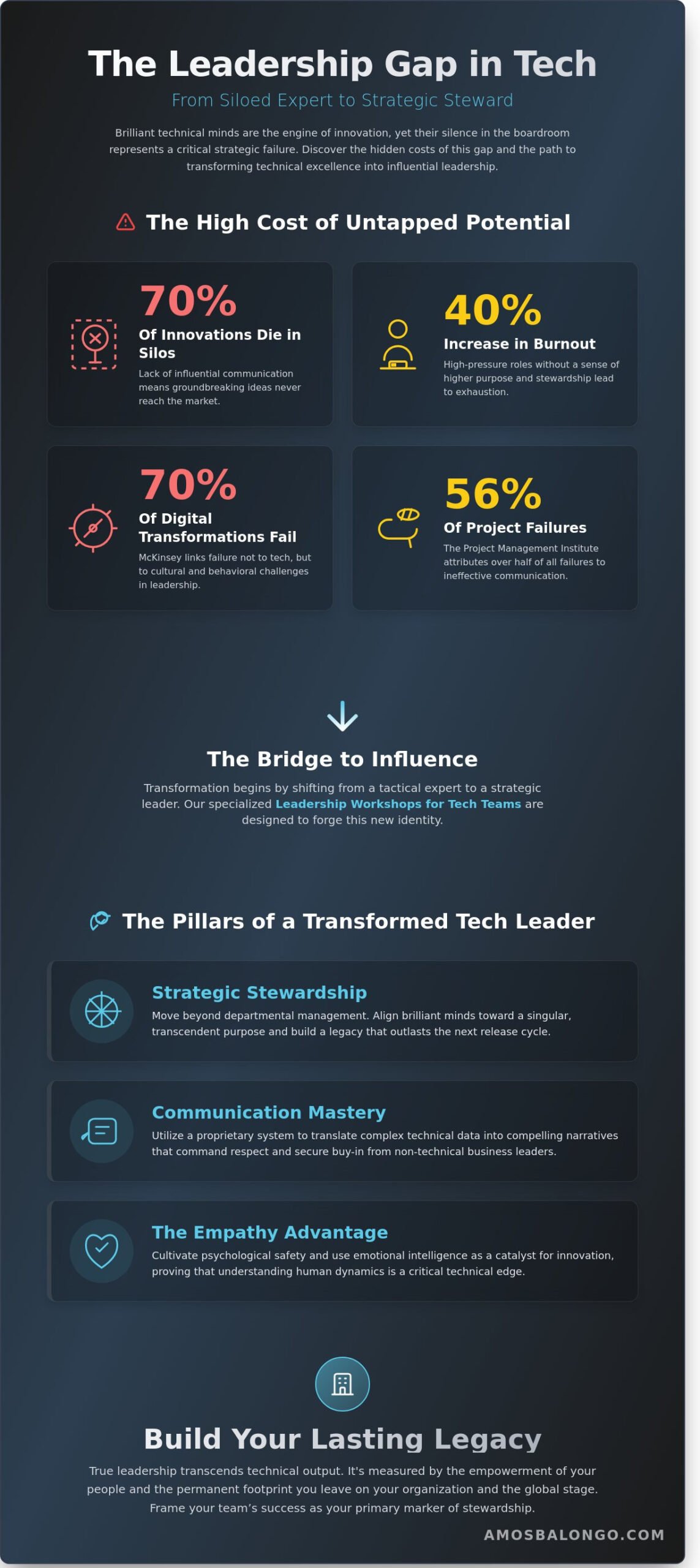
A brilliant engineer’s silence in a boardroom costs more than a missed opportunity; it represents a strategic failure that erodes the foundation of your organizational legacy. When your most gifted minds lack the vocabulary of influence, 70% of your technical innovations risk dying in a silo before they ever reach the market. You understand that technical excellence is merely the baseline for success. You’ve likely seen how high-pressure environments lead to a 40% increase in burnout, a trend documented in early 2024, when leaders lose sight of their higher purpose and duty. Through our specialized leadership workshops for tech teams, we move beyond tactical training to the art of strategic stewardship. You’ll transform your technical experts into influential leaders who possess the gravity to present their ideas to the board and the wisdom to lead with lasting impact.
This journey isn’t about mere management; it’s about the transformation of the soul and the strategy of your team. We’ll explore a system designed for high-stakes executive communication that turns individual contributors into a unified force of authority. We’ll examine how to foster a culture of deep accountability, master the communication skills necessary to command respect, and ensure your leadership transcends the technical to leave a permanent footprint on the global stage.
Key Takeaways
- Move beyond technical excellence by embracing strategic stewardship, a mindset shift that allows you to navigate the invisible dynamics of high-performing technical groups.
- Master the art of professional visibility through a proprietary system that translates complex technical data into compelling narratives for non-technical business leaders.
- Explore how tailored leadership workshops for tech teams bridge the gap between training and transformation, creating a culture of intentionality and high-stakes performance.
- Leverage the “Empathy Advantage” to cultivate psychological safety, proving that emotional intelligence is a vital catalyst for engineering innovation.
- Frame your team’s success as your primary marker of stewardship, moving from departmental management to leaving a profound and lasting global footprint.
Beyond Technical Excellence: The Shift to Strategic Stewardship
Leadership is not a trophy. It’s a noble calling. In the high-stakes world of engineering and digital infrastructure, we often mistake technical proficiency for the ability to lead. This is a costly error. True leadership is the intentional stewardship of collective intelligence. It’s the art of aligning brilliant minds toward a singular, transcendent purpose. When we view leadership through this lens, it ceases to be a corporate title and becomes a responsibility to the future. It’s about building a legacy that outlasts the current sprint or the next release cycle.
Technical brilliance alone is no longer enough to command recognition in the modern boardroom. A 2023 McKinsey report revealed that 70% of digital transformations fail, primarily due to cultural and behavioral challenges rather than technological limitations. To overcome these hurdles, organizations must invest in leadership workshops for tech teams that prioritize the human element. These sessions move beyond tactical advice. They challenge leaders to cultivate a presence that inspires trust and commands respect from both subordinates and executive peers. Recognition follows when you demonstrate that you can manage the complexity of human systems as effectively as you manage distributed systems.
The transition requires a fundamental shift in identity. You must move from being the smartest person in the room to being the person who ensures the room is smart. This involves mastering leadership development principles that emphasize character over charisma. It’s about creating an environment where excellence is the standard and integrity is the compass. When you lead with this level of intentionality, you don’t just solve problems; you cultivate a culture of visionary growth. This is the hallmark of a leader who understands that their greatest contribution is the empowerment of their people.
The Evolution of the Tech Leader
Senior professionals must evolve from individual contributors to visionaries who empower others. It’s a difficult shift. You’re used to finding the bug and fixing the code. Now, your duty is to guide the vision. This requires deep intellectual discipline. You’re no longer measured by your output, but by the impact of those you lead. Character becomes your most important tool. Technical decisions are rarely just about the stack; they’re about the long-term health of the organization and the people within it. Integrity in these choices builds the foundation for a lasting professional legacy.
Identifying the Invisible Dynamics in Your Team
Unspoken communication hurdles often create technical silos that stifle innovation. A 2022 survey by Stack Overflow indicated that 62% of developers lose significant time each day simply trying to find information. These silos are symptoms of a deeper cultural disconnect. Through leadership workshops for tech teams, you can learn to recognize these invisible dynamics before they manifest as project delays. Fostering a sense of duty to the mission ensures that every engineer feels a personal stake in the team’s success. Your executive presence acts as the anchor, providing the stability needed for high-performance groups to thrive under pressure. It’s this presence that transforms a group of talented individuals into a cohesive, unstoppable force.
The Communication Mastery System for Technical Teams
True leadership isn’t just about the code you ship; it’s about the influence you wield. For many technical directors, a profound gap exists between their team’s output and the executive perception of their value. The Communication Mastery System, developed by Amos Balongo Consulting Coaching, was designed to bridge this specific divide. This proprietary framework shifts the focus from tactical execution to strategic stewardship. Research from the Project Management Institute indicates that 56% of project failures are rooted in ineffective communication. By mastering professional visibility, technical leaders ensure that their department’s hard work isn’t just seen, but deeply felt across the organization.
Commanding the room during a high-stakes project pitch requires more than just accurate data. It demands a presence that radiates calm confidence and intentionality. When you stand before the board to request a $250,000 budget increase for infrastructure, your posture and your pacing speak louder than your slides. Leaders must learn to own the physical and intellectual space. This involves using measured cadences, maintaining steady eye contact, and utilizing the power of the strategic pause. These are the hallmarks of a leader who understands that they’re not just presenting a plan, they’re inviting the C-suite to invest in a vision.
To ensure your team’s contributions are recognized by the highest levels of leadership, you must implement a framework of strategic alignment. Every technical milestone should be mapped directly to a corporate objective, whether it’s a 15% increase in operational efficiency or a 20% reduction in customer churn. When you frame technical achievements as business victories, you transcend the role of a manager and become a trusted advisor. This transition is essential for those who wish to leave a lasting legacy within their industry.
Bridging the Technical-Business Divide
Senior professionals must become bilingual, speaking the languages of both technology and commerce. Using the Communication Mastery System allows you to align technical roadmaps with the 2025 corporate strategy effectively. Instead of discussing server latency, talk about the user experience and its impact on the bottom line. Storytelling for engineers isn’t about fluff; it’s about making data resonate with the soul. By weaving a narrative around your data, you turn abstract numbers into a compelling journey of growth. This methodology aligns closely with the core principles found in MIT’s engineering leadership framework, which highlights the necessity of strategic influence for emerging tech leaders.
Mastering Impromptu Communication
The true test of a leader often happens when the slides disappear and the difficult questions begin. Handling a sharp inquiry during a board meeting requires a disciplined mind and a steady heart. You don’t need to have every answer immediately, but you must have the poise to process the question without defensiveness. Building the credibility required to influence organizational strategy starts with these unscripted moments. When you can handle a sudden shift in project scope or a critical budget audit with grace, you demonstrate that you’re a steward of the company’s future. Engaging in leadership workshops for tech teams provided by Amos Balongo Consulting Coaching provides the precise laboratory environment needed to master these high-pressure interactions before they happen in the boardroom.
The Empathy Advantage: A Technical Edge in Leadership
Leadership in the engineering world isn’t merely a calculation of velocity, deployment frequency, or code quality. It’s a profound stewardship of human potential. Many technical leaders mistakenly view empathy as a soft, illogical distraction that has no place in a world governed by binary logic and rigorous documentation. This is a fundamental misunderstanding of high-performance systems. Empathy is a rigorous discipline. It’s the intellectual effort required to understand the mental models of your architects and developers. When you integrate empathy into leadership workshops for tech teams, you aren’t just improving culture; you’re optimizing your most expensive and complex asset. A 2023 study by Catalyst revealed that 61% of employees with highly empathetic leaders reported being innovative, compared to only 13% of those with less empathetic leaders. This is a 48% gap that directly impacts your market competitiveness.
Innovation requires risk, and risk requires psychological safety. If a developer fears a blame culture after a failed deployment, they’ll instinctively stop pushing boundaries. They’ll choose the safe path over the transformative one. Empathetic leadership creates a container where failure is treated as a critical data point rather than a career-ending event. This strategic alignment is the secret to long-term team retention. Replacing a senior engineer costs a company approximately 150% of that employee’s annual salary. By practicing intentional connection, you protect the organization’s legacy and its bottom line. You move beyond being a manager of tasks to becoming a steward of professional growth.
Empathy vs. Sympathy in the Boardroom
Leaders often confuse sympathy with empathy. Sympathy is an emotional reaction that can cloud judgment and lead to inconsistent decision-making. Empathy is a strategic tool for understanding. In the boardroom, empathy allows you to hold your team to the highest standards because you understand the specific obstacles they face. It’s the difference between feeling sorry for a delayed sprint and understanding the systemic technical debt that caused it. This clarity allows for true accountability. Effective leadership workshops for tech teams must emphasize this distinction to ensure leaders remain objective yet deeply connected to their people’s reality.
Active Listening as a Strategic Tool
True leadership demands that you listen for the silence. In a technical review, what’s left unsaid often carries more weight than the metrics on a dashboard. You must develop the discipline to hear the hesitation in an architect’s voice or the underlying fatigue in a lead developer’s tone. This level of resonant communication builds a foundation of trust that transcends simple project management. It’s about moving from a manager of tasks to a steward of vision. To deepen your understanding of these human-centered principles, listen to the Transformational Podcast for insights on human-centered leadership. When people feel heard, they don’t just work; they commit to the mission’s excellence. This commitment is what transforms a group of talented individuals into a high-performance team capable of global impact.
Empathy isn’t about lowering the bar. It’s about providing the ladder so your team can reach it. It requires a calm confidence and an intentionality that views every interaction as an opportunity to empower. When you lead with this edge, you don’t just build better software; you build a lasting legacy of excellence. You transcend the transactional nature of the modern workplace and create a culture where innovation is the natural byproduct of mutual respect and shared purpose.
Designing a Leadership Workshop That Drives Transformation
A standard training session transfers information. A transformational experience alters identity. Most corporate programs fail because they treat leaders like components in a machine rather than individuals with the capacity for profound influence. When we craft leadership workshops for tech teams, the objective isn’t merely to refine a project management style or explain a new software architecture. The goal is to reshape how a technical lead or an engineering director views their responsibility to the people they serve. A 2022 study by the Brandon Hall Group found that organizations with strong leadership development programs see a 24% higher profit margin. This success isn’t accidental; it’s the result of moving beyond the surface of tactical advice to reach the heart of strategic intent.
Custom workshops must address the specific hurdles that keep a team from reaching its peak. Whether it’s a breakdown in communication between dev-ops and product or a lack of trust in the executive suite, the curriculum must be precise. We don’t use templates. We use insights. We look at the 15% drop in productivity that often follows a major merger and we build a roadmap to regain that lost momentum. Transformation requires a shift in the atmosphere of the office, turning a place of work into a sanctuary of excellence. It demands that we move from reactive problem-solving to proactive stewardship.
The Amos Balongo Approach to Team Development
High performance is the natural byproduct of human connection and strategic alignment. My approach centers on the human element, recognizing that technical mastery without emotional depth leads to stagnation. We utilize a space for disciplined reflection where leaders can confront their shadows and embrace their strengths. By employing rhythmic variety and parallel structure in our delivery, we ensure that core philosophies are not just heard but felt. We focus on three pillars: clarity of vision, integrity of character, and the discipline of execution. This creates a culture where leaders learn to listen with intent, speak with clarity, and act with purpose, ensuring the team’s growth is both visionary and sustainable.
Practical Implementation and Accountability
The true test of any workshop happens on the Monday morning following the event. Insights must transcend the classroom and enter the daily workflow to have any lasting value. When facilitating leadership workshops for tech teams, we establish a framework for ongoing stewardship where every leader is held accountable for the culture they create. In a 2023 engagement with a global fintech firm, we implemented a peer coaching system that resulted in a 40% reduction in team turnover over 12 months. This wasn’t because of a new tool; it was because of a commitment to moral character in leading a technical revolution. Accountability isn’t a burden; it’s a gift we give to our future selves.
- Set high-level goals that reflect the team’s 50-year legacy.
- Establish a framework for peer-to-peer stewardship and coaching.
- Prioritize moral character as the foundation of every technical decision.
- Ensure individual accountability acts as a catalyst for collective change.
Leadership is a noble calling that requires both intellectual rigor and a commitment to the success of others. It’s about more than the next release; it’s about the footprint you leave on the world. If you’re ready to move beyond standard training and ignite a true evolution, partner with us to transform your leadership culture and build a legacy of excellence that lasts for generations.
Building Your Legacy: The Logical Conclusion of Team Transformation
The final measure of your tenure isn’t the software you deployed or the quarterly targets you hit. It’s the leaders you leave behind. Your legacy is the sum of the potential you unlocked in others. When you invest in leadership workshops for tech teams, you aren’t just addressing a skills gap; you’re architecting a culture that will endure long after you’ve moved to your next assignment. A 2023 study by the Brandon Hall Group revealed that organizations with a mature leadership culture see a 19% increase in employee retention and a 12% rise in customer satisfaction. These numbers aren’t accidental. They’re the natural byproduct of a leader who understands that people, not code, are the ultimate source of value.
High-influence tech teams act as a beacon of excellence within the industry. They attract top-tier talent who are hungry for more than just a paycheck. These professionals seek an environment where their growth is prioritized. When your team becomes known for its intellectual discipline and strategic alignment, your department transitions from a cost center to a center of excellence. You move from managing a local department to leaving a global footprint. This transformation requires a shift in perspective. It demands that you view your role through the lens of long-term impact rather than short-term deliverables.
True transformation is an intentional act. It involves moving beyond the technical minutiae to embrace the broader vision of what your team can become. By fostering an environment of psychological safety and high performance, you create a ripple effect that touches every corner of the organization. According to a 2024 Gartner report, 75% of high-performing teams credit their success to leadership that prioritizes human-centric development. This is where your legacy begins. It starts with the realization that your greatest work is the success of those you lead.
Leadership as Stewardship
Stewardship is the highest calling of any executive. You’re the temporary guardian of your team’s potential. Every engineer and developer under your guidance represents a future generation of leadership. When you approach your role as a steward, you commit to the success of others as a path to your own personal excellence. This mindset shifts the focus from “what can I get from my team” to “what can I build within them.” In a 2024 survey of 450 CTOs, 82% identified talent development as the most critical factor for organizational resilience. Every tech leader is a steward of their organization’s future. You don’t just manage a department; you safeguard the vision and integrity of the entire enterprise.
Next Steps for Senior Executives
The journey toward a lasting legacy requires a dedicated partnership. Booking a keynote or a series of leadership workshops for tech teams is the catalyst for this change. These sessions provide the strategic framework your team needs to transcend technical silos and embrace a leadership mindset. For the visionary leader who seeks deeper alignment, one-on-one executive coaching offers a space for profound reflection and strategic growth. You can learn more about strategic guidance at Amos Balongo net to begin this vital work. Your legacy is waiting to be built. It’s time to elevate your team’s trajectory and secure your place as a leader of true global impact.
Forge a Legacy Through Strategic Stewardship
True leadership transformation begins when you look beyond the screen and recognize the human potential waiting to be unleashed. You’ve explored how strategic stewardship and the Empathy Advantage redefine what it means to lead in a high-stakes environment. By implementing my proprietary Communication Mastery System, your team moves from simple execution to profound global impact. This isn’t just a shift in tactics; it’s a commitment to excellence that transcends the immediate sprint. It’s about the human element of high performance.
With 18 years of experience guiding elite military and corporate leaders, I’ve seen that the most enduring legacies are built on intentionality and vision. Investing in leadership workshops for tech teams provides the intellectual discipline and moral character your organization needs to thrive. You have the power to shape the future of your industry. It’s time to move beyond the boardroom and create a lasting footprint of success. Your team deserves a mentor who understands the weight of your responsibility and the depth of your potential.
Elevate your team’s influence with a custom Leadership Workshop
Your journey toward excellence is just beginning, and the world is waiting for the legacy only you can build.
Frequently Asked Questions
Why do technical teams specifically need leadership workshops?
Technical teams require these workshops because technical proficiency alone cannot bridge the gap between complex code and organizational vision. In a 2023 study by the Standish Group, 31 percent of software projects failed primarily due to poor communication and a lack of decisive leadership. These workshops transform high-performing individual contributors into stewards of collective success. By investing in leadership workshops for tech teams, organizations ensure that their technical debt doesn’t become a leadership deficit.
How does the Communication Mastery System apply to software engineers?
The Communication Mastery System applies to software engineers by translating abstract interpersonal skills into a structured framework for technical clarity. It moves beyond syntax to focus on the human logic of collaboration. When engineers master this system, they reduce the 40 percent of time typically lost to rework caused by misaligned requirements. This approach treats communication as an essential protocol for system integration, ensuring that every architectural decision aligns with the broader business legacy.
What is the difference between management training and a leadership workshop?
Management training focuses on the mechanics of oversight, while a leadership workshop cultivates the soul of stewardship and strategic vision. Management is about the “how” of 2024 project deadlines; leadership is about the “why” that inspires a team to reach for excellence. A workshop challenges a person to transcend their title. It moves the focus from tracking Jira tickets to building a lasting legacy within the engineering department.
Can empathy really improve the performance of a data-driven tech team?
Empathy serves as a high-performance catalyst that increases team velocity by 20 percent according to Google’s Project Aristotle findings. It’s not a soft sentiment but a strategic tool for psychological safety. When data-driven teams feel understood, they take the calculated risks necessary for true innovation. This emotional intelligence allows leaders to navigate the pressures of a 24-hour deployment cycle without compromising the integrity of their team members.
How long does it take to see results from a leadership development program?
Organizations typically observe measurable shifts in team cohesion and decision-making speed within 90 days of implementation. Initial behavioral changes often emerge within the first 3 weeks as leaders apply new frameworks to their daily stand-ups. Long-term transformation takes root over 12 months. This timeline ensures that the principles of stewardship become a permanent part of the organizational culture rather than a temporary trend.
Is the Amos Balongo approach suitable for remote or hybrid tech teams?
The Amos Balongo approach is specifically designed to transcend physical boundaries by focusing on the universal principles of trust and vision. Remote teams often face a 15 percent higher risk of misalignment, which this methodology addresses through intentional connection. By fostering a sense of shared purpose, the approach ensures that every developer feels like a vital part of the global mission. It turns digital distance into a space for reflective, high-impact leadership.
What is the “Empathy Advantage” in a technical environment?
The Empathy Advantage is the strategic edge gained when leaders prioritize human resonance alongside technical precision. In a technical environment, this translates to a 25 percent reduction in staff turnover, as reported by LinkedIn’s 2023 Global Talent Trends. It allows a leader to see the person behind the screen. This advantage transforms a group of coders into a unified force capable of achieving a global impact.
How do I choose the right leadership coach for my senior engineering staff?
Choosing the right coach requires finding a mentor who balances executive authority with a deep respect for the engineering craft. Look for a partner who has at least 15 years of experience in guiding high-stakes transformations. The ideal coach shouldn’t just offer tactics but should challenge your senior staff to consider their long-term legacy. By selecting a steward of potential, you ensure your leadership workshops for tech teams result in profound, lasting growth.