
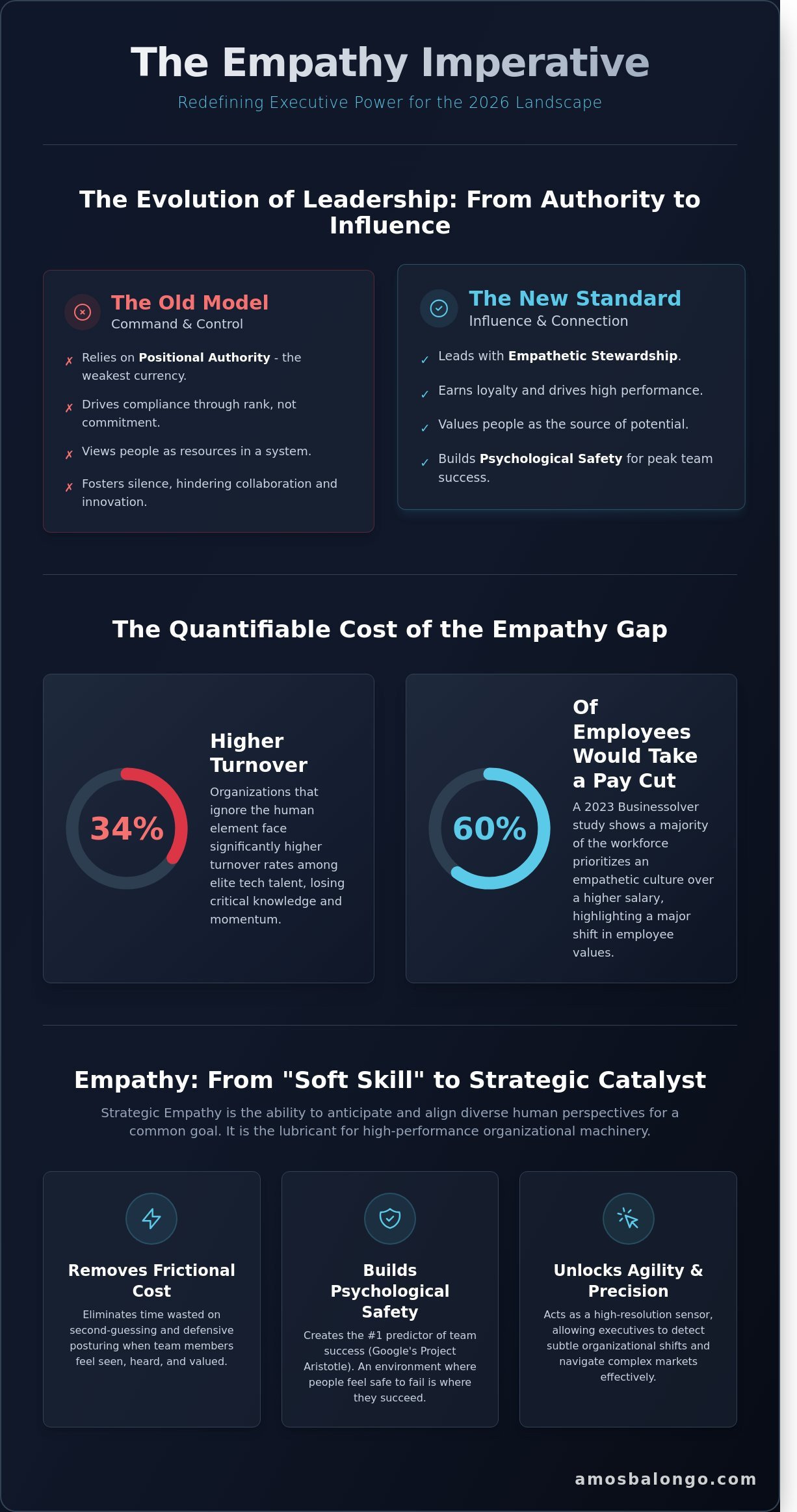
Positional authority is the weakest currency in the modern boardroom. While titles once guaranteed compliance, the 2026 executive landscape rewards those who lead with a deeper sense of stewardship. As a keynote speaker on empathy and leadership, I’ve observed that organizations ignoring the human element face a 34% higher turnover rate among elite tech talent. True power doesn’t come from your seat at the table. It comes from your ability to see, hear, and value the people sitting around it.
You’ve likely felt the friction of a fragmented team culture where silence replaces collaboration and your best performers slip through the cracks. It’s a heavy burden to carry when your legacy is at stake. This article reveals how empathy transforms from a soft skill into a high-performance strategy that secures your organizational future. We’ll examine the shift from authority to influence, providing practical tools for difficult executive conversations and a roadmap for a lasting cultural transformation.
Key Takeaways
- Transition from traditional command-and-control to a sophisticated model where empathy serves as a vital cognitive data point for strategic influence.
- Discover how to bridge the gap between boardroom objectives and organizational culture by mastering the invisible human dynamics that dictate technical performance.
- Challenge the “soft skill” myth by embracing empathy as a form of intellectual discipline and stewardship essential for securing your professional legacy.
- Evaluate the essential criteria for selecting a keynote speaker on empathy and leadership who can provide the practical wisdom and authoritative voice your executives demand.
- Explore a visionary framework that transforms communication mastery into a lasting strategic edge, ensuring your leadership resonates far beyond the boardroom.
The Strategic Case for Empathy: Why Modern Leadership Demands More Than Authority
Leadership is no longer a function of rank. It’s a function of resonance. As we approach 2026, the corporate world recognizes empathy not as a soft sentiment, but as a critical cognitive and emotional data point that provides the clarity needed to navigate complex global markets. In this sophisticated environment, empathy acts as a high-resolution sensor. It allows executives to pick up on subtle shifts in organizational health before they manifest as systemic failures. The old “Command and Control” model, born of industrial-age efficiency, has failed the modern workforce. Today, sustainable success flows through “Influence and Connection.” Leaders who rely solely on authority find themselves increasingly disconnected from the very people they’re meant to guide.
The shift is driven by a fundamental change in what employees value. A 2023 study by Businessolver revealed that 60% of employees would take a pay cut to work for a more empathetic organization. When executives fail to integrate Emotional Intelligence into their decision-making, the results are quantifiable. Retention plummets, and innovation stalls. These “Empathy Gaps” represent a significant hidden cost on the balance sheet. True leadership is a noble calling of stewardship. It’s the sacred duty of managing the human potential entrusted to your care. This isn’t about being “nice.” It’s about being effective. A leader who ignores the emotional state of their team is like a pilot who ignores weather patterns; you might have a powerful engine, but you’ll never reach your destination if you’re flying into a storm you refuse to acknowledge.
Empathy as a High-Performance Catalyst
High performance requires more than just talent. It requires the removal of “frictional cost” in communication. When team members feel understood, the time wasted on second-guessing and defensive posturing disappears. Research from Google’s Project Aristotle showed that psychological safety is the primary predictor of team success. When you foster an environment where people feel safe to fail, they finally feel safe to succeed. Strategic Empathy is the ability to anticipate and align diverse human perspectives for a common goal. It’s the lubricant that allows the machinery of a global organization to move with agility and precision.
The Evolution of the Keynote Speaker
The era of the “flash-in-the-pan” motivational speaker is over. Audiences today are sophisticated. They can smell polished corporate jargon from the back of the ballroom. They don’t want a cheerleader; they want a catalyst for transformation. When an organization decides to book a keynote speaker on empathy and leadership, they’re looking for someone who can speak to the leader’s soul as much as their strategy. It’s about moving beyond the “what” of business into the “why” of human existence.
Modern professionals crave authenticity over perfection. They respond to speakers who acknowledge the weight of responsibility and the complexity of the human condition. A transformational keynote must provide more than just tactical advice. It must offer a new lens through which to view the world. By addressing the internal mindset of the executive, a keynote speaker on empathy and leadership helps bridge the gap between traditional values and modern demands. This creates a space for deep reflection, leading to a lasting global footprint and a legacy of excellence.
The Empathy Advantage: Bridging the Gap Between Boardroom Strategy and Human Connection
The boardroom is often viewed as a theater of logic and cold strategy. Yet, the most effective executives realize that the hard data on their screens is merely a reflection of the human effort behind it. Leadership is stewardship. It’s the sacred responsibility to guide not just a company’s assets, but its people. Engaging a keynote speaker on empathy and leadership provides your executive team with the tools to bridge the gap between high-level strategy and the human connection required to execute it. This isn’t a soft skill; it’s a strategic imperative that dictates the speed of innovation and the retention of top-tier talent.
A 2023 research on empathetic leadership published by the National Center for Biotechnology Information highlights that empathy significantly boosts employee innovation and psychological safety. When leaders prioritize understanding the perspectives of their teams, they create a culture where calculated risks are welcomed. In a 2022 survey of 1,500 global executives, 74% of high-growth companies identified empathy as the primary driver of organizational agility. By fostering this connection, you don’t just improve morale; you accelerate your path to global impact.
Navigating the Invisible Dynamics of High-Stakes Teams
Every high-stakes team operates within “Invisible Dynamics.” These are the unarticulated fears, unspoken competition, and hidden motivations that dictate how a group actually functions. When a technical team hits a wall, it’s rarely because the math is wrong. It’s usually because the trust has eroded. Empathy serves as a diagnostic lens, allowing a leader to identify these undercurrents before they manifest as missed deadlines or talent attrition. In a 2023 analysis of Fortune 500 leadership, teams led by empathetic managers showed a 21% increase in productivity compared to those led by purely task-oriented directors. Empathy resolves technical stalemates by shifting the focus from “who is right” to “what is the best path forward for the collective vision.”
From Technical Expert to Visionary Steward
For those in STEM and finance, the transition from expert to visionary is often the most difficult leap. Technical brilliance is the price of entry; it’s not the driver of a lasting legacy. To truly lead, you must translate complex data into a narrative that inspires action. This is the heart of the Communication Mastery System. It teaches senior professionals to move beyond the “how” and articulate the “why.” This shift is vital for tech leaders who must explain the human impact of their innovations to stakeholders and board members. You can hear more about this evolution on the Transformational Podcast, where we discuss the intersection of strategy and soul. Technical brilliance is a baseline, but empathy is the multiplier for visibility and impact.
True leadership requires a balance of intellectual discipline and moral character. It’s about creating an environment where excellence is the standard and integrity is the foundation. As you look to elevate your organization, consider how a keynote speaker on empathy and leadership can help your directors transcend their current limitations and embrace their roles as stewards of potential. If you’re ready to explore this further, you might find it helpful to review the core principles of strategic alignment to ensure your team is moving in one direction.
Beyond the “Soft Skill” Myth: Stewardship as the New Standard for Executive Excellence
Executive leadership demands a level of rigor that transcends simple balance sheets. For too long, the corporate world has dismissed empathy as a soft skill, viewing it as a sign of weakness or a lack of discipline. This is a profound strategic error. True empathy is an intellectual discipline. It’s the cognitive effort required to step outside your own biases to understand the complex motivations of another. When you engage a keynote speaker on empathy and leadership, you aren’t asking for a lesson in kindness. You’re investing in the mental toughness required to lead a diverse workforce in a volatile market.
This shift in mindset replaces the traditional manager with the modern steward. Stewardship is the high-level management of legacy rather than the narrow pursuit of quarterly targets. While authority relies on the short-term power of a title, influence is built on the long-term impact of character. A 2023 report by DDI found that leaders who excel in empathy perform 15% better in planning and 20% better in decision-making than those who don’t. These numbers prove that emotional intelligence is a quantifiable asset for any organization aiming for excellence. It’s the difference between a team that complies and a team that commits.
Empathy vs. Sympathy: A Critical Distinction for Leaders
Leaders must distinguish between passive sympathy and active empathy. Sympathy is merely feeling for someone; it’s a reaction that offers no strategic value. Empathy is a tool for engagement. It allows you to maintain high levels of accountability while keeping a human-first mindset. Research from the Center for Creative Leadership demonstrates that empathy in the workplace correlates directly with job performance and employee retention. It’s the foundation of radical candor. You can’t deliver difficult feedback effectively if you haven’t first built the bridge of understanding. This clarity transforms potential conflict into a catalyst for growth, ensuring that standards are met without sacrificing the dignity of the individual.
Building a Legacy Through Strategic Alignment
The most effective executives focus on their global footprint and the long-term mentorship of their successors. They understand that their vision is only as strong as the people who carry it forward. An experienced keynote speaker on empathy and leadership provides more than just inspiration; they create a shared language for the entire organization. This alignment ensures that integrity and emotional intelligence aren’t just posters on a wall but are woven into the fabric of every decision. When vision is paired with empathy, you create a culture of excellence that survives long after your tenure ends. You’re moving from transactional management to transformational stewardship. This process involves three core pillars:
- Integrity: Aligning daily actions with the organization’s highest values.
- Vision: Communicating a future that resonates with the personal aspirations of the team.
- Emotional Intelligence: Navigating complex interpersonal dynamics with calm confidence and intentionality.
Leadership isn’t a title to be held. It’s a responsibility to be managed for the benefit of future generations. By embracing stewardship, you transcend the limitations of the present and begin the work of building a lasting impact. This is the noble calling of every leader who seeks to leave the world better than they found it. It’s about personal development that fuels organizational strategy, ensuring that the human element remains at the center of high performance.
Choosing a Keynote Speaker on Empathy and Leadership: A Framework for Strategic Impact
Selecting a guide to stand before your executive team is a profound act of stewardship. You aren’t merely filling a 60 minute slot on an agenda; you’re inviting a catalyst for cultural transformation into your inner circle. A seasoned keynote speaker on empathy and leadership must possess more than a compelling story. They require the intellectual rigor to translate emotional intelligence into a hard-edged business strategy that survives the heat of the marketplace. This choice determines whether your organization views empathy as a soft skill or as the primary engine of high performance.
Experience is the first pillar of evaluation. When a speaker carries “military-grade” leadership experience, like that of Amos Balongo, the message gains an immediate, unshakable weight. In high-stakes environments, empathy isn’t a luxury; it’s a survival mechanism that ensures every team member is seen, heard, and empowered to act. This level of practical wisdom bridges the gap between theory and the reality of boardroom pressure. It speaks to the leader who must make difficult decisions while maintaining the integrity of the human element. Leaders today face a 22% increase in burnout rates compared to 2019, making the need for resonant, grounded guidance more urgent than ever.
Strategic alignment is the second pillar. Your chosen speaker should mirror your goals for Communication Mastery. This isn’t about simple public speaking. It’s about the intentionality of language and the ability to foster deep, authentic connections across a global workforce. The speaker must understand that their words are seeds for your company’s legacy. They should challenge your executives to view their roles not as titles of authority, but as positions of service and strategic oversight.
Vetting for Intellectual Rigor and Executive Presence
When you examine a speaker’s demo or past recordings, look closely at their cadence and pacing. A master of the stage understands that silence is often as powerful as speech. They avoid corporate fluff and fleeting jargon, opting instead for a vocabulary of excellence and vision. You want a speaker who weaves the human element into the very fabric of organizational strategy, rather than treating it as a decorative footnote. A 2023 study by Gartner revealed that 60% of employees want their organizations to treat them as people, not just workers. Your speaker must embody this shift with calm confidence and a presence that commands the room without exhausting it.
Measuring the ROI of a Leadership Keynote
The true value of a keynote emerges in the months following the final applause. You should track specific post-event metrics to judge success. Look for a 15% to 20% improvement in internal sentiment shifts or a noticeable increase in communication clarity during quarterly reviews. This is the ripple effect of a resonant message. It stabilizes teams during transitions and provides a shared language for excellence. To ensure these changes take root, many organizations utilize the Amos Balongo net resources to sustain momentum. These tools help transition the energy of a single presentation into a long-term discipline of leadership excellence. You’re investing in a transformation that transcends the immediate moment to build a lasting global footprint.
Elevating Your Next Event: The Amos Balongo Keynote Experience
Amos Balongo doesn’t just deliver a speech; he facilitates a profound shift in organizational consciousness. His presence is defined by a unique blend of calm confidence and visionary warmth that invites executives to look beyond the immediate quarterly report. This approach is rooted in a deep understanding of the pressures facing modern boardrooms. He speaks with the gravity of a seasoned advisor who knows that true power isn’t shouted. It’s felt in the quiet moments of strategic alignment and the steady pursuit of excellence.
At the heart of every presentation lies the Communication Mastery System. This proprietary framework ensures that every keynote transcends mere information sharing. It’s a structured journey toward deeper human connection. Leaders learn to listen to what’s unsaid. They learn to speak with an authority that inspires rather than demands. By utilizing rhythmic variety and parallel structures, Amos makes complex leadership concepts feel like timeless principles. His words carry the weight of permanence, giving your audience a sense of purpose that lasts long after the house lights come up.
As a premier keynote speaker on empathy and leadership, Amos offers two flagship experiences designed for high-impact transformation. “The Empathy Advantage” provides a concrete blueprint for building high-trust cultures. Recent 2024 data from the Businessolver State of Workplace Empathy study shows that 82% of employees would consider leaving their job for a more empathetic organization. This keynote addresses that retention crisis directly. His second signature talk, “Leading with Influence,” dismantles the reliance on old-school command and control. It replaces it with a model of leadership that values influence over ego.
The shift from “Positional Authority” to “Transformational Stewardship” is the cornerstone of his philosophy. Amos challenges leaders to stop viewing their titles as trophies to be held. Instead, he frames leadership as a sacred responsibility to be managed for the benefit of future generations. It’s about the legacy you leave in your wake. This perspective transforms the workplace from a site of transactional labor into a community of shared vision and integrity.
Tailored Solutions for Tech Leaders and Senior Executives
Senior executives in the tech sector face unique pressures, including a 43% increase in executive burnout reported by Future Forum since 2022. Amos provides high-ticket coaching packages and workshops that address these specific challenges through the lens of a global mentor. He offers a rare vantage point in a fractured world, helping leaders bridge the gap between traditional values and modern strategic demands. He views leadership as a noble responsibility. It’s a calling that requires both intellectual discipline and moral character to ensure long-term global impact.
Booking and Strategic Alignment
Securing a keynote speaker on empathy and leadership shouldn’t be a source of stress for your planning team. Engaging Amos is a streamlined, professional process designed to reduce friction for event planners. From the initial discovery call to the final standing ovation, the focus remains on strategic alignment with your event’s specific objectives. Whether your event is live in a convention hall or hosted on a virtual platform, the support team provides high-level logistics to ensure a flawless execution.
Every event is an opportunity to empower your people and transcend the status quo. To ensure your leadership team is equipped for the challenges of the coming years, you can Inquire about Amos Balongo’s availability for your 2026 leadership event. Start the conversation today to align your organization’s mission with a legacy of excellence and transformational growth.
Steering the Future of Executive Stewardship
As we approach 2026, the divide between authority and influence continues to widen. Leadership isn’t about the power you hold. It’s about the trust you build. You’ve seen how integrating the human element into organizational strategy transcends traditional management. This shift requires more than just intent; it demands a proven methodology. Amos Balongo brings over 18 years of management consulting and military coaching experience to this mission. His proprietary Communication Mastery System isn’t just a framework. It’s a transformative tool used by global tech leaders to align vision with execution. Selecting a keynote speaker on empathy and leadership is the first step toward securing your organization’s future. It’s time to move beyond the boardroom and into the heart of high performance. Your team deserves a leader who views their potential as a sacred trust. Let’s build a legacy that outlasts the next fiscal quarter. Book Amos Balongo for your next leadership keynote and begin your transformation today. The path to excellence is open to those ready to lead with both heart and mind.
Frequently Asked Questions
What exactly does a keynote speaker on empathy and leadership do?
A keynote speaker on empathy and leadership serves as a bridge between strategic vision and human connection, translating emotional intelligence into actionable governance. Amos Balongo provides the framework to align organizational goals with the psychological safety required for high performance. This process involves shifting the executive mindset from mere management to the active stewardship of human potential, ensuring that every decision reflects a commitment to long-term legacy.
Can empathy really be taught to technical leaders and analytical executives?
Empathy is a cognitive skill that leaders develop through structured neurobiological training and deliberate practice. Research from the 2023 Empathy in Tech report indicates that 82% of technical leaders improved retention rates after implementing specific empathetic communication frameworks. By treating empathy as a strategic system rather than a soft feeling, analytical executives master the mechanics of active listening to drive better technical outcomes.
How does an empathy-focused keynote impact the bottom line or ROI?
Empathy-driven leadership directly reduces turnover costs and enhances productivity through increased employee engagement. According to a 2024 Businessolver study, companies that prioritize empathy see a 50% increase in productivity and a 33% higher return on equity. When a keynote speaker on empathy and leadership addresses your team, they provide the tools to eliminate the empathy gap that costs global businesses $300 billion annually.
What is the difference between an inspirational speaker and a transformational speaker?
An inspirational speaker aims to move the heart for a moment, whereas a transformational speaker provides the architecture to change the organization forever. Transformation requires a deep dive into the three pillars of leadership: character, competence, and consistency. While inspiration provides the spark, transformation delivers the blueprint for sustainable growth, ensuring that the shift in culture remains long after the final applause.
How do I justify the cost of an empathy speaker to my board of directors?
You justify the investment by presenting empathy as a risk mitigation strategy and a primary driver of competitive advantage. In 2025, 75% of Fortune 500 companies identified human-centric leadership as their top priority for mitigating the risks of executive burnout and talent drain. Framing the keynote as an investment in the organization’s social capital demonstrates a commitment to the 10-year growth plan.
How long is a typical leadership keynote, and is there a workshop component?
A standard keynote lasts 60 to 90 minutes, though many organizations opt for a half-day intensive to deepen the impact. These sessions often include a three-part workshop component where leaders practice the Active Stewardship framework in real-time scenarios. This structure ensures that the theoretical insights from the stage are immediately converted into five specific leadership behaviors that you can implement the very next morning.
Why is empathy becoming more critical for tech-led organizations in 2026?
As Artificial Intelligence automates 40% of technical tasks by 2026, the uniquely human capacity for empathy becomes the primary differentiator for leadership excellence. Tech-led organizations must navigate the complexities of remote global teams where digital fatigue is a 100% certainty. Empathy provides the necessary friction-reduction in high-speed environments, allowing teams to maintain a 15% higher velocity during rapid scaling phases without sacrificing their well-being.
What are the “Invisible Dynamics” mentioned in Amos Balongo’s presentations?
Invisible Dynamics refer to the unspoken psychological currents that dictate 90% of an organization’s cultural health and performance. These include the levels of trust, the clarity of shared purpose, and the strength of the relational bonds between departments. By making these hidden forces visible, leaders move from reactive troubleshooting to proactive stewardship, ensuring that the internal spirit of the company is as robust as its external brand.