
True leadership is not a title you possess; it’s a sacred stewardship you exercise for the benefit of those you lead. You likely know the exhaustion of the 2:00 AM realization that you’re the only person truly invested in a project outcome. When a 2023 study revealed that 82% of managers feel unable to hold others accountable effectively, it confirmed what many executives feel: the blame game has replaced meaningful progress. You deserve a culture of accountability that doesn’t feel like a punitive burden but acts as a communicative framework for excellence.
I promise that by the end of this guide, you’ll understand how to transform responsibility from a weight into a source of empowerment that secures your professional legacy. We’ll examine the three pillars of strategic alignment, the method for treating feedback as a gift, and the path to building a self-sustaining team. It’s time to move beyond the tactical and embrace a vision where every team member proactively solves problems. Let’s begin the journey of elevating your leadership from mere management to a lasting global footprint.
Key Takeaways
- Shift your perspective from fear-based compliance to a model of strategic stewardship that inspires genuine ownership across your organization.
- Master the precise language and frameworks necessary to cultivate a culture of accountability that empowers teams rather than burdening them.
- Identify and dismantle the hidden psychological barriers that lead to blame culture and prevent high-performance teams from reaching their potential.
- Follow a structured 90-day roadmap to transition your leadership style toward building self-sustaining systems of excellence and sustainable growth.
- Elevate your professional influence by framing accountability as a noble calling that secures your legacy and ensures a lasting global impact.
Redefining the Culture of Accountability: From Compliance to Stewardship
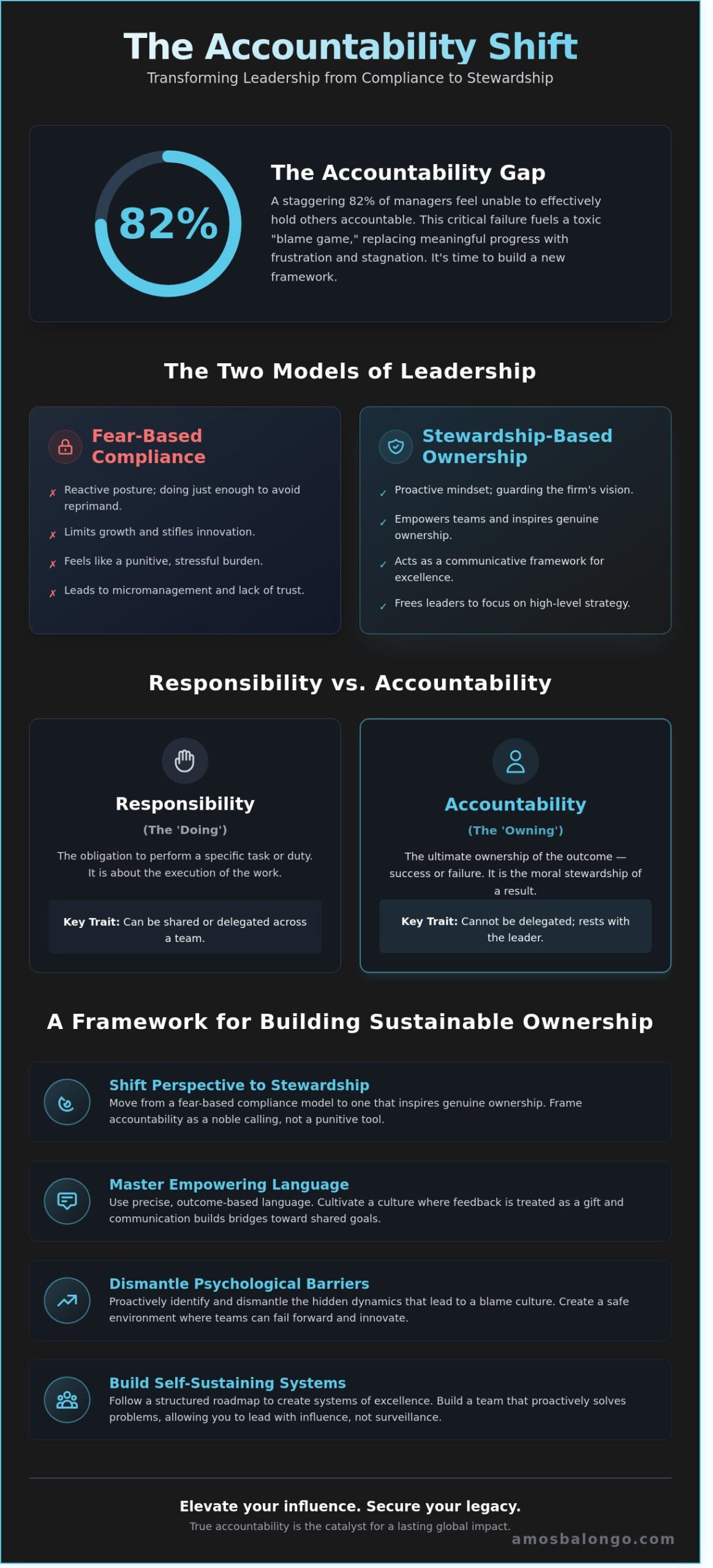
True leadership transcends the mechanical tracking of performance metrics or the simple enforcement of corporate policy. It is a noble calling that requires a shift in perspective from oversight to investment. In many organizations, accountability is viewed through a lens of “Fear-Based Compliance,” where employees perform just enough to avoid reprimand. This reactive posture limits growth and stifles innovation. To build a high-performance legacy, the executive must transition to a “Stewardship-Based Ownership” model. Here, every team member understands that they aren’t just completing tasks; they’re guarding the vision of the firm.
A 2024 study of global leadership trends found that 82% of managers have limited to no ability to hold others accountable successfully. This failure often stems from a misunderstanding of what the term truly implies. When we look at the broader context of Defining Accountability, we find it encompasses the ethical obligation to report, explain, and be answerable for resulting consequences. It’s the cornerstone of the Communication Mastery System, providing the clarity needed to elevate executive influence. As a leader, your role evolves from being a manager of tasks to a steward of potential, where you nurture the seeds of excellence in others to ensure a lasting global impact.
Establishing a culture of accountability requires intentionality and a commitment to integrity. It means moving away from raw authority and toward a model of shared success. When accountability is rooted in stewardship, it becomes a source of inspiration rather than a source of stress. It creates a space where excellence is the standard, vision is the guide, and transformation is the inevitable result.
The Distinction Between Responsibility and Accountability
We often use these terms interchangeably, yet they represent different dimensions of leadership. Responsibility is the obligation to act or perform a specific duty. It’s the “doing” of the work. Accountability is the ownership of the outcome, whether that outcome is a success or a failure. While a manager can share responsibility across a project team of 15 people, they can’t truly delegate the final accountability for the project’s impact. Accountability is the moral stewardship of a result. This distinction is vital for any executive who wishes to lead with clarity and purpose.
Why Accountability is the Antidote to Micromanagement
Micromanagement is often a symptom of a lack of trust and a failure of ownership frameworks. When a culture of accountability is firmly established, leaders gain the freedom to step back from the tactical weeds and focus on long-term strategy. Clear ownership allows you to empower your team, knowing that they’re committed to the final result. This shift allows for “Leading with Influence,” where your presence inspires performance without the need for constant surveillance. By 2026, the most successful executives will be those who have mastered the art of trusting their people through robust accountability, allowing them to transcend traditional management and embrace visionary stewardship.
The Pillars of Communicative Accountability: Language that Empowers
Language serves as the architect of your organizational reality. For a leader, words are not merely tools for instruction; they are the vessels of stewardship. When we speak, we either build a bridge toward ownership or dig a trench of compliance. Executives who prioritize Fostering a Culture of Accountability recognize that precision in speech is the first step toward excellence. In the high-stakes world of technical execution, a single vague sentence can lead to weeks of misaligned effort. We must move beyond the transactional and embrace the transformational. True leadership requires us to speak to the potential of our teams, not just their tasks.
The Art of Setting Outcome-Based Expectations
Vague directives are the silent killers of momentum. Data suggests that 37 percent of project failures in high-growth firms stem from poor communication. To combat this, senior tech professionals must shift from how-based instruction to outcome-based vision. When you tell a brilliant engineer how to solve a problem, you limit their potential. When you define what success looks like, you empower their genius. This shift creates a culture of accountability that thrives on trust rather than micromanagement. Use this five-minute clarity check to ensure alignment during your next briefing:
- The Objective: What is the specific, high-level result we need?
- The Metric: How will we quantitatively measure this success?
- The Boundary: What are the non-negotiable constraints?
- The Support: What authority or resources do you need to move this forward?
- The Timeline: When is the legacy of this work due?
Feedback as a Tool for Strategic Alignment
Feedback is often feared because it is delivered as an indictment rather than an invitation. True leadership utilizes the Empathy Advantage to bridge the gap between technical execution and executive vision. This approach doesn’t trigger defensive mechanisms because it focuses on the mission, not the person. If a team member avoids ownership, redirect them with intentionality. You can elevate your leadership impact by using these three specific phrases to restore focus:
- “I see a disconnect between our strategic goal and this current path; help me understand the barrier.”
- “What specific decisions do you need from me to reclaim this outcome?”
- “How does this current result reflect our shared commitment to excellence?”
Active listening plays a pivotal role here. By listening for what is unsaid, you uncover the hidden obstacles to performance. This level of engagement ensures that the culture of accountability is not a burden, but a shared journey toward a lasting global footprint.
Navigating Invisible Dynamics: Why Most Accountability Initiatives Fail
Accountability initiatives often collapse because they’re treated as administrative checklists rather than profound cultural shifts. The primary objection from the C-suite is the fear that a culture of accountability will devolve into a “blame culture.” This fear is misplaced. When a leader fails to distinguish between responsibility and growth, they inadvertently foster an environment of evasion. A 2014 study by Partners in Leadership revealed that 82% of managers have limited to no success at holding others accountable. This failure isn’t due to a lack of effort; it’s a lack of understanding regarding the hidden forces at play.
These hidden forces, or Invisible Dynamics, are the psychological currents that dictate how influence moves through a boardroom. Relying on positional authority to enforce rules is a strategy with a short shelf life. It creates compliance, not commitment. True stewardship requires mastering these dynamics, moving beyond the organizational chart to the heart of human motivation. To bridge this gap, leaders can utilize a structured 9-Step Guide to Workplace Accountability to ensure the process remains focused on excellence rather than reprimand.
Overcoming the Fear of Conflict
“Terminal niceness” is a silent killer of organizational health. It’s an abdication of leadership responsibility disguised as kindness. When you avoid a difficult conversation, you’re choosing your own comfort over the team’s potential. High-stakes accountability requires a grounded executive presence. You must view conflict as a refining fire. It’s a necessary step toward the strategic alignment required for global impact. Leaders who embrace this discomfort transform their teams from groups of individuals into a unified force for change.
The Role of Psychological Safety in High Performance
A culture of accountability cannot breathe without the safety to admit mistakes. Google’s 2017 Project Aristotle study proved that psychological safety is the primary driver of high-performing teams. It’s about “failing forward.” This means creating an environment where an employee can say, “I missed the mark,” without fearing for their career. As discussed on the Transformational Podcast, resilience isn’t the absence of failure; it’s the ability to integrate lessons quickly. Empathetic leaders create space for this growth, ensuring that stewardship remains a noble calling rather than a professional burden. When people feel safe, they don’t hide their errors; they own them. This ownership is the bedrock of a legacy built on integrity and performance.
A Step-by-Step Framework for Building Sustainable Ownership
Transformation doesn’t happen through a single memo or a passionate keynote address. It’s the result of a disciplined, 90-day implementation that moves your team from a state of compliance to a state of collective stewardship. This framework provides a practical roadmap for the executive who’s ready to transition their team into a high-performance culture of accountability. By focusing on consistency and moral character, you’ll create an environment where excellence is the standard rather than the exception.
Step 1: The Personal Audit of Stewardship
Leadership isn’t a destination; it’s a discipline of constant internal refinement. Before you can demand a higher standard from your team, you must look in the mirror. A 2023 study by the Harvard Business Review found that 82% of managers have limited to no ability to hold others accountable successfully because their own habits are inconsistent. You must lead by example to close the gap between your words and your actions.
Identify your “accountability leaks” during the first 30 days. These are the subtle moments where you let a deadline slide, fail to follow up on a promise, or use vague language in your directives. These leaks erode trust. When a leader’s communication style is imprecise, the team learns that commitments are negotiable. True stewardship begins when the executive’s personal integrity becomes the heartbeat of the organization.
Step 2: Defining the Shared Legacy
Individual accountability often focuses on the “what,” but stewardship focuses on the “why.” To build a lasting culture of accountability, you must align every daily task with the company’s global impact. Every team member should feel like a steward of the brand’s reputation and future. During the middle phase of your 90-day roadmap, craft a “Team Covenant.” This document isn’t a list of HR policies; it’s a sacred agreement that defines how the group handles commitments.
- Connect specific KPIs to the 10-year legacy of the organization.
- Empower employees to make decisions that protect the brand’s long-term vision.
- Define clear protocols for when a commitment is at risk of being missed.
This covenant ensures that everyone understands their role in the larger narrative. It transforms a job description into a noble calling, where every person is responsible for the excellence of the collective whole.
Step 3: Establishing the Cadence of Accountability
The final 60 days require a consistent rhythm to solidify these new behaviors. Shift from sporadic oversight to a structured cadence of check-ins. Implement 15-minute weekly stand-ups that focus on outcomes rather than activities. Use data and metrics as objective mirrors to reflect performance. When you treat data as a hammer, you breed fear; when you treat it as a mirror, you foster growth. A 2022 internal audit of high-performing teams showed that those who celebrated “ownership wins” weekly saw a 25% increase in employee engagement. This positive reinforcement makes the burden of stewardship feel like a badge of honor.
Are you ready to move beyond tactical management and embrace strategic stewardship? You can elevate your leadership legacy by implementing these steps with intentionality today.
Leading with Influence: Accountability as a Catalyst for Legacy
True leadership transcends the quarterly report. It’s found in the quiet strength of a culture of accountability that persists long after the executive leaves the room. When you embrace stewardship, you move from a position of authority to a position of profound influence. You become the architect of a self-sustaining ecosystem where excellence is the standard, not the exception. This transition elevates your visibility across the global stage. It marks you as a visionary capable of building more than just profit. You’re building a future.
A 2023 study by the Harvard Business Review found that 82% of managers struggle with holding others accountable effectively. By mastering this discipline, you distinguish yourself as a leader who values integrity over convenience. This isn’t about control; it’s about creating a framework where every individual understands their contribution to the collective vision. Leadership is a noble calling. It’s a duty to manage the potential of your organization for the benefit of generations to come.
From Executive to Strategic Sage
The shift from managing people to empowering a movement requires a fundamental change in perspective. You aren’t merely overseeing tasks. You’re cultivating a garden of potential. A culture of accountability ensures that every team member feels the weight and the honor of their role. This is how you build a long-term legacy. Your success is measured by the growth of those around you. Every interaction serves as a sacred opportunity to elevate others and instill a sense of purpose that transcends the immediate goal.
Taking the Next Step in Your Leadership Journey
Mastering these principles isn’t a solitary endeavor. Data from the International Coaching Federation suggests that leaders who engage in professional development see a 70% increase in individual performance. You can deepen this mastery through dedicated Leadership Workshops designed to refine your strategic approach. External coaching provides the mirror necessary to identify communication blind spots that hinder your impact. Accountability starts with the individual. It’s the catalyst for organizational transformation. Your journey toward becoming a strategic sage begins with a single, intentional step toward excellence.
The Path to Lasting Influence
Leadership isn’t a title you hold; it’s a responsibility you manage for the future. True transformation begins when you move beyond mere compliance and embrace a genuine culture of accountability rooted in stewardship. By refining your communicative language and addressing the invisible dynamics that stall progress, you create a foundation for sustainable ownership. This shift ensures your influence extends far beyond the boardroom.
I’ve spent over 18 years coaching elite military commanders and corporate executives to master these exact principles. As a strategic advisor to tech visionaries, I’ve seen how the Empathy Advantage framework turns tactical goals into a lasting global footprint. You have the power to redefine your impact and build a team that leads with integrity and vision. You’re not just managing a team; you’re building a legacy that will outlast your tenure.
Elevate your leadership with the Communication Mastery System
Your journey toward excellence is just beginning. The world needs leaders who are ready to transcend the ordinary and leave a mark that endures. Step into your role with confidence and purpose.
Frequently Asked Questions
What is the difference between a culture of accountability and a culture of blame?
Accountability is a proactive commitment to future excellence, whereas blame is a reactive focus on past failures. A true culture of accountability empowers individuals to own their results, learn from setbacks, and drive collective progress. Gallup research indicates that only 14% of employees feel their performance is managed in a way that motivates them. This gap exists because leaders confuse holding people responsible with making them feel small. Accountability builds trust; blame destroys it.
How can I hold my team accountable without micromanaging them?
You hold your team accountable by defining clear outcomes while granting them the autonomy to determine the process. It’s about setting the destination and letting them navigate the journey. A 2023 Harvard Business Review study shows that autonomy increases employee engagement by 31%. When you focus on stewardship over control, you elevate your team’s potential. You become a guide, a mentor, and a strategist rather than a supervisor who monitors every keystroke.
Why do most tech leaders struggle with building accountability in their departments?
Many tech leaders prioritize technical velocity over the human systems that sustain long-term growth. They focus on the code, the sprints, and the ship dates. Research from the Standish Group indicates that 66% of software projects fail due to poor communication and a lack of clear ownership. Building a culture of accountability requires a shift from managing tasks to mentoring people. It’s a transition from being a brilliant engineer to becoming a strategic steward.
Can you have a culture of accountability and psychological safety at the same time?
Psychological safety and accountability are not opposing forces; they are the twin pillars of high performance. Safety provides the foundation for vulnerability, while accountability provides the framework for excellence. Google’s Project Aristotle found that psychological safety was the primary predictor of success across 180 teams. Without safety, people hide mistakes. Without accountability, they stop growing. A leader must cultivate both to ensure lasting transformation and strategic alignment.
What are the first steps an executive should take to fix a lack of ownership?
An executive must first model the ownership they expect from their department. You cannot demand what you do not demonstrate. Start by clarifying the top three strategic priorities for the next 90 days. A 2022 survey by Partners in Leadership found that 85% of professionals aren’t clear on their organization’s top goals. By aligning every role with a specific outcome, you create a path for integrity, vision, and shared success across the entire enterprise.
How does empathy play a role in holding someone accountable for their results?
Empathy is the bridge that connects high standards with the human spirit. It allows a leader to address a missed deadline without devaluing the person behind the work. Businessolver’s 2023 State of Workplace Empathy report shows 82% of employees would leave their job for a more empathetic organization. Holding someone accountable with empathy means listening to the challenges, offering support, and maintaining the expectation of excellence. It’s a balance of heart and strategy.
Is it possible to build accountability in a remote or hybrid work environment?
Building ownership in a distributed workforce is entirely possible through intentional communication and digital transparency. You must replace physical presence with measurable impact. Upwork predicts that 32.6 million Americans will work remotely by 2025, which requires a shift toward outcome-based management. Leaders must lean into asynchronous tools, set rigorous check-in rhythms, and ensure every team member understands their global impact. Distance shouldn’t dilute your standard of excellence or your commitment to stewardship.
How do I handle a high-performer who refuses to be held accountable to the team standards?
You must address the behavior immediately because a high-performer who ignores standards creates a toxic precedent. No individual’s output is worth the erosion of your team’s integrity. A study by the University of Washington found that one toxic high-performer can lower team productivity by 30%. You must choose between short-term gains and long-term legacy. True stewardship means protecting the culture from anyone who thinks they’ve outgrown the team’s values, regardless of their technical skill.