
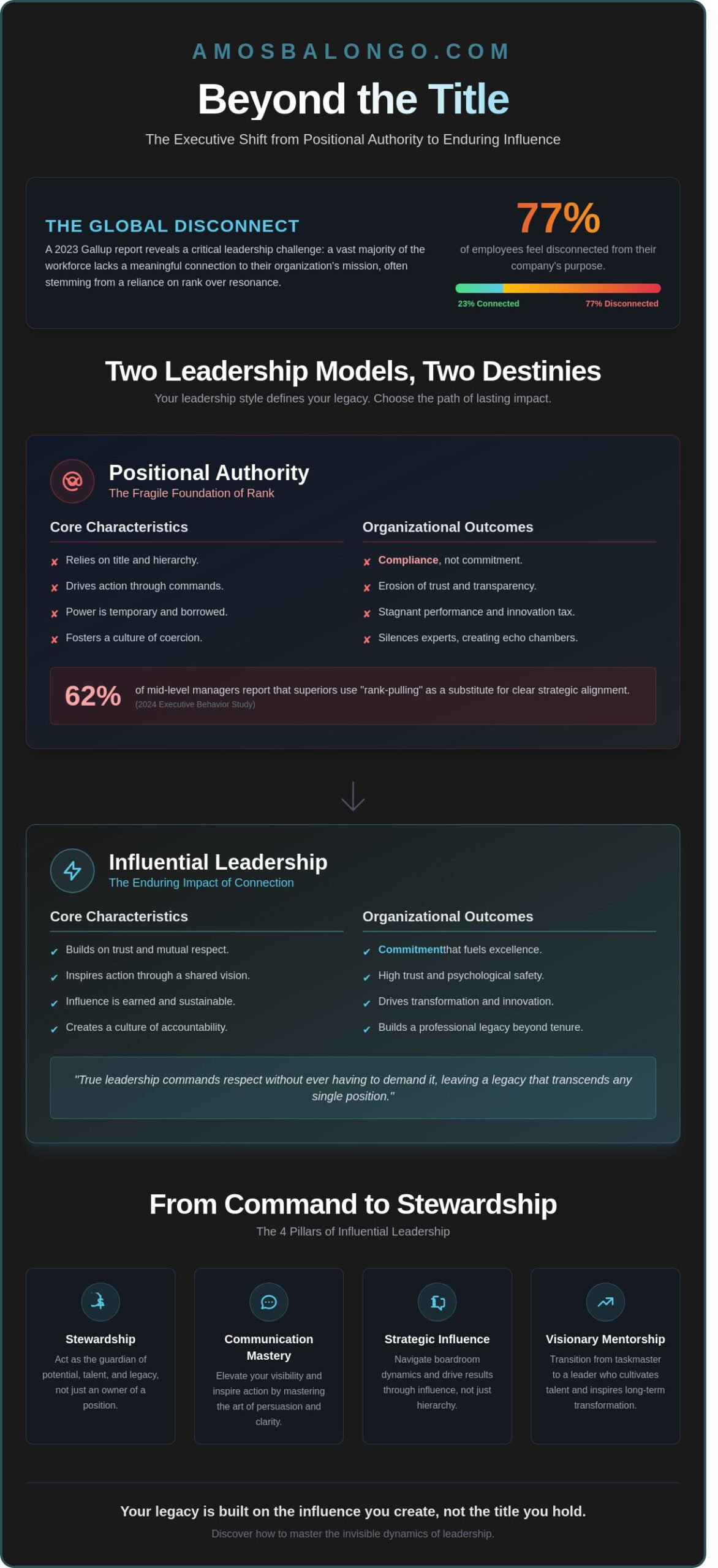
Your title is the least powerful tool in your leadership arsenal. While a corner office provides a platform, it doesn’t guarantee the loyalty or the excellence required to drive global impact. A 2023 Gallup report revealed that only 23% of employees globally feel a genuine connection to their organization’s purpose. This disconnect often stems from a reliance on positional authority to drive results. You’ve likely felt this burden; the frustration of seeing stagnant performance, the friction of cultural resistance, or the exhaustion of acting as a taskmaster rather than a visionary mentor.
True leadership isn’t a rank to be held; it’s a responsibility to be managed for the benefit of those you serve. You’ve worked hard for your seat at the table, yet you know that lasting transformation requires more than just a mandate. I promise that by understanding the shift from power to influence, you’ll discover how to build a culture of individual accountability and leave a professional legacy that transcends your tenure. We’ll examine the specific principles of stewardship that allow you to command respect without ever having to demand it.
Key Takeaways
- Distinguish between the temporary power of positional authority and the enduring impact of influential leadership to secure your professional legacy.
- Recognize how relying on rank creates a culture of compliance rather than commitment, eliminating the hidden “innovation tax” within your organization.
- Master the invisible dynamics of the boardroom to command respect and drive results through strategic influence rather than organizational hierarchy.
- Transition from a command-and-control mindset to a philosophy of stewardship that prioritizes individual accountability and the art of persuasion.
- Leverage communication mastery to transcend your job title and elevate your visibility as a visionary leader who inspires long-term transformation.
Defining Positional Authority: The Difference Between a Title and a Legacy
Leadership is often mistaken for the nameplate on an office door or the corner suite in a high-rise. This misconception creates a glass ceiling for influence that many executives never break through. Positional authority is power granted by a corporate hierarchy, acting as a temporary permit to direct others based on rank. It’s a borrowed asset. It’s a formal mandate. It’s limited by the boundaries of a job description. True leadership doesn’t reside in the title; it lives in the space between the leader and the led. It requires a shift from holding a position to embodying a purpose.
When communication barriers arise, many executives retreat to their rank because it feels safe. They issue mandates instead of invitations, choosing the speed of a command over the depth of a conversation. Relying on a title is easier than building a bridge of trust. In a 2024 study of executive behavior, 62 percent of mid-level managers reported that their superiors used rank-pulling as a substitute for clear strategic alignment. This reliance on formal power reveals a lack of influence and signals a move from inspiration to coercion. It shows a leader who has forgotten that their authority is meant to serve the mission, not the ego.
The Fragility of Rank-Based Leadership
Rank is a fragile foundation. It’s a coat you take off at the end of the day. If your ability to move people vanishes when the title is removed, you haven’t been leading; you’ve been presiding. This dynamic creates a culture of compliance where teams do the bare minimum to avoid friction. High-stakes environments require commitment, a state where individuals give their best because they believe in the vision, not because they fear the boss. Positional authority is a temporary mandate that requires moral character to sustain.
Leadership as Stewardship in 2026
As we look toward 2026, the executive role is evolving into one of stewardship. You aren’t the owner of your position; you’re the temporary guardian of organizational potential, human talent, and future legacy. Stewardship demands that you leave the chair better than you found it, focusing on long-term global impact rather than quarterly optics. By refining your voice through resources at amosbalongo.com, you can transcend the limitations of rank and lead with authentic resonance. This shift ensures your influence survives long after you’ve handed over the keys to the office.
The Hidden Dangers of Relying on Rank: Why Compliance Is Not Commitment
Leadership isn’t a trophy you keep. It’s a responsibility you carry. When a leader relies solely on their rank, they stop being a steward and start being a hurdle. High-performance tech teams don’t thrive under a command and control regime. They wither. This style of management creates a psychological toll that’s often invisible until the moment your best talent walks out the door. It fosters a culture where compliance is the goal, but commitment is the casualty. When you lean too heavily on positional authority, you aren’t leading. You’re just managing tasks. True leadership is about the soul of the organization. It’s about moving people toward a vision they actually believe in.
The Erosion of Trust and Transparency
Rank-heavy leadership builds high walls and short sightlines. It silences the very experts you hired to guide you. If your team feels that their title is their only value, they’ll stop offering honest feedback. They’ll tell you what you want to hear to avoid the friction of rank. This creates dangerous echo chambers. Research on effective leadership in organizations highlights that relying on title alone consistently leads to poor organizational health. Relying on positional authority creates a culture of silence that masks underlying problems. You must learn to see through the surface of compliance. It’s vital to understand the human element by mastering invisible dynamics within your team. Without transparency, your strategy is built on a foundation of sand.
The Innovation Tax in Tech Leadership
In the technical world, the cost of ego is measurable. We call it the innovation tax. It’s the price you pay when your best engineers stop taking risks because they don’t feel safe. A 2015 study by Google, known as Project Aristotle, proved that psychological safety is the single most important factor in team performance. When leaders stop leading with empathy, they kill that safety. Technical excellence requires the freedom to fail. If rank is the primary motivator, engineers will only do exactly what they’re told. They won’t suggest the breakthrough that could save 40% on operational costs. ‘When rank speaks loudest, innovation becomes a whisper.’
You might argue that authority is necessary to get things done during a crisis. This is a trap. It’s a short-term win that guarantees a long-term loss. You might hit a deadline today, but you’ll lose the heart of the developer who should have hit the deadline next year. High turnover and burnout are the real results of rank-based leadership. Real stewards of talent understand that influence is earned, not assigned. If you want to build a lasting legacy, you must transcend your title. You can elevate your leadership strategy by focusing on influence over control. This is how you move from being a boss to being a legend.
Influence vs. Authority: Navigating the Boardroom’s Invisible Dynamics
True leadership isn’t found in the ink of a contract or the height of an office chair. It lives in the resonance of your voice and the clarity of your vision. While positional authority might grant you the right to speak, it doesn’t automatically earn you the right to be heard. The most effective executives understand that their title is merely a platform, not the power itself. To drive real results, you must master the art of influential leadership. This approach bypasses the rigid hierarchy to foster a culture of excellence through shared purpose rather than forced compliance. It’s a shift from being a manager of tasks to becoming a steward of potential.
Mapping the Invisible Power Structures
Every organization possesses a shadow hierarchy that exists parallel to the formal chart. These are the “shadow influencers” who hold no grand titles but possess the collective trust of the team. A 2023 analysis of corporate culture found that 74% of successful organizational transformations were anchored by these informal leaders rather than executive mandates. To lead effectively, you must identify these individuals and engage them as partners in your vision. Building lateral influence across departments requires you to step outside your silo. You don’t need a formal invitation to collaborate. Instead, seek strategic alignment by identifying how your objectives can serve your peer’s success. This proactive stewardship elevates your professional visibility and cements your reputation as a strategic sage who values the whole over the part.
The Empathy Advantage in High-Stakes Communication
Empathy is the most efficient fuel for high-performance leadership. It’s often mistaken for a soft trait, yet it functions as a precision tool in the boardroom. By connecting with the “leader’s soul” in your colleagues, you move beyond transactional exchanges. You begin to understand the hidden pressures, the personal stakes, and the legacy goals of those around you. This depth of connection bridges the gap between rank and resonance, allowing you to lead with a calm confidence that inspires rather than demands. When you speak to the person rather than the position, you unlock a level of loyalty that positional authority can never buy. For those seeking to deepen these philosophical and strategic insights, The Transformational Podcast serves as a vital resource for exploring the human element of global impact. It’s where the discipline of the executive meets the intentionality of the mentor.
From Command to Stewardship: 4 Pillars of Influential Leadership
Leadership isn’t a destination reached by a promotion. It’s a continuous journey of service. When you rely solely on positional authority, you limit your impact to the boundaries of your job description. To transcend these limits, you must adopt four foundational pillars that anchor your influence in stewardship rather than control. These pillars represent a shift from demanding compliance to inspiring commitment.
- Cultivate individual accountability: You must act as the catalyst for change by fostering an environment where every team member owns their outcomes.
- Master the art of persuasion: You should integrate persuasion techniques in leadership to align diverse interests toward a singular, noble goal.
- Prioritize organizational legacy: Shift your gaze from quarterly wins to the 50-year impact of your decisions.
- Implement a structured communication system: Influence requires a predictable, transparent system to ensure your vision remains the team’s North Star.
Building a Culture of Accountability
Moving from a culture of policing to one of empowerment requires a fundamental shift in your internal narrative. Policing relies on surveillance; empowerment relies on trust. When you model stewardship, you show your team that you’re responsible for them, not just in charge of them. A 2023 analysis of high-performing organizations shows that teams with high internal accountability outperform their peers by 35% in revenue growth. This transformation often begins in leadership workshops that prioritize long-term value over short-term compliance. To truly establish this foundation, leaders must understand how to implement cultivating a culture of accountability that transforms responsibility from a burden into a source of empowerment.
Strategic Persuasion and Connection
There’s a thin line between manipulation and strategic stewardship. Manipulation exploits vulnerabilities for personal gain; stewardship leverages strengths for collective excellence. Influential leadership is the ability to move others through shared vision rather than shared fear. To anchor your philosophy, utilize the power of three in your address. Speak to the heart, the mind, and the hands of your audience. This rhythmic structure ensures your message is heard, understood, and enacted. By moving beyond positional authority, you create a resonance that lasts long after you’ve left the room.
True leadership requires a commitment to growth that exceeds the requirements of your title. It’s about the legacy you leave in the lives of those you lead. If you’re ready to elevate your impact and move beyond the title, explore our executive mentorship programs today.
Elevating Your Impact: How Communication Mastery Transcends Rank
True influence isn’t found in the ink on a business card. It’s found in the resonance of your voice and the clarity of your vision. The Communication Mastery System serves as the ultimate bridge between technical proficiency and influential leadership. This framework moves you beyond the fragile safety of positional authority into a space of enduring impact. It’s a shift from demanding attention to commanding respect through the power of your ideas.
Professional visibility isn’t something you chase through self-promotion. It’s a natural byproduct of how you articulate value. When you master your message, you stop being a manager of tasks and start being a mentor of souls. This journey transforms you from a mere title-holder into a global mentor and a strategic sage. You become a leader whose presence is felt long after you leave the room.
Transcending the Boardroom Pressure
Organizational shifts are constant and often chaotic. A 2023 study by Deloitte found that 68% of executives feel overwhelmed by the pace of change within their industries. You must maintain calm confidence during these periods of volatility. It requires deep intellectual discipline to stay aligned with your core strategy when others are reacting in fear. This intentionality ensures that your leadership remains a steadying force for your entire organization.
Maintaining this level of poise isn’t accidental; it’s a practiced discipline. If you’re ready to refine this level of presence and move beyond the noise of the boardroom, explore Amos Balongo’s official site for personalized guidance. We focus on the human element of high performance to ensure your strategy remains unshakable regardless of the external climate.
Your Global Legacy Starts with Stewardship
The 2026 leader won’t be measured by the size of their office or the length of their tenure. They’ll be measured by the depth of their character and the legacy they leave behind. Move past the superficial metrics of success that dominate the corporate landscape. Excellence is a standard, not a destination. You must view every interaction as an act of stewardship, recognizing that you’re managing potential for the benefit of future generations.
You aren’t just leading a team for this quarter’s results; you’re shaping the leaders of the next decade. Your duty is to transcend the limitations of your current role and embrace your calling as a steward of potential. This requires a commitment to transformation that goes deeper than tactical business advice. It’s about the soul of your leadership. Your rank is the stage; your influence is the performance.
Embrace the Stewardship of Influence
True leadership isn’t a destination reached by a promotion; it’s a continuous act of stewardship. Relying solely on positional authority creates a fragile culture of compliance rather than the deep commitment required for global impact. Excellence emerges when you trade the weight of rank for the power of resonance. This shift requires more than tactical skill. It demands a transformation of your character and your strategic communication.
I’ve spent over 18 years in management consulting refining these principles for the world’s most demanding environments. My experience as a former advisor to military officers and corporate C-suite executives has shown me that titles are temporary, but legacy is permanent. You have a duty to lead with intentionality. You have a responsibility to inspire. It’s time to transcend the limits of your office and embrace the noble calling of high-performance leadership through my proprietary Communication Mastery System.
Elevate your influence with the Communication Mastery System
Your journey toward a lasting footprint begins with a single, disciplined choice. Believe in your capacity to transform your organization and your world.
Frequently Asked Questions
What is the primary difference between positional authority and influential leadership?
The primary difference lies in the source of a leader’s power; positional authority relies on a formal title to demand compliance, while influential leadership stems from earned trust to inspire commitment. According to John Maxwell’s 5 Levels of Leadership, those stuck at Level 1 only get the minimum effort from their teams. True leaders transcend their rank to build 360-degree influence that moves people beyond what’s required on a job description.
Can a leader be effective using only positional authority?
A leader can achieve short-term results using only rank, but they cannot sustain high performance or build a lasting legacy. Gallup research indicates that 70% of the variance in team engagement is tied directly to the manager. If you rely solely on your seat at the table, you’ll find that 8 out of 10 employees do only enough to avoid being fired, stifling the innovation required for global impact.
How can I build influence if I don’t have a high-ranking title?
You build influence by consistently delivering excellence and fostering genuine connections with colleagues regardless of your place on the organizational chart. Focus on the 3 pillars of credibility: character, competency, and consistency. By solving 2 major problems for your department each quarter, you establish yourself as a strategic asset. This creates a reputation that carries more weight than any printed business card or corporate designation.
Why is positional authority often seen as a trap for tech leaders?
Tech leaders often fall into the trap of positional authority because they mistake technical expertise for the ability to steward human potential. A 2023 study by Robert Half found that 38% of tech professionals leave jobs due to poor management styles. When a CTO relies on their title rather than emotional intelligence, they create a bottleneck that prevents 100% of their engineers from reaching their full creative capacity.
How does empathy improve leadership impact without appearing ‘soft’?
Empathy serves as a strategic tool that identifies the barriers to performance, allowing a leader to remove them effectively. It isn’t about being soft; it’s about the 21% increase in profitability that Gallup associates with highly engaged, understood teams. When you understand the human element, you can align an individual’s personal vision with the organization’s mission. This creates a culture of excellence where every team member feels seen and valued.
What are the first steps to transitioning from a command-based style to stewardship?
The first steps involve shifting your focus from giving orders to asking 3 critical questions: “What do you need?”, “How can I help?”, and “What is blocking your success?”. This 180-degree turn moves you from a commander to a steward of your team’s talent. By dedicating 15 minutes each day to active listening, you begin to transform your professional environment into a space of mutual respect and shared purpose.
How do invisible dynamics affect team performance in senior management?
Invisible dynamics like psychological safety and unspoken power structures determine 100% of a team’s ability to innovate under pressure. Google’s Project Aristotle proved that the highest-performing teams aren’t those with the smartest individuals, but those with the highest levels of social sensitivity. In senior management, these undercurrents dictate whether a 5-year strategy succeeds or fails based on the collective trust of the executive suite.
Is it possible to regain influence once you’ve relied too heavily on rank?
It’s entirely possible to regain influence by practicing radical transparency and apologizing for past reliance on rank. Start a 60-day reconciliation period where you solicit honest feedback from your direct reports through anonymous surveys. By acknowledging your mistakes and demonstrating a commitment to their growth, you can rebuild the 4 core components of trust. This shift transforms your leadership from a burden of command into a noble calling of service.