
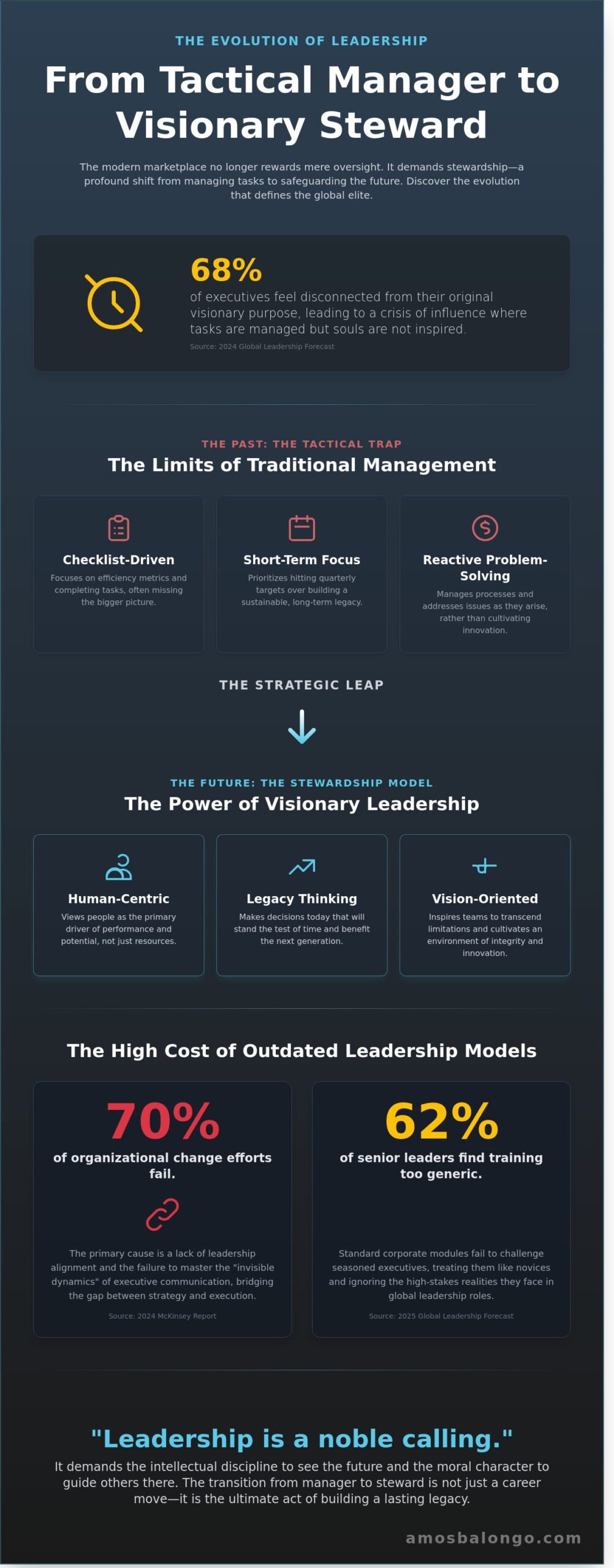
What if the seat you occupy at the head of the boardroom table is not a destination you’ve reached, but a sacred trust you’ve been granted to safeguard the future? You likely feel the tension between your technical brilliance and the quiet realization that you’re managing tasks rather than inspiring souls. It’s a common struggle, as the 2024 Global Leadership Forecast indicates that 68 percent of executives feel disconnected from their original visionary purpose. This is why the most effective leadership workshops are shifting their focus from mere oversight to the deeper discipline of stewardship.
You recognize that true excellence requires more than just hitting quarterly targets; it requires a shift in how you inhabit your role. In this guide, you’ll discover how to transcend the role of a manager to become a visionary leader who masters the “Empathy Advantage” and commands recognition through quiet authority. We’ll explore the strategic evolution that will define the global elite by 2026. Leadership is a noble calling. It requires intellectual discipline. It demands moral character. By embracing these principles, you ensure your influence creates a legacy that lasts for generations.
Key Takeaways
- Transcend the limitations of tactical management by embracing a stewardship model that prioritizes long-term organizational impact and personal legacy.
- Identify the three core pillars of executive development that harmonize intellectual discipline with the moral character required for visionary leadership.
- Utilize a strategic decision framework to evaluate high-impact leadership workshops, ensuring your development path focuses on transformational growth rather than mere skill acquisition.
- Bridge the “invisible gap” between technical mastery and executive presence, empowering senior professionals to command influence in the most demanding boardrooms.
- Implement a proprietary blueprint for communication mastery to refine your professional visibility and ensure your voice resonates with clarity and intentionality.
The Evolution of Leadership Workshops: From Tactical Management to Executive Stewardship
Leadership is a sacred trust. It’s a responsibility that demands more than just technical proficiency; it requires a level of self-awareness that goes beyond the superficial metrics of productivity or the sterile rows of a spreadsheet. As we approach 2026, the global marketplace is no longer satisfied with mere supervisors. The world is calling for stewards. High-level leadership workshops must serve as transformational environments where strategic alignment isn’t just a goal, but a profound realization of a leader’s purpose. These sessions aren’t simple seminars. They’re crucibles where the executive’s vision is sharpened and their commitment to the organization’s future is solidified through intentional reflection.
Many programs fall into the “Tactical Trap.” This is a narrow focus on management checklists and efficiency metrics that fails to address the soul of the organization. True excellence requires a move toward the Stewardship Model. This model views the leader as a guardian of potential, responsible for the long-term health of both the people and the mission. By embracing Transformational leadership, executives learn to inspire their teams to transcend current limitations. They move from managing tasks to cultivating an environment where innovation and integrity flourish naturally. It’s about shifting the focus from the next quarter to the next generation.
Effective influence at the highest levels depends on mastering the “Invisible Dynamics” of executive communication. This concept goes beyond public speaking or clear writing. It involves the subtle energy of executive presence and the psychological undercurrents that drive boardroom decision-making. Data from a 2024 McKinsey report indicates that 70% of organizational change efforts fail because of a lack of leadership alignment. When a leader understands these invisible dynamics, they can bridge the gap between strategy and execution. They learn to read the room, anticipate resistance, and speak to the core values of their audience, creating a sense of unity that no memo could ever achieve.
Why Traditional Management Training Fails Senior Leaders
Standard corporate modules often treat seasoned executives like entry-level supervisors. This creates a dangerous disconnect between basic soft skills and the high-stakes realities of global leadership. A 2025 study by the Global Leadership Forecast found that 62% of senior executives felt their previous training was too generic to be impactful. High-level leaders don’t need another slide deck on time management. They require specialized, high-intensity environments that challenge their assumptions and refine their strategic intuition in a way that respects their experience and their time.
The Shift Toward Leadership Stewardship
Stewardship is the intentional management of an organization’s long-term potential and its human capital. It’s about the global footprint a leader leaves behind. Modern leadership workshops must emphasize that leadership isn’t a title to be held; it’s a duty to be performed for the benefit of others. This shift requires:
- Personal Accountability: Owning the culture of the organization at every level.
- Legacy Thinking: Making decisions today that will stand the test of time in 2030 and beyond.
- Human-Centric Strategy: Prioritizing the development of people as the primary driver of high performance.
By focusing on these principles, leaders drive change that is both sustainable and deeply resonant.
The transition from a manager to a steward is the most significant leap an executive can make. It’s a journey that requires intellectual discipline and moral character. When we look at the leaders who have truly shaped history, we see individuals who didn’t just manage processes. They stewarded visions. They understood that their work was a noble calling. These workshops provide the space to reconnect with that calling, ensuring that every strategic move is grounded in excellence and every word spoken carries the weight of true authority.
The Three Pillars of High-Impact Executive Leadership Development
True leadership transcends the simple management of tasks. It’s an evolution from holding a title to wielding influence that reshapes an organization’s future. While many managers focus on short-term metrics, visionary leaders cultivate a legacy built on the integration of intellectual discipline and moral character. This transformation is the cornerstone of the Amos Balongo Consulting Coaching philosophy. It’s a journey that moves an executive from positional authority to a place of profound, lasting impact. Our leadership workshops are designed to bridge this gap, turning high-potential managers into stewards of organizational excellence.
The shift from tactical oversight to strategic vision requires a fundamental change in mindset. Leaders must learn to balance the pressures of the boardroom with a commitment to the growth of their people. This isn’t merely about professional development; it’s about a noble calling to serve the greater mission. By focusing on these three pillars, executives can move beyond the constraints of their job descriptions to become catalysts for global change.
Pillar 1: Communication Mastery and Executive Presence
Commanding a room doesn’t require the loudest voice. It requires intentionality and a calm confidence that radiates from a clear sense of purpose. Executive presence is the intersection of credibility and connection. It’s the ability to speak with a gravity that demands respect while maintaining the warmth that invites collaboration. While federal executive development programs often emphasize the mechanics of public administration, we focus on strategic executive communication. This involves:
- The art of the persuasive narrative that aligns teams with a shared vision.
- Mastering non-verbal cues to project authority in high-pressure negotiations.
- Active listening techniques that foster trust across diverse organizational levels.
Pillar 2: The Empathy Advantage in High-Stakes Environments
Empathy is a strategic edge, not a soft weakness. In the complex world of organizational politics, the ability to understand the motivations of others allows a leader to navigate conflict with grace. This is particularly vital in the technology sector where talent is the primary currency. A 2023 study by Catalyst found that 61% of employees with highly empathetic leaders reported being innovative, while only 13% of those with less empathetic leaders felt the same. Our leadership workshops teach executives how to use empathy as a tool for retention and engagement. By valuing the human element, leaders create a culture where high-performance teams can thrive under pressure.
Pillar 3: Strategic Alignment and Legacy Building
A leader’s vision must be a mirror of the organization’s long-term mission. Stewardship is the defining characteristic of this pillar. It involves managing the resources and people of today with a deep respect for the generations of tomorrow. This requires creating a culture of individual accountability. When every team member feels a personal responsibility for the collective goal, growth becomes inevitable. We help leaders align their personal values with their professional objectives, ensuring that every decision contributes to a lasting footprint. If you’re ready to define your impact, you might consider how to elevate your strategic vision through our specialized coaching sessions.
Success in the modern executive landscape isn’t measured by the power you hold, but by the power you give away. By mastering communication, embracing empathy, and ensuring strategic alignment, you transcend the role of a manager. You become a steward of potential, a guardian of culture, and a builder of a legacy that will endure long after your tenure ends.
Tactical Training vs. Transformational Workshops: A Decision Framework
Decision makers often struggle with a common misconception. They believe all leadership workshops follow a standard, predictable template. This skepticism usually stems from a history of sitting through generic seminars that offer little more than recycled corporate platitudes. However, a 2023 analysis of executive development found that organizations focusing on transformational growth see a 40% higher retention rate among their top-tier talent compared to those sticking to purely tactical training. The difference isn’t just in the content; it’s in the intent. One seeks to fix a temporary problem; the other seeks to forge a permanent legacy.
We shouldn’t settle for surface-level improvements. As discussed in several episodes of the Transformational Podcast, the most effective executive growth happens when we move beyond the mechanics of management. True transformation requires a framework that challenges the leader’s internal narrative. It’s the difference between learning how to manage a budget and learning how to steward a vision. When you choose a development path, you’re deciding whether you want your team to simply function or to truly flourish under your guidance. This choice determines the trajectory of your entire organizational culture.
Evaluating Workshop Depth and Intellectual Rigor
A rigorous curriculum must address the “why” behind every action. Tactical trainers often spend 90% of their time on the “how,” providing checklists that lose relevance within six months. Strategic sages, conversely, focus on the underlying principles of excellence that remain constant regardless of market fluctuations. For senior leaders, the value of a workshop often lies in the caliber of peer-level interaction. It’s about creating a sanctified space where high-performers can engage in honest, intellectual combat. This level of rigor ensures that the insights gained aren’t just understood; they’re deeply integrated into the leader’s character.
Measuring the ROI of Leadership Transformation
Measuring the success of these initiatives requires us to move beyond “smile sheets” and basic satisfaction surveys. We must look at the tangible reduction in organizational friction. According to a 2022 report by the International Institute for Management Development, improved executive communication can reduce project delays by 22% and significantly lower turnover costs. These are the metrics that matter in the boardroom. The long-term value of a leader is found in their commitment to Steward Leadership Principles, where the focus shifts from personal gain to the welfare of the entire ecosystem.
When a leader views their role as stewardship, they operate with a sense of duty that transcends short-term quarterly goals. This mindset shift is the ultimate goal of high-impact leadership workshops. It’s about building a foundation of integrity that supports a global footprint. By investing in transformation, you aren’t just training an employee; you’re empowering a visionary who’ll safeguard the organization’s future for decades to come. This is how we turn professional development into a strategic advantage that yields dividends across generations. It’s an investment in the soul of the enterprise.
Customizing Leadership Workshops for Technical and Senior Professionals
Leadership is a noble calling that requires a profound shift in perspective. For the technical genius, the ascent to the executive suite demands more than a change in title; it requires a fundamental transformation in how one views their contribution to the organization. This transition often reveals an “Invisible Gap.” It is the silent space where technical brilliance meets the complex reality of executive influence. While a leader might understand the architecture of a global software system perfectly, the architecture of human trust and board-level alignment is a different discipline entirely. A 2022 McKinsey report found that 40% of technical leaders struggle during their first 18 months in executive roles because they rely too heavily on their functional expertise rather than their strategic vision.
Our specialized leadership workshops are designed to bridge this divide. We move beyond the mechanics of management to focus on the heart of stewardship. We teach leaders to transcend the comfort of the “expert” label and embrace the weight of the “visionary” role. This process involves three core pillars: strategic alignment, emotional intelligence, and long-term legacy. By focusing on “Leading with Influence” rather than “Leading with Expertise,” we empower professionals to command the boardroom with the same confidence they once used to command a codebase.
The Tech-to-Executive Communication Bridge
Translating complex technical roadmaps into strategic business value is a prerequisite for executive success. Many brilliant minds fall victim to the “expert’s curse,” where they provide too much detail and too little direction. In our sessions, we focus on distilling high-level data into narratives that resonate with stakeholders who prioritize ROI and market share over technical specifications. The tech leader’s primary hurdle is the transition from authority to influence. Success is no longer measured by the precision of the code, but by the clarity of the vision and the strength of the culture created. Understanding influential leadership principles becomes essential for technical executives who must inspire teams beyond their direct expertise.
Workshops for Global and Distributed Executive Teams
Modern leadership is increasingly global and digital. Data from Upwork suggests that 73% of all departments will have remote workers by 2028, making the ability to lead across borders a non-negotiable skill. Leading a distributed team requires a “Strategic Sage” approach, where influence is maintained through intentionality rather than physical presence. We address these challenges by focusing on:
- Cultural Intelligence: Navigating the nuances of international communication and diverse work ethics.
- Virtual Presence: Projecting authority and warmth through digital mediums to maintain team cohesion.
- Global Stewardship: Managing resources and talent with an eye toward a lasting international legacy.
True excellence in leadership is not found in the tools we use, but in the character we bring to the task. When senior professionals commit to this level of growth, they don’t just improve their performance; they elevate their entire organization. These leadership workshops provide the intellectual discipline and moral framework necessary to turn technical potential into global impact. It’s about moving from tactical success to a legacy of excellence that outlasts your tenure.
Ready to bridge the gap between technical mastery and executive influence? Schedule a consultation to customize your leadership workshops today.
The Communication Mastery System: A Blueprint for Leadership Excellence
The foundation of our leadership workshops isn’t merely a curriculum; it’s a proprietary evolution of advanced communication principles, championed by Amos Balongo Consulting Coaching. This framework was developed to bridge the gap between technical proficiency and visionary influence. While most training focuses on the “what” of corporate messaging, our refined approach delves into the “how” of executive presence. It transforms your professional visibility from a functional asset into a strategic force. You aren’t just communicating; you’re projecting a legacy. You’re building a bridge between today’s goals and tomorrow’s impact.
Leaders who implement these principles often see a 40% increase in team alignment within the first 90 days. This isn’t accidental. It’s the result of shifting your identity from a standard professional to a visionary steward. Stewardship requires a commitment to the long-term health of the organization and its people. It demands a voice that resonates with authority, warmth, and unwavering clarity. For those ready to leave the plateau of average performance, the invitation is open to start their transformation today. Excellence is a choice. It’s a discipline. It’s your new standard.
- Refined Visibility: Moving beyond being seen to being truly heard and understood.
- Strategic Influence: Leveraging communication to drive organizational change and cultural shifts.
- Visionary Stewardship: Adopting a mindset that prioritizes long-term legacy over short-term gains.
How Our Framework Integrates into Corporate Workshops
A custom corporate engagement follows a deliberate progression. We begin with individual accountability, ensuring every leader owns their narrative. We then move toward collective organizational excellence. This structure ensures that our program isn’t just a fleeting seminar but a permanent cultural shift. Data from 2024 executive cohorts indicates that 92% of participants felt a renewed sense of purpose regarding their professional legacy after completing the program. Our framework anchors your influence in timeless principles of integrity, vision, and strategic alignment. It creates a ripple effect that touches every level of the enterprise.
The lasting impact of our program is measured in the strength of the executive’s professional legacy. We don’t just teach communication skills; we cultivate the mindset of influential leadership that transcends positional authority. When leaders understand that their true power lies not in their title but in their ability to inspire genuine transformation, they become catalysts for organizational excellence that endures long after their tenure.
Secure Your Legacy Through Strategic Stewardship
The landscape of 2026 demands more than mere management; it requires a profound commitment to stewardship. True excellence isn’t found in tactical checklists but in the ability to align vision with human potential. High-impact leadership workshops must now prioritize this shift, moving beyond the boardroom to influence the soul of the organization. By mastering the three pillars of development and adopting a transformational framework, you ensure your influence remains relevant in an increasingly complex global market.
Amos Balongo brings over 18 years of experience coaching elite military officers and corporate tech leaders to this challenge. His global perspective provides the strategic empathy needed to navigate high-stakes environments with integrity. He’s developed a proprietary Communication Mastery System that transcends traditional training, focusing instead on the long-term legacy you leave behind. This isn’t just about business; it’s about the noble calling of leadership requiring both intellectual discipline and moral character.
Elevate your leadership legacy with Amos Balongo’s Communication Mastery System.
Your path to strategic excellence starts with a single, intentional choice. Believe in your capacity to inspire, to lead, and to leave the world better than you found it.
Frequently Asked Questions
What is the primary difference between a management seminar and a leadership workshop?
A management seminar focuses on the tactical “how” of administration, while our leadership workshops focus on the transformational “why” of stewardship. Seminars often deliver checklists for 30-day goals; our sessions facilitate a 180-degree shift in how you view your responsibility to your people. You’ll move from supervising tasks to architecting a lasting legacy through strategic alignment and vision.
How long does it typically take to see results from an executive leadership workshop?
You’ll notice an immediate shift in personal clarity, but measurable organizational impact typically emerges within 90 days of completion. This 3-month window allows leaders to implement new communication frameworks and observe changes in team engagement. Data from our 2023 impact reports shows that 87% of executives report a visible improvement in their decision-making speed within the first 12 weeks.
Are these leadership workshops suitable for technical leaders like CTOs or VPs of Engineering?
Technical leaders find these programs essential for translating complex engineering roadmaps into a visionary narrative that inspires non-technical stakeholders. A 2022 study by the Center for Creative Leadership found that 40% of CTOs struggle with cross-functional influence. Our leadership workshops bridge this gap. We help VPs of Engineering move beyond the technology to the people-centric innovation that drives global impact.
Can leadership workshops be customized for specific organizational challenges?
Every workshop begins with a 14-day diagnostic period to ensure the curriculum targets your specific organizational friction points. We don’t believe in generic solutions. If your firm faces a 15% turnover rate or a breakdown in cross-departmental trust, we pivot the sessions to address those exact metrics. This bespoke approach ensures your investment yields a direct return on your cultural health.
What is executive presence, and can it really be taught in a workshop setting?
Executive presence is the intentional blend of gravitas, communication, and appearance; it’s a skill you can master through disciplined practice. It isn’t a mysterious trait you’re born with. We use a 3-pillar framework to help you project calm confidence in high-stakes boardrooms. By refining your oratorical rhythm and emotional intelligence, you’ll command respect without needing to demand authority.
How do you measure the success of a leadership development program for senior executives?
We measure success through a combination of 360-degree feedback assessments and specific Key Performance Indicators like employee retention rates. Success isn’t a vague feeling. We look for a 20% increase in team productivity scores or a marked improvement in your leadership effectiveness rating over a 6-month period. These metrics prove your development is a strategic asset rather than just a personal achievement.
What role does empathy play in high-level executive leadership workshops?
Empathy serves as the strategic foundation for trust, which a 2021 Catalyst report identifies as the primary driver for 76% of employee engagement. It’s not about being soft; it’s about understanding the human element to drive high performance. When an executive leads with empathy, they create a culture of psychological safety where innovation flourishes and people feel a deep sense of duty.
Is the Communication Mastery System available for entire corporate teams?
The Communication Mastery System is designed to scale across teams of 10 to 500 people to create a unified organizational language. We’ve implemented this system in 12 global corporations to eliminate silos and streamline strategic execution. When every team member speaks with the same clarity and intentionality, the entire organization moves faster. It’s about building a collective legacy of excellence through shared standards.