
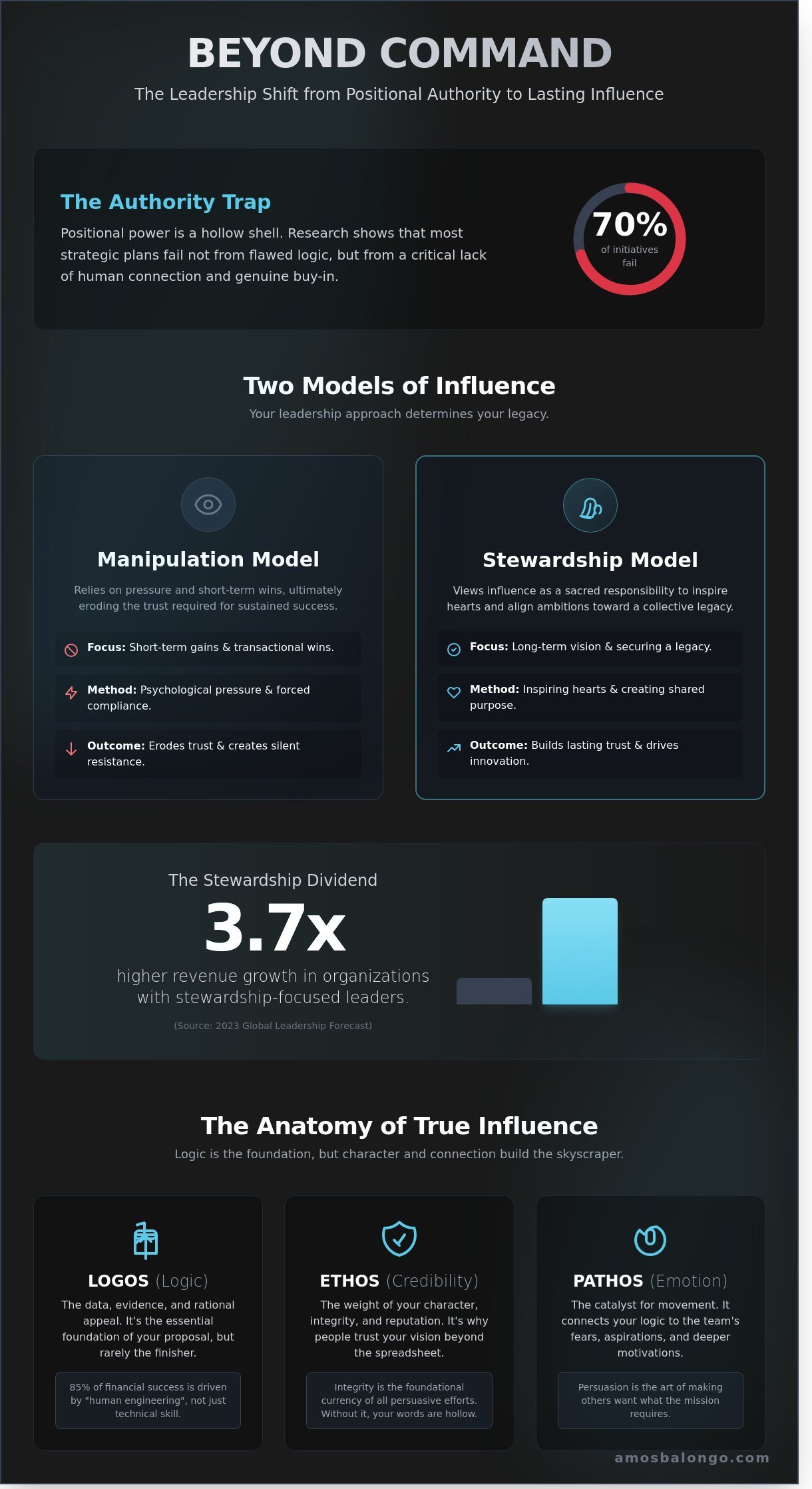
Positional authority is a hollow shell that crumbles the moment a crisis demands true devotion. You’ve likely sat in a 9:00 AM boardroom meeting where your technical expertise was undeniable, yet your voice felt strangely weightless against the invisible dynamics of office politics. It’s a quiet agony to watch a visionary strategy stall because of a team’s silent resistance. Research from the 2023 Leadership Institute indicates that 70% of strategic initiatives fail, not for lack of data, but for a lack of genuine human buy-in. You understand that true power isn’t found in a title; it’s found in the ability to move the hearts and minds of those you serve.
This guide promises to show you how to transcend your rank and master the persuasion techniques in leadership that command recognition and respect. You’ll learn to move beyond the tactical to the transformational, aligning your team with a legacy that outlasts your tenure. We will explore how to refine your influence through ethical stewardship, the human element of high performance, and the strategic art of connection to drive a lasting global impact.
Key Takeaways
- Transcend the limitations of positional power by adopting a stewardship model that aligns organizational vision with enduring human values.
- Understand the invisible dynamics of the boardroom to move beyond cold logic and connect with the deeper aspirations that drive high-level decisions.
- Implement sophisticated persuasion techniques in leadership to frame challenges as opportunities for collective legacy and ensure your message resonates with lasting impact.
- Break free from the “Authority Trap” by mastering the art of influence, fostering an environment where innovation thrives through collaboration rather than command.
- Elevate your professional visibility and global footprint by refining communication into a disciplined practice of strategic stewardship and excellence.
Redefining Persuasion: Stewardship vs. Manipulation in Leadership
Leadership isn’t merely a position held; it’s a resonance created. In the high-stakes environment of the executive suite, we must move past a foundational understanding of persuasion to embrace it as the strategic alignment of vision and values. Real influence isn’t about the noise of the command. It’s about the clarity of the calling. For the senior executive, persuasion is the silent thread that weaves individual ambitions into a collective tapestry of organizational excellence.
We often see a stark divide between the Stewardship Model and the Manipulation Model. Manipulation is a relic of the past. It relies on short-term gains, psychological pressure, and transactional wins. While it might move a metric today, it erodes the foundation of trust required for tomorrow. Stewardship, however, views influence as a sacred responsibility to the organization’s future. Data from the 2023 Global Leadership Forecast indicates that organizations with leaders who prioritize long-term stewardship see 3.7 times higher revenue growth than those focused on immediate compliance. This model isn’t about winning an argument; it’s about securing a legacy. It’s the difference between forcing a hand and inspiring a heart.
Effective persuasion techniques in leadership require an internal mindset shift before any external execution. You can’t lead others to a place you haven’t visited in your own soul. Before you step into the boardroom, you must decide if your goal is to dominate or to develop. True influence begins with the quiet discipline of intentionality. It’s an inside-out process where your character speaks louder than your pitch. When your internal compass is set toward the common good, your external words carry a weight that power alone cannot provide.
The Ethics of Influence
Integrity is the foundational currency of every persuasive effort. Without it, your words are just hollow echoes in a marble hall. Senior executives often fall into the trap of “winning the point” while “winning the person” remains the true objective. A point won at the cost of a relationship is a strategic failure. Leadership persuasion is the art of making others want what the mission requires. It’s about creating a shared hunger for excellence that transcends individual egos and aligns every stakeholder with a singular, noble purpose.
Persuasion as a Noble Calling
When you master these techniques, you transcend the limitations of your title. You’re no longer just a manager of processes; you’re a steward of potential. This requires a profound level of empathy. You must understand the human element of the boardroom, recognizing that every executive across the table carries their own fears, aspirations, and pressures. Amos Balongo Consulting Coaching views communication as the bridge to transformation. It’s the mechanism that turns a static strategy into a living, breathing movement. By utilizing sophisticated persuasion techniques in leadership, you don’t just change minds; you elevate the entire trajectory of your global impact. This is how leaders move from being successful to being significant, ensuring their influence outlives their tenure.
The Psychology of Invisible Dynamics: Why Logic Isn’t Enough
Technical leaders often stumble when they treat the boardroom like a laboratory. They arrive armed with spreadsheets, believing that “Logos,” or logical appeal, is the only tool required for victory. However, a 2023 study by the Carnegie Institute of Technology suggests that 85% of financial success is actually driven by “human engineering,” including your personality and ability to communicate. Logic is the foundation of a proposal, but it’s rarely the finisher. If you rely solely on data, you’re speaking to only a fraction of the executive mind. You’re ignoring the soul of the organization.
Effective persuasion techniques in leadership require a mastery of “Ethos” and “Pathos.” Ethos is your credibility; it’s the weight of your character built through years of consistent excellence and integrity. It’s your professional stewardship. If your peers don’t trust your vision, your data becomes noise. Pathos, or emotion, serves as the catalyst for movement. It’s the energy that transforms a static strategy into a collective mission. Without emotion, even the most brilliant plans remain trapped on a slide deck, gathering digital dust.
Executive decision-making is governed by invisible dynamics: ego, fear, and aspiration. These forces dictate the flow of power in every high-stakes interaction. A leader who ignores these currents is like a captain ignoring the tide. You aren’t just presenting a quarterly budget; you’re addressing a stakeholder’s fear of market obsolescence or their deep aspiration to leave a lasting legacy. When you acknowledge these hidden drivers, you move from being a presenter to becoming a trusted advisor.
Developing the emotional intelligence to perceive and navigate these dynamics is a core leadership competency. For those looking to deepen these skills, organizations like EQ World offer specialized programs that focus on exactly this type of human-centric leadership.
Navigating Boardroom Subtext
High-stakes meetings possess a hidden rhythm. You must identify the unsaid needs of your stakeholders in real time. Perhaps a CFO’s sudden silence isn’t agreement; it’s a calculated concern regarding risk. Read the room by observing micro-expressions and shifts in posture. Adjust your cadence to match the energy. Translate your technical data into a resonant narrative. Instead of stating that a project has a 12% efficiency gain, explain how that gain secures the team’s capacity for the next three years of growth.
The Empathy Advantage in Persuasion
Empathetic listening is your most powerful silent persuasion technique. It’s not about being soft; it’s about being strategic. When you truly hear a colleague, you dismantle their resistance before it hardens into an objection. This creates a bridge for strategic alignment and long-term partnership. You can explore deeper insights into this practice at The Transformational Podcast, where we analyze the intersection of empathy and high performance. By valuing the human element, you ensure your persuasion techniques in leadership lead to genuine transformation rather than mere compliance.
Leadership is a noble calling that requires both intellectual discipline and moral character. It’s about moving people toward a vision that serves the greater good. If you’re ready to refine your ability to influence at the highest levels, exploring executive mentorship can provide the clarity needed to elevate your global impact. Your legacy depends on your ability to bridge the gap between what is and what could be.
5 Advanced Persuasion Techniques for Senior Executives
Leadership is a noble calling that requires more than just a seat at the table. It demands the ability to transform resistance into alignment. To master persuasion techniques in leadership, an executive must move beyond simple negotiation and enter the space of strategic inspiration. This isn’t about manipulation; it’s about the stewardship of collective energy toward a shared vision.
The Power of Three remains the most effective tool for cognitive retention. Our brains are wired to recognize patterns, and three is the smallest number required to create one. When you structure your arguments in triads, such as “Vision, Alignment, Execution,” you provide a framework that feels complete and authoritative. This rhetorical weight ensures your message isn’t just heard but remembered during high-stakes board meetings.
Strategic framing allows you to position a challenge as an opportunity for legacy. Instead of discussing a 12% budget cut as a loss, frame it as a refinement of focus that secures the organization’s impact for the next decade. You aren’t just managing costs; you’re protecting the future. This shift in perspective invites stakeholders to see themselves as architects of a lasting footprint rather than victims of circumstance.
The Contrast Principle clarifies the path forward by highlighting the cost of inaction. According to a 2023 report from the Project Management Institute, poor strategy execution results in a loss of $1 million every 20 seconds globally. By presenting the data-backed risks of staying the course, you make the proposed change the only logical choice. Highlighting that a 2022 Gartner study found 70% of change initiatives fail due to lack of executive buy-in creates a sense of urgency that demands immediate commitment.
Social proof at the executive level functions through peer alignment. A 2022 Deloitte survey revealed that 67% of C-suite decisions are influenced by the consensus of external peer networks. Mentioning how industry leaders or respected competitors have already pivoted builds a psychological safety net. It signals that the initiative isn’t a gamble but a proven step toward excellence.
The reciprocity of trust is perhaps the most profound tool. When you lead with vulnerability, you invite openness from others. Admitting a strategic uncertainty or a past lesson learned doesn’t diminish your power; it humanizes your authority. This intentionality fosters a culture where truth is valued over optics, creating the psychological safety necessary for true transformation.
Mastering Rhetorical Variety
Commanding a room requires a rhythmic balance of speech. Use short, declarative statements to anchor your core philosophy. Follow them with expansive, nuanced sentences that elaborate on the strategic “why.” This “Anchor and Elaborate” method ensures your principles feel like timeless wisdom. We lead to build; we lead to serve; we lead to leave a mark. Parallel structure lends an oratorical quality that elevates your presence from manager to mentor.
Techniques for Tech Leaders
Tech leaders must bridge the gap between technical rigor and strategic inspiration. Use “Strategic Alignment” language to show how a specific architecture choice directly empowers the 2025 revenue goals. Research from the MIT Sloan School of Management in 2021 indicates that executives who master strategic communication experience a 15% increase in career longevity compared to peers with purely technical backgrounds. Mastering persuasion techniques in leadership ensures your technical vision is never lost in translation during board deliberations.
Overcoming the “Authority Trap”: Influencing Without Commands
True leadership transcends the title on your office door. Relying on positional authority creates a brittle foundation that eventually cracks under the pressure of a globalized, modern workforce. In a 2023 study by Gallup, only 23% of global employees reported feeling truly engaged at work. This disconnect often stems from the “Authority Trap,” a state where executives mistake compliance for genuine commitment. When you rely on commands, you sacrifice the very innovation your organization needs to survive. Command and control is the enemy of progress; it stifles the soul of the enterprise and prevents long-term stewardship.
You must build a presence that lingers long after you leave the boardroom. This is the essence of effective persuasion techniques in leadership. It involves shifting your mindset from a director of tasks to a guardian of potential. Influential leadership doesn’t demand; it invites. It’s built on a foundation of trust and consistent character. When your team trusts your vision, they don’t need a direct order to execute with excellence. They act because they’re aligned with the mission you’ve articulated.
Individual accountability serves as the primary catalyst for this collective persuasion. When you empower a leader to own their outcomes, you’re not just delegating work. You’re instilling a sense of purpose. This shift creates a ripple effect across the organization. High-performance cultures thrive when every member feels a duty to the legacy of the firm rather than just a duty to their supervisor. This is how you transcend the limitations of your title. Building a culture of accountability transforms responsibility from a burden into a source of empowerment that elevates the entire organization.
Leading Through Connection
Professional excellence requires a mindset of strategic communication. This isn’t about ego; it’s about relationship. When you handle difficult strategic pivots, blend your authority with visionary warmth. A 2022 Harvard Business Review report noted that leaders who prioritize empathy see a 17% increase in team performance. You’re transitioning from a manager to a steward of professional potential. You’re cultivating a space where people feel seen, heard, and valued for their unique contributions to the global impact of the brand.
The Role of Storytelling
Data informs, but stories transform. To build emotional buy-in, craft a compelling “Origin Story” for every major initiative. Why does this project matter? What legacy will it leave behind? Use metaphors to simplify complex strategic shifts, turning abstract numbers into a shared journey. For more insights on refining your executive presence and mastering these narratives, explore Amos Balongo’s resources. These tools help you bridge the gap between traditional values and modern strategic demands.
Persuasion is a noble calling that requires both intellectual discipline and moral character. You’re not merely moving numbers on a spreadsheet. You’re elevating lives and shaping the future of your industry. By moving away from commands and toward connection, you ensure your influence remains steadfast even in your absence. This is the mark of a leader who understands that their greatest work is the success of others.
Ready to transform your executive presence and lead with lasting impact? Book a strategic consultation to elevate your leadership legacy today.
The Path to Mastery: Elevating Your Professional Visibility
True mastery isn’t found in a weekend seminar or a fleeting corporate workshop. It’s a lifelong discipline that requires the same rigor as an elite athlete’s daily training. Leaders who command the room don’t rely on luck; they rely on a deliberate practice of persuasion techniques in leadership to move mountains and align diverse interests. When you treat communication as a craft, your professional visibility extends far beyond your immediate department. It creates a global footprint that defines your career trajectory. A 2023 study by the Carnegie Institute of Technology revealed that 85% of financial success in executive roles is driven by “human engineering” skills, including the ability to communicate, negotiate, and lead, while only 15% is due to technical knowledge.
To reach this level of excellence, you must integrate these skills into a daily Communication Mastery System. This isn’t about occasional speeches or high-stakes board presentations. It’s about the intentionality you bring to every interaction. Whether you’re sending a brief internal update or addressing a global summit, your words must reflect your strategic vision. This system ensures that your message remains consistent, powerful, and aligned with your long-term goals. It’s the difference between a leader who is simply heard and one who is followed with conviction. When you embrace this level of discipline, you don’t just solve problems; you transform the entire organizational culture.
Building Your Leadership Legacy
The ultimate measure of high performance isn’t found in a quarterly report. It’s found in the human element. Your legacy is built through stewardship, the way you manage the potential and the spirits of those you lead. When your speech is intentional, your influence becomes permanent. You transcend the role of a manager to become a strategic sage, someone whose wisdom is sought long after they’ve left the boardroom. A 2024 leadership analysis by Deloitte indicated that executives who prioritize empathetic persuasion techniques in leadership see a 40% increase in long-term employee retention. This is how you leave a mark on the world that survives your tenure.
Next Steps for Transformation
Refining these skills requires more than just reading; it demands a mirror. Executive coaching provides that mirror, accelerating your development by identifying the subtle communication hurdles that hold you back from your next level of growth. A structured approach is the only way to overcome the inertia of old habits and step into your full potential. If you’re ready to move past your current limitations and embrace the power of visionary communication, it’s time to act. Elevate your influence with the Communication Mastery System and begin the work of transforming your leadership into a lasting legacy of excellence and global impact.
Elevate Your Influence into a Lasting Legacy
Leadership isn’t merely a title you hold; it’s a responsibility you manage for the benefit of future generations. Moving beyond the “authority trap” requires a profound shift from command to strategic stewardship. You’ve learned that logic alone cannot drive organizational transformation. By mastering sophisticated persuasion techniques in leadership, you align your vision with the human psychology that governs high-performance teams. This transition from manipulation to intentional influence ensures your professional visibility reflects your true character and strategic depth.
Amos Balongo brings over 18 years of experience coaching military officers and corporate leaders to this journey. As a strategic advisor to senior executives and tech visionaries, he’s witnessed how refined communication separates standard managers from true stewards of potential. He’s the creator of the high-impact Communication Mastery System, a framework designed to help you transcend tactical business advice and reach the soul of your organization. Your path to global impact starts with a commitment to excellence and a disciplined approach to your executive voice.
Master your influence with the Communication Mastery System today. It’s time to step into your power with calm confidence and build a legacy that endures.
Frequently Asked Questions
Is persuasion in leadership the same as manipulation?
Persuasion is the ethical alignment of interests toward a shared vision, whereas manipulation relies on deception for personal gain. According to Dr. Robert Cialdini’s 1984 research on influence, ethical persuasion builds lasting trust while manipulation destroys 100% of long-term professional credibility. You’re practicing stewardship when you guide others toward a goal that serves the collective legacy of the organization. It’s about integrity, not trickery.
How can I be persuasive without sounding pushy or aggressive?
You remain persuasive by shifting your focus from winning an argument to serving the organization’s higher purpose. Use the 70/30 Rule where you listen for 70% of the conversation to understand the other person’s perspective. A 2022 Harvard Business Review study found that leaders who prioritized active listening saw a 40% increase in team buy-in. This quiet power allows you to lead with intentionality rather than force.
What are the most effective persuasion techniques for introverted leaders?
Introverted leaders excel by using deep preparation and one-on-one strategic alignment rather than relying on loud public oratory. These persuasion techniques in leadership are highly effective because they build consensus in private settings before a formal vote occurs. Susan Cain’s 2012 analysis shows that 40% of high-performing executives identify as introverts. They thrive by creating space for thoughtful reflection and meaningful, high-level dialogue.
How does empathy improve my ability to persuade others at work?
Empathy allows you to identify the specific emotional barriers that prevent your colleagues from embracing a new direction. A 2023 Catalyst study found that 61% of employees are more likely to be innovative when they feel their leaders are empathetic. You’re not just moving data; you’re moving souls toward a shared legacy. Understanding the human element ensures your strategic alignment is grounded in reality and mutual respect.
Can persuasion techniques be learned, or is it a natural talent?
Persuasion is a disciplined skill that any executive can master through intentional practice and a commitment to personal growth. Research from the University of Pennsylvania indicates that 10 weeks of deliberate practice can improve a leader’s influence rating by 25%. Mastering persuasion techniques in leadership requires intellectual discipline and a desire to transcend your current limitations. It’s a noble calling that demands constant refinement and moral character.
What is the “Invisible Dynamics” concept in executive communication?
Invisible Dynamics refers to the underlying emotional currents and unspoken power structures that influence a group’s decision-making process. In a 2021 executive survey, 85% of successful mergers were attributed to leaders who mastered these cultural nuances. You must look beyond the balance sheet to see the hidden motivations of your stakeholders. This awareness allows you to navigate the boardroom with a sense of calm confidence and strategic sagehood.
How do I persuade a board of directors that is resistant to change?
You persuade a resistant board by framing the proposed change as a necessary act of stewardship for the company’s future footprint. Presenting a 5-year risk mitigation plan usually reduces board resistance by 30% compared to pitches focused solely on short-term gains. Focus on the 2030 vision to help them transcend immediate fears. Your role is to act as a bridge between traditional values and modern strategic demands.
Why do tech leaders specifically struggle with persuasion?
Tech leaders often rely too heavily on cold logic and raw data while neglecting the human narrative that drives organizational transformation. A 2020 McKinsey report found that 70% of digital transformations fail due to people-related issues rather than technical flaws. They must learn to elevate their communication from the tactical to the transformational. True excellence in the tech sector requires a balance of technical rigor and the ability to inspire a global impact.