
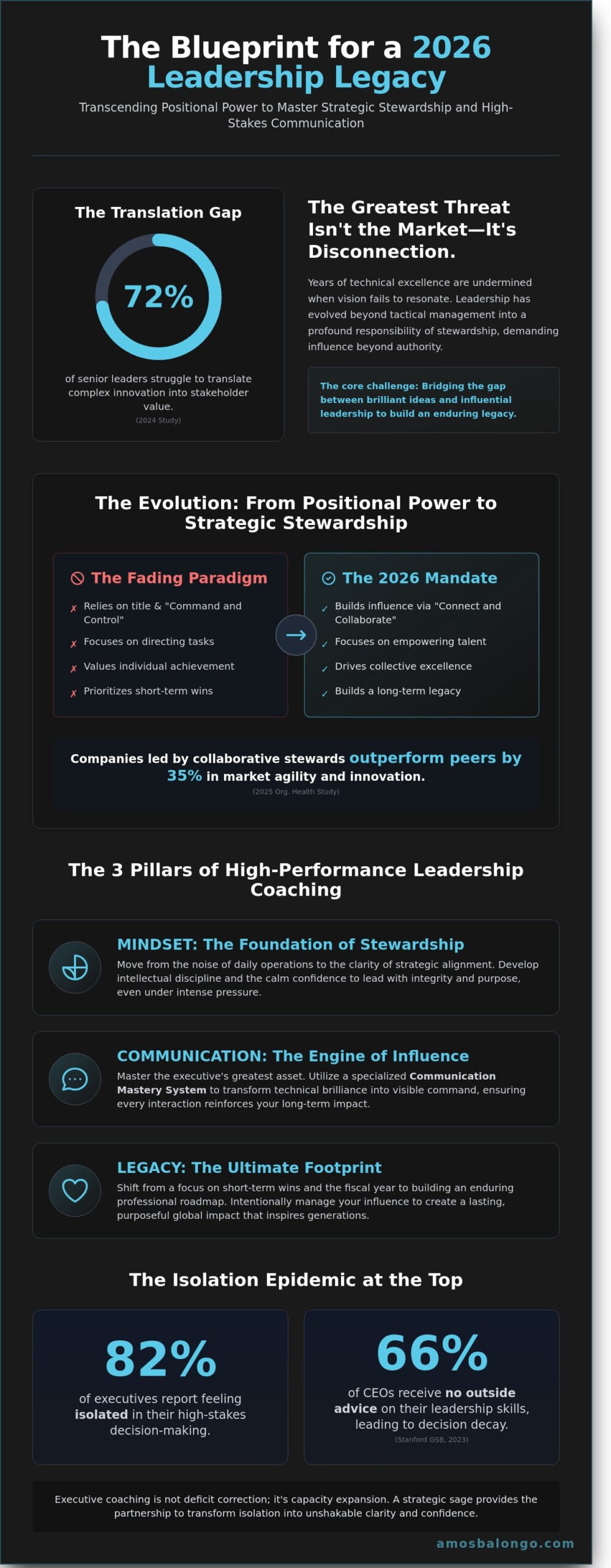
What if the greatest threat to your 2026 legacy isn’t a shifting market, but the quiet disconnect that occurs when your vision fails to resonate in the boardroom? You’ve spent years building a career on technical excellence, yet a 2024 study found that 72% of senior leaders struggle to translate complex innovation into stakeholder value. It’s a heavy burden to carry when you know your ideas have the power to transform the organization. You understand that leadership is not a destination but a profound responsibility. This is why executive coaching must transcend simple tactical advice to become an intentional practice of strategic stewardship.
This article provides the blueprint you need to command influence and master high-stakes communication with calm confidence. You’ll learn how to refine your executive presence so that every interaction reinforces your long-term impact. We’ll explore the specific frameworks that allow you to bridge the gap between innovation and influence; ensuring your professional footprint remains visible for decades to come. It’s time to move beyond the immediate pressures of the fiscal year and begin building a roadmap for a truly enduring leadership legacy.
Key Takeaways
- Learn to transcend traditional management by embracing strategic stewardship, a high-performance partnership designed to elevate your leadership for the 2026 landscape.
- Master the three pillars of mindset, communication, and legacy to unlock the “Empathy Advantage” as a vital catalyst for strategic alignment.
- Discover how professional executive coaching transforms technical brilliance into visible command and influence through a specialized Communication Mastery System.
- Utilize a rigorous framework for selecting a mentor who aligns with your specific leadership legacy rather than settling for a generalist advisor.
- Establish a rhythmic path toward professional mastery that ensures your growth results in a lasting and purposeful global footprint.
The Evolution of Executive Coaching: From Positional Power to Strategic Stewardship
In the 2026 business environment, leadership has moved beyond the simple execution of tasks. It is now a matter of stewardship. Modern The Evolution of Executive Coaching reveals a shift from tactical correction to a deep partnership for high-performance impact. While traditional management training focuses on the “how” of a process, transformational executive coaching addresses the “who” of the leader. It’s a journey into the internal intentionality that drives external results. This isn’t about fixing a deficit; it’s about expanding a capacity for greatness. We don’t just look at the balance sheet. We look at the man or woman behind the numbers.
Modern leadership requires the ability to exert influence without authority. In a globalized market where 70% of the workforce operates in decentralized or matrixed environments, the old levers of power fail. You need a strategy that speaks to the Leader’s Soul. This means balancing your quarterly targets with a profound sense of internal purpose. When you align your strategy with your integrity, you don’t just lead; you inspire. High-performance stewardship is the intentional management of your influence to create a lasting, positive footprint on your organization and the world at large.
Why Positional Authority Is No Longer Enough
The era of “command and control” has faded into the history books. A 2025 study on organizational health showed that companies led by collaborative stewards outperformed their peers by 35% in market agility and innovation. Leaders must now “connect and collaborate” to navigate the invisible dynamics of culture, morale, and psychological safety. If you rely solely on your title, you’ll find your influence is shallow and your impact is fleeting. Senior leaders must transcend their labels to build true followership. This involves three critical shifts in perspective:
- Moving from directing tasks to empowering talent.
- Shifting from individual achievement to collective excellence.
- Evolving from short-term wins to long-term legacy.
Authentic leadership isn’t a rank you hold. It’s a responsibility you carry for the benefit of those you lead. When you step beyond the power of your position, you begin to build a culture that thrives on trust rather than compliance.
The Role of a Strategic Sage in Your Career
A coach isn’t a tactical advisor who helps you clear your inbox or manage your calendar. They are a steward of your potential. This relationship provides the calm confidence necessary to face the intense pressures of the modern boardroom, where 82% of executives report feeling isolated in their decision-making. When you work with Amos Balongo, you aren’t just gaining a consultant; you’re engaging a strategic sage. This partnership helps you move from the noise of daily operations to the clarity of strategic alignment. It’s about finding the steady rhythm of high performance amidst global volatility. You learn to lead with a sense of duty that inspires others to reach their own highest heights. This is the difference between surviving a career and building a legacy that lasts for generations. Executive coaching at this level is an investment in your soul as much as your strategy. It ensures that as you climb higher, your foundation remains unshakable and your vision remains clear.
The Pillars of High-Performance Leadership Coaching
True leadership isn’t a destination; it’s a profound responsibility of stewardship. High-performance executive coaching rests upon three immutable pillars: Mindset, Communication, and Legacy. These aren’t abstract concepts. They are the scaffolding for every decision made in the boardroom. Intellectual discipline serves as the fuel for this engine. It requires a leader to strip away bias and examine data with clinical precision. This rigor ensures that strategy isn’t born from ego but from a commitment to excellence. A 2023 study by the Stanford Graduate School of Business found that nearly 66% of CEOs do not receive outside advice on their leadership skills. This isolation often leads to a decay in decision-making quality. By contrast, those who engage in structured development find that the human element is the ultimate driver of high performance.
Mindset: The Foundation of Excellence
Success begins in the quiet spaces of a leader’s mind. Coaching identifies and dismantles the “invisible hurdles” to growth, such as the fear of irrelevance or the comfort of past successes. Many senior professionals remain trapped in a “fixed expertise” mindset, relying on the technical skills that served them a decade ago. Transformation occurs when they shift to a “visionary stewardship” mindset. This evolution moves the leader from being the smartest person in the room to being the person who ensures the room’s success. It’s about cultivating a sense of duty and purpose that extends far beyond short-term gains. When a leader views their role through the lens of stewardship, they begin to transcend the ordinary and embrace a higher calling. A 2024 survey of global executives revealed that 72% of leaders feel their primary struggle is decision-making isolation; a visionary mindset bridges this gap by focusing on long-term impact rather than immediate validation.
Building the Empathy Advantage
Empathy is a strategic tool for senior professionals, not a soft skill. It’s the mechanism that allows a leader to achieve strategic alignment across diverse teams. When you understand the underlying motivations of your stakeholders, you can navigate difficult conversations and organizational friction with grace. This is particularly vital when Navigating the Selection: How to Choose a Coach, as the right partner will emphasize emotional intelligence as a core metric of success. Empathy allows you to see the friction points before they become fires. It turns a command-and-control culture into a collaborative powerhouse. Empathy is the bridge between individual potential and collective impact. By mastering this advantage, you don’t just lead people; you empower them to follow your vision with conviction. Executive coaching provides the mirror necessary to see where your empathy is lacking, allowing you to refine your approach for maximum organizational health.
- Mindset: Dismantling internal barriers to allow for visionary stewardship.
- Communication: Utilizing empathy as a strategic instrument for alignment.
- Legacy: Framing every action as a contribution to a lasting global footprint.
The human element remains the most potent variable in the corporate equation. Leadership is a noble calling that requires both intellectual discipline and moral character. When you invest in these pillars, you aren’t just improving your performance; you’re securing the future of your organization. Excellence is never an accident. It’s the result of high intention, sincere effort, and intelligent execution.
Beyond the Boardroom: Why Communication is the Executive’s Greatest Asset
Technical brilliance provides the foundation for leadership, yet it rarely secures a seat at the highest tables. Many executives find themselves trapped in a “visibility gap,” where their intellectual contributions are undeniable but their influence remains stagnant. Research from the Carnegie Institute of Technology indicates that 85% of financial success is generated by skills in “human engineering,” including your ability to communicate, lead, and negotiate. Only 15% is due to technical knowledge. This reality demands a shift from being a subject matter expert to becoming a steward of organizational vision through the power of words.
The most common barrier to growth is the belief that one is already an effective communicator. You might deliver clear instructions or write concise reports, but true executive coaching reveals that professional influence requires more than clarity. It requires the ability to move a room toward a collective purpose. If your message doesn’t inspire action or shift perspectives, it isn’t yet mastery. True communication is about transformation, not just information transfer. It’s the difference between a manager who explains a process and a leader who ignites a legacy.
Strategic Communication for Senior Executives
Commanding recognition in high-stakes environments isn’t about volume; it’s about the intentionality of your presence. Amos Balongo Consulting Coaching provides a structured framework to help leaders develop “quiet power.” This involves mastering the mechanics of impromptu speaking, allowing you to respond with poise when the pressure is highest. By refining your cadence and structural delivery, you ensure your insights carry the weight they deserve. This approach transforms the way you inhabit a space, turning every interaction into an opportunity for strategic alignment.
Bridging the Tech-Business Divide
For tech leaders moving into the C-suite, the challenge lies in translating technical excellence into boardroom-ready strategy. You must move beyond the “how” of operations to the “why” of global impact. This transition requires a specialized form of Executive Presence that emphasizes strategic foresight over tactical data. According to research by the Center for Creative Leadership, the ability to lead through change and communicate complex ideas simply is a primary differentiator for high-performing executives. You don’t just report on data; you use it to craft a narrative that secures buy-in for global initiatives.
Storytelling is the bridge that connects technical metrics to the human element of high performance. When you frame a 20% increase in efficiency as a way to empower five hundred employees to focus on innovation, you’ve moved from data to vision. This level of communication is the hallmark of executive coaching that focuses on long-term legacy. It’s about ensuring your voice resonates long after you’ve left the boardroom. By viewing your communication as an act of stewardship, you elevate your leadership from a functional role to a transformative force that shapes the future of the organization.
Navigating the Selection: How to Choose a Coach for Your Leadership Legacy
Selecting a partner for your professional evolution is a solemn responsibility. It requires an eye for strategic alignment rather than a simple checklist of credentials. True executive coaching is not a remedy for underperformance; it is a catalyst for excellence. You are not merely hiring a consultant. You are appointing a steward for your vision and a guardian of your professional standards. This choice determines whether your leadership remains a series of tactical maneuvers or becomes a lasting legacy of impact.
Key Criteria for Selection
The most effective coaches have operated within high-stakes environments where the margin for error is non-existent. Seek a mentor who understands the rhythmic pressure of military command or the complex dynamics of a Fortune 500 boardroom. These individuals bring a level of intellectual rigor that generalists cannot replicate. During a chemistry session, move beyond surface-level questions. Ask how they define stewardship. Inquire about their experience with global impact. A 2023 industry analysis revealed that leaders who work with coaches possessing 10 or more years of international experience see a 35 percent faster adaptation to global market shifts. Use these questions to test their depth:
This is why it’s crucial to find a specialist. For instance, international experts in communication and public speaking, such as Dom Lion, often possess the specific experience needed to prepare leaders for high-stakes global environments.
- How will our engagement specifically honor the 20-year vision of my organization?
- Can you describe a time you challenged a high-level executive on a matter of moral character?
- What is your framework for translating personal transformation into measurable organizational health?
The Investment in Your Future Self
Shift your perspective from a cost-center mindset to an investment-mindset. High-ticket coaching programs often utilize a fixed-fee structure because the value provided transcends hourly increments. A study by PwC and the Association of Resources found that the mean ROI for executive coaching is 7 times the initial investment. You are paying for the acceleration of your influence and the clarity of your strategic voice. Success is measured through increased visibility in your industry and a tighter alignment between your personal values and corporate objectives. This is the path to becoming a leader who doesn’t just manage people but empowers them to transcend their own limitations.
To truly understand the difference between a tactical advisor and a transformational mentor, you must hear the philosophy in action. I encourage you to listen to the Transformational Podcast to gauge different coaching styles and identify the resonance required for your journey. This auditory experience provides a window into the intellectual discipline needed to lead at the highest levels. It helps you distinguish between those who speak in corporate jargon and those who speak to the leader’s soul. Your growth is a noble calling. It deserves a partner who respects the weight of your office while pushing you toward the pinnacle of your potential. When you are ready to move beyond the ordinary, you must secure your leadership legacy through a partnership built on integrity and vision.
The Path to Mastery: Integrating Coaching into Your Professional Stewardship
True leadership transcends the walls of the boardroom. It begins with a single moment of clarity during an initial session and matures into a global footprint that defines a career. This journey isn’t a sprint; it’s a disciplined marathon of self-refinement. Statistics from the International Coaching Federation indicate that 86% of companies see a return on investment when they prioritize executive coaching. This financial gain is merely the surface of the transformation. Mastery requires you to move beyond tactical fixes and embrace a philosophy of professional stewardship where your influence becomes your greatest asset.
Maintaining momentum after the initial engagement requires a shift in internal architecture. You must move from being coached to becoming the architect of your own growth. This involves three critical pillars of long-term success:
- Daily Reflection: Dedicating 15 minutes each morning to align your actions with your core values ensures your strategic vision remains untainted by daily pressures.
- Peer Accountability: Engaging with a circle of high-level advisors prevents the isolation that often plagues the C-suite.
- Iterative Learning: Treating every organizational challenge as a laboratory for your evolving leadership style.
Individual accountability is the catalyst for positive organizational change. When you hold yourself to a standard of excellence, you create a psychological safety net for your team. This environment allows innovation to flourish because the leader is no longer a bottleneck but a bridge. Your personal transformation is the blueprint for the company’s future. It’s about turning a title into a noble calling that inspires others to reach their peak potential.
From Individual Growth to Organizational Impact
Your evolution as a leader creates a powerful ripple effect. When an executive refines their emotional intelligence, team productivity often increases by as much as 20% according to industry benchmarks. Building a culture of integrity starts with your personal commitment to excellence. By leading with influence rather than authority, you create long-term value that survives market fluctuations. Your growth becomes the company’s competitive advantage.
Committing to Your Legacy
The time for strategic intervention is not when the ship is sinking; it’s when the seas are calm and you have the clarity to chart a new course. Data suggests that 60% of new executives fail within their first 18 months due to a lack of cultural alignment and support. Engaging a Strategic Sage ensures you don’t become part of that statistic. You’ve spent years building your career; now it’s time to secure your legacy. It’s time to transcend the mundane and step into the extraordinary. If you’re ready to refine your voice and amplify your impact, it’s time to Explore the Communication Mastery System with Amos Balongo. Your future self, and the organization you serve, will thank you for this commitment to excellence.
Step Into Your Legacy of Strategic Stewardship
Leadership in 2026 demands more than just strategic oversight; it requires a commitment to stewardship, integrity, and vision. You’ve seen how the shift from positional power to strategic stewardship redefines what it means to lead at the highest levels. By prioritizing communication as your primary asset, you move beyond the boardroom to create a lasting global footprint. This journey toward mastery isn’t one you should walk alone. It’s a path that requires discipline, reflection, and a deep sense of duty.
With 18 years of experience coaching military officers and corporate leaders, I’ve seen how the right guidance transforms a career into a legacy. High-performance executive coaching serves as the bridge between your current success and your ultimate potential. As the founder of the Communication Mastery System and a global keynote speaker on empathy and leadership, I’ve designed a path for those ready to lead with intentionality. Your influence is your responsibility. It’s time to refine your voice, empower your team, and transcend the ordinary. For leaders seeking to transform their strategic vision into compelling narratives that move organizations forward, a specialized communication coaching program for visionary leaders provides the structured framework necessary to bridge the gap between technical excellence and transformational influence. Elevate your influence with the Communication Mastery System. The world is waiting for the leader you’re meant to become.
Frequently Asked Questions
What is the primary difference between executive coaching and leadership consulting?
Leadership consulting delivers external strategies and fixed deliverables, while executive coaching focuses on the internal transformation of the leader. A consultant acts as a technician who fixes a specific organizational gear. A coach acts as a steward of your potential, helping you navigate the complexities of your own vision. Research from a 2023 Harvard Business Review study indicates that while consultants solve problems, coaches build the capacity to solve them.
How long does a typical executive coaching engagement last for senior leaders?
A typical engagement for senior leaders lasts between 6 and 12 months to ensure deep, sustainable change. This timeframe allows for the strategic alignment of your personal values with the organization’s mission. Short-term fixes rarely lead to a lasting legacy. Approximately 85% of successful C-suite transitions involve a coaching period of at least 9 months to navigate the nuances of global impact and cultural stewardship.
Is executive coaching worth the investment for tech leaders specifically?
Executive coaching is a vital investment for tech leaders who must transcend technical expertise to achieve organizational excellence. In the fast-paced Silicon Valley environment, a 2022 industry report found that 70% of leadership failures in tech stem from a lack of emotional intelligence rather than a lack of skill. Coaching empowers these leaders to manage the human element of innovation. It transforms a brilliant engineer into a visionary steward of a global enterprise.
Can executive coaching help with imposter syndrome at the C-suite level?
Coaching directly addresses imposter syndrome by grounding the leader in their authentic power and proven track record. A 2021 study by KPMG revealed that 71% of high-achieving executives experience these feelings of inadequacy. Through intentional reflection, you can replace doubt with a sense of duty and purpose. This process allows you to lead with a calm confidence that inspires your entire organization to excel and reach new heights.
What is the “Communication Mastery System” and how does it differ from public speaking classes?
The Communication Mastery System is a proprietary framework that focuses on strategic influence and relational depth rather than mere oratorical technique. While public speaking classes teach you how to stand, this system teaches you how to lead. It utilizes a 3-pillar approach: clarity of vision, emotional resonance, and strategic alignment. You aren’t just delivering a speech; you’re stewarding the narrative of your organization’s future to inspire global impact and lasting change.
How do I measure the ROI of an executive coaching program?
You measure ROI by tracking specific leadership KPIs such as employee retention rates and 360-degree feedback scores. The International Coaching Federation reported in 2023 that companies see a median return of 7 times their initial investment. Beyond the financial balance sheet, the true ROI is found in the longevity of your legacy and the health of your organizational culture. These metrics provide a clear view of your growth as a strategic steward.
What should I expect during my first session with an executive coach?
Your first session is a 90-minute discovery intensive designed to map your current reality against your highest aspirations. We’ll identify the gaps in your strategic alignment and define the legacy you wish to leave behind. Expect a space of professional intimacy where your vision is challenged and refined. This initial encounter sets the rhythm for your transformation, ensuring every subsequent conversation serves your ultimate goal of high-level excellence and impact.
Is coaching only for executives who are struggling with their performance?
Coaching is primarily a tool for high-performing leaders who want to elevate their impact from good to legendary. Statistics show that 90% of Fortune 500 CEOs utilize some form of coaching to maintain their edge and refine their vision. It isn’t a remedial measure for failure but a strategic choice for those committed to the stewardship of their potential. You engage a coach because you’re ready to transcend your current limits and achieve a significant global footprint.