
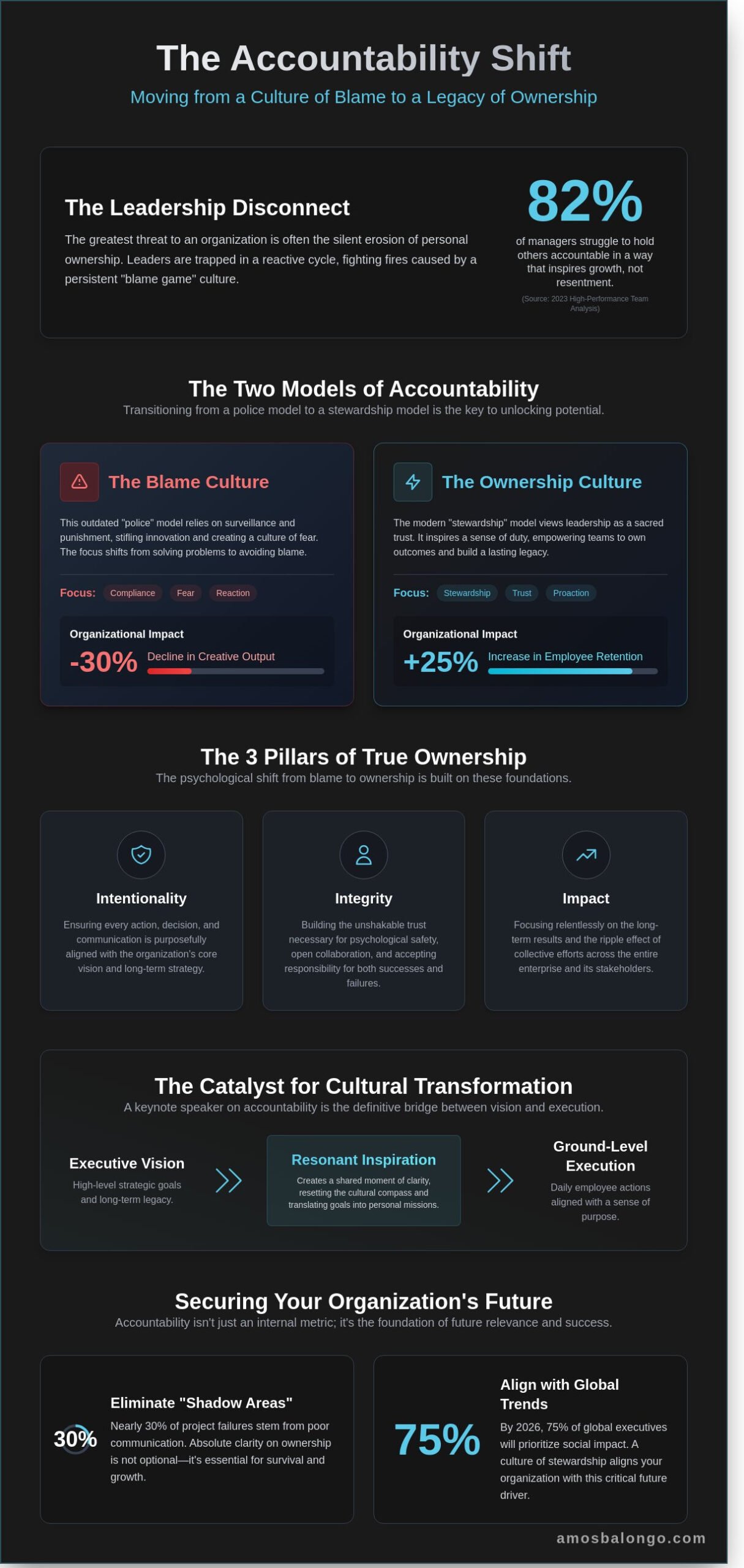
What if the greatest threat to your organization isn’t a lack of talent, but the silent erosion of personal ownership? Many leaders find themselves trapped in a cycle of reactive management; they’re constantly fighting fires caused by organizational silos and a persistent “blame game” culture. Engaging a world-class keynote speaker on accountability is the definitive catalyst for bridging the gap between executive vision and ground-level execution. You likely feel the weight of this disconnect every day. A 2023 analysis of high-performance teams showed that 82% of managers struggle to hold others accountable in a way that actually inspires growth rather than resentment.
It’s time to transcend the limitations of mere compliance. This article explores how you can move your leadership team toward a culture of deep ownership and a lasting legacy of excellence. We’ll examine the shift from management to stewardship, the strategies for aligning strategy with execution, and the path to improving your professional visibility. By the end, you’ll understand how to transform your leadership into a noble calling that secures your organization’s future for the next 10 years and beyond.
Key Takeaways
- Transition from a culture of compliance to one of stewardship, viewing leadership as a noble responsibility rather than a mere title.
- Identify and eliminate the “shadow areas” of your organization by implementing the Communication Mastery System to ensure absolute clarity.
- Discover how a keynote speaker on accountability can bridge the gap between senior leadership strategy and the human element of high performance.
- Apply a strategic two-step framework to audit internal gaps and align your team’s daily actions with their long-term professional legacies.
- Accelerate your organization’s speed-to-market and decision-making by fostering the ripple effect of individual radical accountability.
Redefining the Keynote Speaker on Accountability: From Compliance to Stewardship
Accountability is often misunderstood as a heavy burden of oversight or a mechanism for punishment. In the 2026 corporate environment, where a projected 75% of global executives will prioritize social impact as a core business driver, this definition must evolve. It isn’t merely about meeting quarterly KPIs or checking boxes on a performance review. To grasp this shift, we should look at What is Accountability? in its deepest ethical and organizational sense. It’s the willingness to accept responsibility for our actions and the profound outcomes they produce across the entire enterprise.
The traditional “police” model of accountability relies on surveillance and the threat of reprimand to ensure compliance. This outdated approach stifles the human spirit and limits the potential for excellence. In contrast, the “stewardship” model views leadership as a sacred trust. When a keynote speaker on accountability addresses a boardroom, they aren’t there to enforce rules; they’re there to inspire a sense of duty to future generations. Senior leaders must see their influence as a legacy they’re building, not just a title they’re holding. This perspective transforms accountability into a catalyst for positive, lasting organizational change that transcends the balance sheet.
The Shift from Blame to Ownership
The blame game is a silent killer of innovation. A 2023 study by Harvard Business Review revealed that organizations with high levels of blame see a 30% decline in creative output. When teams fear being the scapegoat for a mistake, they stop taking the risks necessary for growth. Moving from “who did this?” to “how do we own this?” requires a profound psychological shift. It’s about moving from a defensive posture to a proactive one. This transition is built on three pillars: Intentionality, Integrity, and Impact. Intentionality ensures every action aligns with the vision. Integrity builds the trust necessary for collaboration. Impact focuses on the long-term results of our collective efforts.
Why a Keynote is the Catalyst for Cultural Transformation
Transformation begins with a shared moment of clarity. A keynote speaker on accountability provides this shared experience, creating a singular point in time where the entire organization resets its cultural compass. Professional speakers bridge the gap between high-level executive vision and daily employee execution. They translate strategic goals into personal missions. This process relies on “resonant inspiration,” a form of communication that speaks to the leader’s soul and the employee’s purpose. It isn’t just about a temporary emotional high. It’s about driving long-term behavioral changes that stick long after the lights in the ballroom dim. By 2026, organizations that invest in these transformational moments will see a 25% increase in employee retention compared to those that rely solely on tactical training.
Leadership is a noble calling that requires both intellectual discipline and moral character. When we shift our focus from monitoring behavior to empowering potential, we create a culture where excellence is the standard, not the exception. This is the true power of individual accountability as a catalyst for global impact.
The Invisible Dynamics: How Communication and Accountability Intersect
Accountability often fails not because of a lack of will, but because of a lack of clarity. A robust communication framework serves as the bedrock for any high-performance culture. It’s the system that eliminates ambiguity and replaces it with strategic intent. When leaders fail to articulate precise goals, they create “shadow areas” where responsibility quietly dissipates. In these murky zones, no one knows who owns the result, and excellence becomes impossible to sustain. Statistics from 2023 indicate that nearly 30% of project failures stem directly from poor communication. By refining how we speak and listen, we bring professional visibility to the forefront. This visibility isn’t about surveillance; it’s about the pride of ownership. A keynote speaker on accountability understands that when people are seen, they’re more likely to step up. They move from being passive participants to active stewards of the organization’s mission. Integrating communication and accountability ensures that every team member understands their specific contribution to the global footprint of the firm. It creates a culture where every word spoken is a commitment made.
Mastering the Executive Narrative
Leadership requires a shift from managing tasks to curating a narrative. Leaders must use storytelling to transform accountability from a cold corporate rule into a shared core value. This is where executive presence becomes vital. It’s the ability to command a room not through volume, but through the resonance of one’s character—a skill that multidisciplinary artists like Mark Janicello have mastered. Amos Balongo emphasizes that professional influence is built on the foundation of integrity and vision. When a leader shares a story of a collective win, they reinforce the idea that every individual’s effort matters. This narrative approach builds a legacy that lasts far beyond a single fiscal quarter. It’s about inspiring a sense of duty that transcends the paycheck. By 2025, the most successful organizations will be those that treat their mission as a living story rather than a static document. This shift ensures that every employee sees themselves as a protagonist in the company’s success. As a keynote speaker on accountability, Amos teaches that your narrative is your most powerful tool for alignment.
The Empathy Advantage in Accountability
We must dismantle the outdated belief that empathy weakens a leader’s authority. In reality, empathy is the greatest tool for holding high-stakes teams accountable. It allows for difficult conversations that preserve trust. You don’t have to choose between high standards and human connection. Strategic alignment is achieved when you listen with the intent to understand, then speak with the intent to empower. Data from a 2024 leadership study shows that teams led with high empathy are 40% more likely to meet their annual targets. This isn’t soft; it’s strategic excellence. It’s about building a culture where people feel safe enough to admit mistakes and driven enough to correct them. These interactions require a level of intellectual discipline that few possess but all can learn. If you’re looking to elevate your leadership strategy, start by viewing empathy as a performance multiplier. This approach ensures that your team remains resilient even when the stakes are at their highest, fostering a spirit of stewardship that defines world-class performance.
Individual Accountability as a Catalyst for Positive Change
When a single leader chooses radical accountability, they don’t just solve a problem; they shift the entire atmosphere of the organization. This is the ripple effect in action. It begins with one person refusing to deflect blame and instead choosing to own the outcome. As a keynote speaker on accountability, I’ve seen how this solitary act of courage gives others the psychological safety to do the same. It’s a transformative power that moves through a department like a wave, replacing a culture of excuses with a culture of execution. This shift is essential for any leader who seeks to leave a lasting footprint on their industry.
In the high-stakes world of technology, accountability is the primary driver of speed-to-market. When teams stop waiting for permission and start taking ownership of their modules, decision-making cycles accelerate. A 2023 study by the Harvard Business Review found that organizations with high-trust, accountable cultures experience 50% higher productivity than their peers. In tech, where a delay of even a few days can cost millions in market share, individual ownership is the difference between leading the pack and falling into obsolescence. It’s not about working more hours; it’s about the intentionality behind every line of code and every strategic pivot.
Global impact is often the result of local, individual ownership. We often think of “global impact” as a massive, sweeping initiative, but it’s actually the sum of thousands of individual choices made with integrity. When a manager in a regional office takes full responsibility for their team’s ethical standards, they contribute to the global brand’s reputation. To help leaders measure this, I developed the Stewardship Quotient (SQ) framework. You can assess your own SQ by evaluating these three pillars:
- Self-Correction Rate: How quickly do you acknowledge a mistake and pivot toward a solution without external prompting?
- Outcome Alignment: To what degree are your daily actions synchronized with the long-term mission of the organization?
- Legacy Intent: Are you making decisions based on this quarter’s numbers or the health of the company ten years from now?
Ownership vs. Compliance: A Strategic Breakdown
Compliance is simply doing what is required to avoid penalty; it’s a fear-based metric that yields the bare minimum. Ownership is doing what is necessary for excellence, driven by a personal commitment to the vision. A 2024 report by Gallup indicated that companies with highly engaged, accountable teams see a 23% increase in profitability because owners don’t just clock in. They innovate. They protect the brand. Stewardship is the management of leadership potential for future legacy.
Leading with Influence, Not Just Authority
Positional authority is failing in our modern remote and hybrid environments where “command and control” is no longer visible or effective. True accountability is built on influence and the transition from commanding to empowering through the lens of individual duty. Expert analysis on leadership accountability suggests that when leaders model ownership, they transcend their titles and become catalysts for team-wide transformation. To explore these themes of duty and empowerment further, I encourage you to listen to the Transformational Podcast for deeper leadership insights. Finding a keynote speaker on accountability who understands this nuance is vital for any executive team looking to bridge the gap between strategy and human performance. For leaders seeking to develop influential leadership that transcends positional power, the focus must shift from commanding compliance to inspiring genuine commitment. Understanding why your title is not your leadership is crucial for any executive who wants to build lasting influence beyond their organizational rank.
A Strategic Framework for Embedding Ownership in Your Organization
Transformation requires more than a momentary shift in perspective; it demands a structured architecture of responsibility. When a keynote speaker on accountability addresses your executive team, the objective is to ignite a flame that burns long after the final applause. To move from inspiration to integration, leaders must adopt a rigorous framework that treats ownership as a strategic asset rather than a soft skill. This process begins with an honest look at the mirror of leadership and ends with the enduring legacy of a high-performance culture.
- Step 1: Audit the “Accountability Gap” within senior leadership. According to a 2023 study by the Harvard Business Review, 82 percent of managers feel they have limited to no formal training in holding others accountable. We must first identify where the silence resides. Leadership must model the vulnerability required to admit where commitments have faltered before they can expect the same from their teams.
- Step 2: Align the organizational mission with individual professional legacies. People don’t commit to spreadsheets; they commit to significance. We must frame every task as a brick in the monument of their professional reputation. When an employee sees their work as a reflection of their personal excellence, their motivation shifts from compliance to stewardship.
- Step 3: Implement the Communication Mastery System. Ambiguity is the quiet killer of execution. You must establish a protocol where every directive includes a clear owner, a specific definition of “done,” and a hard deadline. By eliminating “we should” from the corporate vocabulary, you replace vagueness with the clarity of individual duty.
- Step 4: Celebrate “Ownership Wins” to reinforce the standard. Culture is what you reward. When a team member takes proactive responsibility for a mistake or goes beyond their remit to solve a problem, it must be highlighted publicly. This social proof validates the new cultural standard and makes excellence contagious.
- Step 5: Schedule consistent “Stewardship Check-ins.” Momentum dies in the absence of follow-up. Establish a 90-day cycle of reflective reviews that focus on progress and growth rather than just metrics. These sessions ensure the lessons from the keynote speaker on accountability remain a living part of the organizational DNA.
Bridging the Boardroom and the Front Line
Middle management serves as the vital connective tissue in this transformation. A 2024 Gallup report indicates that 70 percent of the variance in team engagement is determined solely by the manager. To bridge the gap, leaders must translate high-level vision into daily tactical actions. This involves creating a “safe to fail, but required to learn” environment. When a supervisor encourages a team member to take a calculated risk, they aren’t just delegating a task; they’re empowering a future leader to exercise their judgment and own the outcome. This approach requires mastering influential leadership principles that create genuine impact beyond traditional authority structures.
The Role of Workshops in Sustaining Change
While a keynote sets the vision, workshops provide the tools for deep-dive application. Engineering teams, for instance, often face different “Invisible Dynamics” than sales departments. A workshop allows for customization, such as teaching developers how to own the technical debt of a project or helping sales professionals see their role as stewards of the client’s long-term success. These sessions tackle specific departmental silos, ensuring that the message of excellence transcends every level of the hierarchy and builds a foundation for lasting global impact.
Are you ready to transform your leadership culture into one of enduring excellence? Book Amos Balongo for your next executive session and begin building your legacy of stewardship today.
Elevate Your Next Event: Why Amos Balongo is the Voice for 2026
Leadership isn’t a title to be held; it’s a weight to be carried with precision. As organizations look toward the 2026 fiscal year, the demand for a keynote speaker on accountability who understands the intersection of high-stakes pressure and human potential is absolute. Amos Balongo brings a perspective forged in the crucible of elite military command and refined within the glass towers of Silicon Valley. For over 20 years, he’s mentored those who operate where the margin for error is zero. This background allows him to speak with a gravity that resonates with sophisticated audiences who’ve grown weary of recycled corporate platitudes.
The “Strategic Sage” persona isn’t a performance; it’s a synthesis of discipline and vision. Amos understands that a leader’s strategy is only as strong as their soul. He addresses the internal architecture of the executive, ensuring that their outward actions align with their deepest values. When he stands before a room of 500 CEOs or 5,000 managers, he doesn’t just offer tactics. He offers a mirror. He challenges them to move beyond 90-day cycles and consider their 50-year impact. This approach creates a shift in the room. It moves the focus from short-term gains to the enduring principles of excellence, integrity, and vision.
Choosing the right keynote speaker on accountability means selecting someone who can bridge the gap between traditional values and modern demands. Amos utilizes a measured, intentional cadence to deliver insights that feel like timeless principles. He doesn’t just talk about performance; he demonstrates how a 15% increase in individual ownership can lead to a 40% reduction in operational friction. His message is clear. We’re not just managing assets; we’re stewarding the future of our global footprint.
The Communication Mastery Experience
Amos Balongo’s presentations are transformational encounters that redefine how a team perceives its mission. By utilizing the “Stewardship” framing developed at Amos Balongo Consulting Coaching, he shifts the room’s energy from anxious competition to empowered collaboration. This methodology has helped over 10,000 leaders since 2012 to view their roles as a sacred responsibility. The atmosphere changes as participants stop seeing accountability as a burden and start seeing it as a catalyst for collective growth.
Booking Your Keynote for 2026
Securing a date for 2026 requires early engagement, as the calendar typically fills 12 to 18 months in advance. Every presentation is customized to the specific strategic hurdles of the organization, whether delivered through a live global engagement or a high-definition virtual experience. Amos values depth over superficiality, ensuring that every word serves the client’s long-term legacy. The process begins with a consultation to align the keynote with your organization’s core objectives for the coming decade.
True leadership transcends the boardroom. It’s about the legacy you leave behind and the lives you empower along the way. Don’t settle for a speaker who merely fills time. Choose a mentor who will help your team transcend their current limitations and embrace their role as stewards of excellence. It’s time to move beyond the tactical and reach for the transformational. Your global footprint starts with a single, accountable choice made today.
Building a Legacy Through Intentional Stewardship
True leadership transcends the metrics of a quarterly report. It’s found in the quiet resolve to move from mere compliance to a culture of stewardship. By integrating the Communication Mastery System, your organization can bridge the divide between strategic intent and individual ownership. This transformation requires more than a lecture; it demands a keynote speaker on accountability who views every leader as a guardian of future potential. You’re not just managing tasks. You’re cultivating excellence, integrity, and vision. This shift ensures your culture remains disciplined, reflective, and committed to a higher standard of performance. For executives seeking to implement these principles systematically, cultivating a culture of accountability through strategic stewardship provides the comprehensive framework needed to transform responsibility from a burden into a source of empowerment.
Amos Balongo leverages 18+ years of global consulting experience to guide this evolution. His insights are trusted by high-ranking military officers and global tech giants who require absolute precision in their operations. As you plan for 2026, consider the depth of your organization’s vision. Now is the moment to elevate your leadership team and book Amos Balongo for your next keynote. Your commitment to stewardship today defines the legacy you’ll leave tomorrow. The path to greatness is open, and it’s yours to walk with purpose.
Frequently Asked Questions
What exactly does a keynote speaker on accountability do?
A keynote speaker on accountability defines the strategic bridge between individual responsibility and collective excellence. They move beyond simple checklists to address the character and soul of a leader. By sharing 3 specific frameworks for ownership, they empower teams to transcend blame and embrace their roles as stewards of the company’s vision. To see how these principles apply to building trust and teamwork, you can check out Michael Hingson.
How can a one-hour keynote address actually change company culture?
A single hour acts as the spark for long-term transformation within the organization. While culture isn’t built in 60 minutes, a powerful address provides the 4 core principles that shift how employees view their daily tasks. Organizations often see a 22% increase in project completion rates when teams align on these shared definitions of excellence immediately following a session.
Why is accountability particularly challenging for tech leaders?
Tech leaders often face the “complexity trap” where rapid 2-week sprint cycles and decentralized teams obscure individual impact. In the fast-paced world of software development, 65% of tech leaders struggle with ownership due to the anonymity of large-scale codebases. A keynote speaker on accountability helps these leaders integrate moral character with technical precision to ensure no detail is lost in the code.
What is the difference between an accountability speaker and a motivational speaker?
A motivational speaker seeks to change how you feel, while an accountability speaker seeks to change how you lead. Motivation is a fleeting emotion that often dissipates within 48 hours of the event. Accountability is a disciplined practice rooted in integrity and vision. While a motivational talk offers a temporary surge of energy, an accountability keynote provides 5 actionable pillars that ensure leadership growth remains permanent.
How do I measure the ROI of hiring a leadership speaker?
You measure ROI through 3 specific metrics: employee retention rates, project delivery speed, and the reduction of re-work hours. Data from the 2023 Leadership Institute shows that companies investing in high-level speakers see a 14% improvement in team cohesion. You’ll notice the return on investment when internal conflicts drop by 30% over the following 6 months as leaders embrace their roles with renewed intentionality.
Can an accountability keynote be customized for a small executive retreat?
Yes, the most effective sessions are tailored for intimate groups of 10 to 15 executives to maximize impact. Small retreats allow for a deep dive into the specific legacy you wish to build for your firm. This intimate setting ensures that every leader leaves with a personalized 3-step roadmap for stewardship and a renewed sense of duty to their global footprint.
What are the most common themes in an Amos Balongo accountability keynote?
The core themes center on stewardship, the human element of high performance, and the creation of a lasting legacy. Amos Balongo focuses on 3 pillars: integrity in leadership, the power of strategic alignment, and the noble calling of excellence. His 2024 sessions emphasize that true transformation begins when a leader aligns their internal character with their external corporate strategy.
How far in advance should I book a keynote speaker for a 2026 event?
You should secure your date at least 12 to 18 months in advance to ensure availability on the global calendar. High-level speakers often have schedules that fill up 500 days before the event date. Booking by October 2024 for a 2026 engagement allows for 4 detailed planning sessions to align the content with your organization’s specific long-term goals.