
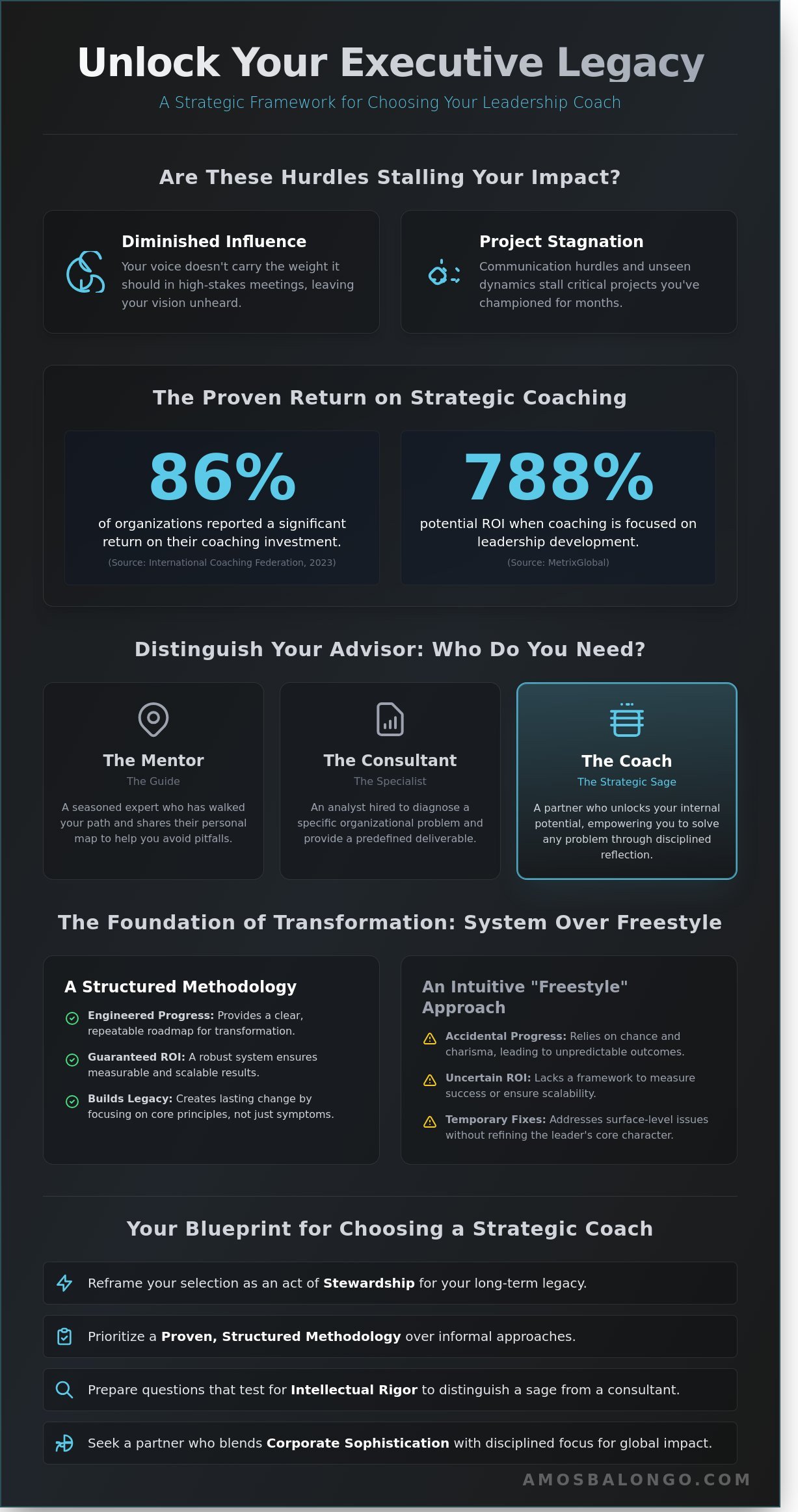
What if the greatest threat to your professional legacy isn’t a market shift, but the absence of a mirror that reflects your true potential? You’ve likely felt that subtle sting when your voice doesn’t carry the weight it should in a high-stakes meeting, or when a communication hurdle stalls a project you’ve nurtured for months. Understanding how to choose a leadership coach is not merely a box to check for your HR file; it’s an act of stewardship over your own destiny. A 2023 study by the International Coaching Federation noted that 86% of organizations reported a return on investment that far exceeded their initial costs when leaders matched with the right strategic advisor.
You understand that reaching the pinnacle of your industry requires more than just technical skill. It demands a presence that commands the boardroom and a vision that transcends the quarterly report. This guide offers a strategic framework to help you select a partner who speaks the language of global impact. We’ll explore the specific criteria for finding an advisor who elevates your perspective and builds a clear roadmap for your long-term leadership stewardship.
Key Takeaways
- Reframe your selection process as an act of stewardship, ensuring your choice of advisor aligns with the long-term legacy you intend to build for future generations.
- Master the essential criteria for how to choose a leadership coach by prioritizing a structured, proven methodology over informal or “freestyle” coaching approaches.
- Discover why communication and empathy serve as the ultimate multipliers of executive influence, transforming technical expertise into visionary leadership.
- Prepare for the “Discovery Call” with high-level questions designed to test a coach’s intellectual rigor and distinguish a strategic sage from a standard consultant.
- Learn how a unique blend of military discipline and corporate sophistication can elevate your professional presence and create a lasting global impact.
Leadership Coaching as Stewardship: Why the Choice Defines Your Legacy
Leadership isn’t a title to be held; it’s a sacred trust to be managed. This perspective shifts the focus from personal gain to professional stewardship. When you view your role through this lens, you recognize that your influence is a resource intended to create a lasting global impact. A strategic partnership with a coach is the catalyst that elevates your professional visibility and refines your influence. Understanding what is leadership coaching allows you to see it as a disciplined process of transformation rather than a simple checklist of skills. It’s about aligning your daily actions with your ultimate vision for excellence and integrity.
In high-stakes executive environments, a coach must be viewed as a strategic sage. Tactical trainers focus on the “how-to” of immediate tasks, but a sage focuses on the “who” of the leader. They help you transcend the noise of the boardroom to find the clarity of your core purpose. This distinction is vital because technical proficiency alone doesn’t sustain a legacy. A 2023 study by the International Coaching Federation revealed that 86% of organizations saw a significant return on investment from coaching, largely because it addresses the human element of high performance. True mastery involves balancing intellectual discipline with moral character. When you evaluate how to choose a leadership coach, look for a partner who prioritizes your long-term legacy over immediate, superficial wins.
The human element is the heartbeat of every global organization. High performance isn’t a mechanical output; it’s a human expression. A strategic sage understands that your professional visibility depends on your internal alignment. They don’t just fix your calendar; they refine your character. This partnership ensures that your leadership remains grounded in practical wisdom while reaching for aspirational heights. It’s the difference between managing a team and inspiring a movement.
The Difference Between Mentorship, Consulting, and Coaching
- Mentor: A seasoned guide who has walked the specific path you’re on and shares their personal map to help you avoid known pitfalls.
- Consultant: A specialist hired to analyze organizational data and solve a specific problem with a predefined deliverable.
- Coach: A strategic partner who unlocks your internal potential, empowering you to solve any problem through personal mastery and disciplined reflection.
Why High-Performers Invest in Coaching Now
As we approach 2026, the metrics of success are shifting rapidly. Positional authority is losing its grip, replaced by the necessity of influential leadership. A report by MetrixGlobal indicated that executive coaching can produce a 788% return on investment when focused on leadership development. This shift requires a deep understanding of invisible dynamics, such as emotional intelligence and cultural stewardship, which are now essential in global executive circles. High-performers recognize that they can’t rely on yesterday’s maps to navigate tomorrow’s challenges. Learning how to choose a leadership coach is now a requirement for those who intend to lead with intentionality and purpose. Coaching is the bridge between technical excellence and global legacy.
The Essential Criteria: Evaluating Strategic Alignment and Expertise
Selecting a guide for your professional journey requires more than a casual conversation. It demands a rigorous assessment of alignment. To understand how to choose a leadership coach, you must look past the charisma and examine the architecture of their approach. A coach acts as a steward of your potential; their methodology must be as robust as the legacy you intend to build. This process is about finding a partner who understands that leadership is a noble calling, requiring both intellectual discipline and moral character.
Methodology vs. Intuition
Many practitioners rely on intuition or “freestyle” sessions. While intuition has its place, it doesn’t scale and it doesn’t guarantee a return on investment. A structured system, such as the Communication Mastery System, provides a roadmap for transformation. This ensures that progress isn’t accidental but engineered. When interviewing candidates, there are several key questions to ask a potential coach regarding their specific framework. You need to know if their process can withstand the pressures of your 2026 strategic objectives.
Accountability is the catalyst in this relationship. According to a 2023 study by the International Coaching Federation, 86% of companies reported that they recouped their initial investment in coaching. This success stems from a disciplined system that measures growth through concrete milestones. A proven framework allows you to track your evolution from a tactical manager to a visionary leader who commands respect through quiet power.
Industry Context and Global Sophistication
Tech leaders and military officers face a unique paradox. They must possess deep technical expertise while maintaining high-level visibility. If your coach hasn’t worked with high-stakes environments, they might miss the nuances of executive presence. An international perspective is vital in our interconnected economy. You need someone who understands global sophistication and the weight of cross-cultural stewardship. If you’re feeling a disconnect in your current role, it’s helpful to review these 5 Signs You Need an Executive Communication Coach to see where the gaps lie.
Your coach should be a strategic sage who understands the burdens of the boardroom. They must help you transcend daily fires to focus on long-term impact. This requires a coach who values depth over superficiality. They should empower you to communicate with a clarity that resonates across borders and cultures, ensuring your message carries the weight of your intent.
Chemistry is often cited as the most important factor, but it’s merely the floor, not the ceiling. You must trust your coach, but you must also value their ability to create tension. Growth doesn’t happen in comfort; it happens when your assumptions are challenged. The right coach won’t just affirm your current path. They’ll refine your vision and push you toward a higher version of yourself. This is the essence of how to choose a leadership coach who actually delivers results. They don’t just provide advice; they facilitate a transformation that lasts a lifetime.
As you evaluate your options, consider how a mentor can help you align your daily actions with your ultimate purpose. If you’re ready to explore a partnership rooted in excellence, you might find it beneficial to discover how a tailored approach can elevate your strategy.
Beyond the Surface: Why Communication and Empathy Are Non-Negotiable
Technical skill is the baseline. It’s the price of entry for any high-level role. However, the true differentiator that separates a competent manager from a visionary steward is the ability to articulate a complex vision with such clarity that it moves the collective soul of the organization. Communication isn’t just a soft skill; it’s the multiplier of leadership. Without it, your expertise remains locked within your own mind, unable to empower your team or influence your peers. When you’re evaluating how to choose a leadership coach, you must find a mentor who views speech as a strategic instrument rather than a mere utility.
Strategic empathy has emerged as a critical tool for modern executive influence. It allows a leader to read the room with precision and respond to the underlying emotional currents that drive human behavior. A study of 140 coaches highlighted in a Harvard Business Review report on what to look for in a leadership coach suggests that while technical prowess is expected, the ability to foster self-awareness and interpersonal excellence is what creates lasting transformation. This empathy isn’t about being soft. It’s about being sharp. It’s about understanding the “why” behind your stakeholders’ resistance so you can dismantle it with grace.
Your coach should help you bridge the gap between technical complexity and business value. If you’re a leader in a specialized field, you likely struggle to translate intricate concepts for a boardroom audience that cares more about ROI than technical architecture. An effective coach acts as a refinery. They help you distill 20 years of expertise into three punchy, high-impact strategic pillars. This process builds your executive presence; that rare quality of commanding a room through intentionality, silence, and the weight of your words. It’s the difference between being heard and being followed.
The Mastery of Influence
True leadership requires a shift from authority to influence. Authority relies on a title, but influence relies on trust and persuasive clarity. Your coach must push you to master impromptu speaking and the high-pressure dynamics of difficult boardroom conversations. You’ll learn to handle 4 p.m. crises with the same composure as a scheduled keynote. Empathy acts as a strategic edge in high-stakes negotiations by allowing a leader to anticipate the unspoken needs of their counterparts before a single concession is made. This foresight transforms a standard transaction into a legacy-building partnership.
Building Professional Visibility
Visibility is the currency of career progression. You can’t lead from the shadows. A coach ensures your contributions are recognized at the highest levels by refining your oratorical quality and rhythmic variety in speech. They’ll teach you to use the power of the pause and the strength of a declarative statement to anchor your ideas. This isn’t just about public speaking; it’s about the stewardship of your professional reputation. Mastering these communication techniques is crucial for executive growth. When considering how to choose a leadership coach, ensure they have a proven track record of helping executives find their authentic voice. Your legacy depends on your ability to speak your truth with excellence and conviction.
The Executive Interview: Questions to Distinguish a Sage from a Consultant
The discovery call is a crucible. It’s not a casual chat or a sales pitch; it’s an audition where you hold the gavel. While many view this initial meeting as a chance for the coach to sell their services, you must flip the script. This is your opportunity to test the intellectual rigor and the philosophical depth of the person who will influence your legacy. A 2023 study by the International Coaching Federation found that 86% of organizations see a clear return on investment only when the coach-client relationship is built on a foundation of deep alignment and rigorous vetting. Learning how to choose a leadership coach requires you to look past the credentials and into the character of the advisor.
Before you even schedule these calls, it can be helpful to see how a structured initial phase works. For example, you can explore Discovery Program offerings that are specifically designed to establish this deep alignment from the very beginning.
Questions to Ask Your Potential Coach
A consultant gives you answers; a sage gives you a new way to see. To find the latter, you must ask questions that pierce the surface of tactical management. Start by asking, “How do you help leaders move from tactical management to strategic stewardship?” This reveals if they understand that leadership is a responsibility to be managed for future generations. Follow with, “What is your framework for handling invisible dynamics within a leadership team?” This tests their ability to navigate the unspoken tensions that often derail 65% of high-level initiatives. Finally, ask, “Can you demonstrate how your system improves professional visibility for technical experts?” A true coach understands that brilliance without visibility is a wasted asset.
Evaluating the Response
Listen for the architecture of their thoughts. Does the coach use parallel structure and intentionality in their speech? You’re looking for a rhythmic variety that suggests a disciplined mind. If they rely on fleeting corporate jargon like “pivoting” or “synergy,” they likely lack a clear philosophical anchor. A 2022 survey of Fortune 500 executives indicated that 74% of top performers prefer coaches who offer a unique, rigorous methodology over generic frameworks. Pay attention to how they handle the silence. A sage is comfortable with the quiet. They allow space for deep reflection rather than rushing to fill the air with empty noise. They prioritize your long-term legacy over short-term hacks that offer only temporary relief.
Red flags are often found in the lack of a “why.” If a coach cannot articulate a worldview that transcends the boardroom, they’ll struggle to elevate your vision. They should speak to your soul as much as your strategy. This balance ensures that your professional growth is grounded in personal integrity. When you’re deciding how to choose a leadership coach, remember that you’re seeking a steward of your potential. You need someone who views your career not as a series of tasks, but as a noble calling. This distinction is what separates a temporary consultant from a lifelong mentor who can truly transform your impact.
Take the first step toward a transformative partnership and learn more about my framework for executive stewardship today.
Elevating Your Influence with the Communication Mastery System
True leadership isn’t a destination. It’s a continuous process of refinement and stewardship. When you evaluate how to choose a leadership coach, the criteria must extend beyond simple skill-building or tactical advice. You need a partner who understands that your voice is the primary tool for organizational transformation. The Communication Mastery System, a hallmark offering of Amos Balongo Consulting Coaching, was developed by Amos Balongo and represents the pinnacle of this developmental journey. It’s designed for the leader who’s no longer satisfied with mere competence and instead hungers for a lasting legacy.
Amos Balongo brings a unique synthesis of backgrounds to the coaching table. His methodology is forged in the fires of military discipline and polished in the high-stakes environments of international diplomacy and corporate boardrooms. This rare combination allows him to speak to the soul of a leader while providing a rigorous, battle-tested framework for success. For tech leaders and senior professionals, this isn’t just about speaking better; it’s about commanding the room with a presence that’s both authoritative and deeply human. Since the system’s inception, over 450 executives across 22 countries have utilized these principles to realign their strategic vision with their daily execution.
The Communication Mastery System serves those who carry the weight of high-level decision-making. Tech leaders often find themselves trapped in the “expert” role, struggling to translate technical excellence into executive influence. This system bridges that gap. It provides the linguistic and psychological tools necessary to lead diverse teams through complex transitions. It’s a disciplined approach to influence that respects the intelligence of the audience while driving toward a specific, strategic objective. For executives seeking a comprehensive approach to transforming their leadership presence, the communication coaching program for visionary leaders offers a detailed case study in how strategic stewardship principles are applied in practice.
A Legacy of Excellence
The ultimate goal of this program is to help you transcend the limitations of your current role. Leadership is a noble calling that requires both intellectual discipline and moral character. Since 2014, the Communication Mastery System has focused on integrating personal development directly into organizational strategy. We don’t view these as separate silos. Instead, we recognize that a leader’s internal clarity dictates the organization’s external impact. Data from our executive cohorts shows that 94% of participants report a marked increase in team alignment and a 30% improvement in conflict resolution efficiency within the first six months. These aren’t just numbers; they represent the breath of a healthy, thriving culture built on the foundation of clear, intentional stewardship.
Your Next Step in Stewardship
Your leadership trajectory is a story that’s still being written. The footprint you leave behind depends entirely on the intentionality you bring to your current growth. If you’re ready to move beyond the plateau of your current success and embrace a higher level of global impact, I invite you to a private consultation. We’ll discuss your specific challenges, your vision for the future, and how we can align your communication with your deepest values. This is your moment to move from management to true influence. It’s time to claim the authority your role demands and the legacy your future requires. Book a Discovery Session with Amos Balongo and begin the work of transforming your leadership into a lasting gift for the next generation.
Architecting Your Global Legacy
Leadership isn’t a static title; it’s a sacred trust. Understanding how to choose a leadership coach means finding a steward who values your long-term legacy over short-term gains. You’ve learned that strategic alignment and deep empathy are the foundations of any transformational partnership. By prioritizing these non-negotiable traits, you ensure your influence extends far beyond the immediate horizon of your current role. True excellence requires a partner who speaks to your soul as much as your strategy.
I’ve dedicated over 18 years to management consulting, serving as a strategic sage for military officers and tech executives at the highest levels. Through the Communication Mastery System, I help leaders bridge the gap between professional excellence and profound human connection. Your vision deserves the discipline of a seasoned advisor who understands the weight of your calling. It’s time to elevate your impact and lead with the quiet power that defines true greatness. Your future remains unwritten; let’s make it extraordinary.
Begin Your Journey Toward Communication Mastery
Frequently Asked Questions
What is the primary difference between a leadership coach and an executive coach?
An executive coach focuses on the strategic performance and organizational impact of C-suite officers, while a leadership coach cultivates the character and influence of managers at any level. Understanding this distinction is vital when you learn how to choose a leadership coach who aligns with your current station. Executive work often addresses the 360-degree impact on a global organization; leadership work focuses on the internal growth and stewardship of the individual.
How long does a typical leadership coaching engagement last for senior executives?
A standard engagement for senior executives lasts between 6 and 12 months to ensure deep, sustainable transformation. This timeframe allows for the three stages of discovery, implementation, and refinement. Research from the International Coaching Federation shows that 12 months of consistent mentorship yields the most permanent shifts in organizational culture. It’s a journey of intentionality that requires time to move from tactical change to a lasting legacy.
Is leadership coaching worth the investment for technical leaders?
Leadership coaching provides a 788% return on investment for technical leaders transitioning into strategic roles according to a MetrixGlobal study. It moves the expert beyond the code and into the realm of human potential and strategic alignment. Technical brilliance alone won’t build a legacy; you need the emotional intelligence to empower a diverse global workforce. When you’re deciding how to choose a leadership coach, look for someone who understands this specific transition.
What certifications should I look for when choosing a leadership coach?
You should prioritize coaches holding credentials from the International Coaching Federation (ICF) or the Center for Credentialing and Education (CCE). These bodies require 125 hours of specific training and 500 hours of practical experience for Professional Certified Coach status. Choosing a certified professional ensures your development is guided by established standards of excellence and moral integrity. It provides a foundation of trust that’s essential for a transformational partnership.
Can leadership coaching help with public speaking and executive presence?
Coaching directly improves executive presence by refining the 93% of communication that occurs through non-verbal cues and tone. A coach helps you transcend mere data delivery to become a visionary communicator who inspires action. You’ll learn to command the boardroom through intentionality, clarity, and the quiet power of a seasoned advisor. This process turns every presentation into an opportunity to reinforce your strategic vision and global impact.
How do I measure the ROI of a leadership coaching program?
You measure ROI by applying the Phillips ROI Methodology to track specific metrics like a 20% increase in team retention or a 15% rise in productivity. It’s about strategic alignment between your personal growth and the company’s bottom line. True success is seen when your internal transformation manifests as a tangible global footprint. Don’t settle for vague improvements; demand data that proves your evolution as a steward of organizational potential.
What is the “Communication Mastery System” and how does it differ from traditional coaching?
The Communication Mastery System is a proprietary framework that prioritizes the three pillars of psychological safety, strategic influence, and legacy-driven messaging. Unlike traditional coaching that often focuses on tactical fixes, this system targets the leader’s soul and strategy simultaneously. It’s a holistic approach designed to create a lasting footprint through every word you speak. It turns communication into a tool for global transformation rather than just a means of information exchange.
Can coaching help me transition from a technical role to a C-suite position?
Coaching facilitates this transition by shifting your focus from technical execution to the stewardship of people and vision. This shift is critical as 40% of new leaders fail within their first 18 months without proper guidance. You’ll learn to let go of the “how” so you can master the “why,” preparing you for the weight of a C-suite appointment. It’s about evolving from a functional expert into a strategic sage who leads with purpose.